
A hurricane deductible is a separate deductible, usually a percentage of your dwelling limit rather than a flat dollar amount, that applies specifically to wind damage from storms once a hurricane or named storm is officially declared. Pull out your declarations page today, find the hurricane deductible line, and confirm the exact trigger and percentage with your agent before storm season catches you guessing.
TL;DR:
- The hurricane deductible is usually a percentage of your dwelling limit, often between 2% and 10%, which can translate into thousands of dollars for high-value homes.
- It activates only if a storm meets specific triggers, such as being classified as a hurricane or reaching certain wind speeds, with timing windows generally extending up to 72 hours after warnings.
- When a qualifying storm causes damage, the hurricane deductible replaces your standard deductible, and multiple storms in a year may still only require paying the deductible once, depending on your policy.
- Inflation guard endorsements can increase your dwelling coverage and, consequently, your dollar deductible over time, so it is essential to review your declarations annually.
- Making small claims below your deductible amount is often not worth the cost, as it can lead to claims history without any payout, affecting future premiums.
Table of Contents
- How Hurricane Deductibles Are Calculated
- When Does a Hurricane Deductible Actually Kick In?
- How the Deductible Applies When You File a Claim
- Do the Math on Your Own Exposure
- Lowering Your Deductible Exposure Before the Next Storm
- Why I Tell Every Homeowner to Budget for This Number
- Get a Clear Answer on Your Own Deductible
- Where to Verify This Information
- Sources
- FAQ
How Hurricane Deductibles Are Calculated
Your homeowners policy likely has two kinds of deductibles: a standard, flat-dollar deductible for everyday claims like a burst pipe or a fallen tree limb, and a hurricane deductible that kicks in once a storm meets your policy’s specific definition. The hurricane version is usually a percentage, and that detail changes everything about your risk.
Here’s the part that surprises a lot of Savannah homeowners: the percentage applies to your dwelling limit (Coverage A), not to the size of your claim.
Always calculate the actual figure. Never assume the lower percentage means lower cost.*
The math scales fast:
- $200,000 dwelling limit: 2% = $4,000 deductible; 5% = $10,000 deductible.
- $400,000 dwelling limit: 2% = $8,000 deductible; 5% = $20,000 deductible.
- $800,000 dwelling limit: 2% = $16,000 deductible; 5% = $40,000 deductible.
Some states require insurers to offer a menu of choices. Florida law requires carriers to offer hurricane deductible options of $500, 2%, 5%, or 10% of the dwelling limit, so the amount you carry is often a choice you made, or one made for you by default, at the time you bound the policy.
One more wrinkle: if your policy carries an inflation guard endorsement, your Coverage A limit rises automatically each year to keep pace with rebuilding costs. That’s good for replacement value, but it also quietly raises your dollar deductible since the percentage is recalculated against a higher number. Check your declarations page annually, not just at the start of hurricane season.
When Does a Hurricane Deductible Actually Kick In?
Not every windstorm triggers your hurricane deductible, and the exact wording in your policy determines whether a rough afternoon storm costs you your standard deductible or your much larger hurricane one.
Insurers generally use one of these trigger styles:
- Hurricane-only trigger: activates only when the National Hurricane Center classifies the storm as an actual hurricane.
- Named-storm trigger: activates for any system with a name, including a tropical storm well below hurricane strength.
- Sustained-wind threshold: activates once winds in your area reach a specific speed, regardless of the storm’s official classification.
Timing matters just as much as classification. Most policies define an activation window that starts when a hurricane watch or warning is issued and extends for a set period afterward, often up to 72 hours past when the warning ends. That window catches damage that happens as a storm weakens or moves inland, not just at peak landfall.
Florida offers the clearest statutory example: state law ties the hurricane deductible trigger to National Hurricane Center declarations, with coverage extending up to 72 hours after the warning is lifted. Other states rely on named-storm triggers instead, meaning a tropical storm that never reaches hurricane strength could still activate the higher deductible depending on where you live.
Don’t guess on this one. Ask your agent directly which trigger your endorsement uses and how your insurer defines the activation window, because those two details decide which deductible applies to your claim.
How the Deductible Applies When You File a Claim
When a storm damages your home, your insurer applies one deductible to that loss, not both your standard deductible and your hurricane deductible stacked together. The hurricane deductible replaces your standard deductible for that specific claim once the trigger conditions are met.
Most hurricane deductibles apply on a calendar-year basis rather than per storm. In a year with multiple qualifying storms, you typically pay the full hurricane deductible on your first claim, and depending on your policy’s crediting rules, a partial credit may carry forward if a second storm hits before the year resets. Florida law includes specific crediting provisions for this exact scenario, so a second claim doesn’t always mean paying the full deductible twice.
Here’s how to move once damage happens:
- Document everything immediately. Photograph and video every room and the exterior before you touch anything, including debris and standing water.
- Get a contractor estimate as soon as possible so your claim reflects accurate repair costs, not guesswork.
- File your claim promptly. Most policies require notice within a reasonable time, and delays can complicate the adjuster’s assessment of what happened when.
- Keep records of temporary repairs, like tarps or board-up costs, since many policies reimburse reasonable steps taken to prevent further damage.
Pro Tip: Wind and water are treated as entirely separate perils. If your home floods from storm surge, that damage falls under a flood policy, not your hurricane deductible, so file both claims if both types of damage occurred. That separation trips up more homeowners than any other part of the claims process, since a standard homeowners policy simply does not pay for flood damage from storm surge.
Do the Math on Your Own Exposure
The formula is simple: Coverage A × deductible percentage = your dollar deductible. Once you know your dwelling limit and your percentage, you can calculate your worst-case number in under a minute.
Common deductible structures include a flat $500 option in some states, and percentage tiers typically ranging from 0.5% to 10%, with 1% to 5% being the most common range nationally.
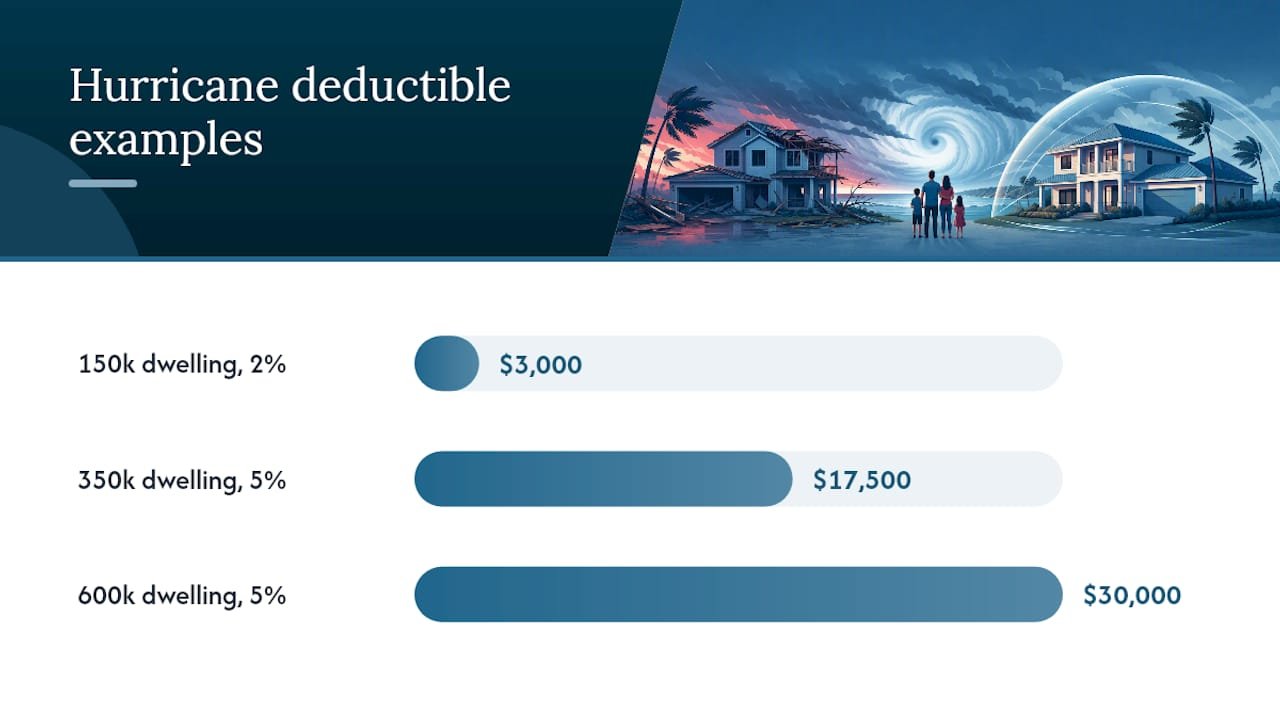
Three quick examples:
- Low end: $150,000 dwelling at 2% = $3,000 deductible.
- Mid-range: $350,000 dwelling at 5% = $17,500 deductible.
- High end: $600,000 dwelling at 5% = $30,000 deductible.
That $17,500 or $30,000 figure is exactly why small partial claims, like a few damaged shingles or minor fence repair, often aren’t worth filing. If the repair cost falls below your deductible, filing a claim just creates a claims history without any payout, which can affect future premiums and renewal decisions.
Remember that inflation guard endorsements raise Coverage A automatically over time, which raises your deductible dollar amount right along with it even if your percentage never changes.
Lowering Your Deductible Exposure Before the Next Storm
You have more control here than most homeowners realize. Mitigation upgrades like roof-to-wall straps, impact-rated windows, and code-compliant shutters installed by certified contractors often qualify for wind mitigation credits that lower your premium and sometimes open the door to better deductible options.
Pro Tip: Keep every mitigation inspection report and contractor invoice in a dedicated folder. Insurers generally require documentation, not just the upgrade itself, to apply the credit.
When you talk to your agent, come prepared with specific questions:
- What exact trigger does my hurricane endorsement use, named storm or hurricane classification?
- What is my activation window, and does it match the standard 72 hour post-warning period?
- Is a flat-dollar deductible option available on my policy, and what would it cost in premium?
- How is my deductible applied if two storms hit in the same calendar year?
At Daly & Alexander Insurance, agents walk clients through this exact math on a homeowners policy review, calculating real dollar exposure rather than leaving anyone to guess at percentages on a form.
Why I Tell Every Homeowner to Budget for This Number
Most people treat their deductible as fine print until a storm makes it real money.
Your agent can walk you through every trigger, window, and credit available to you, and mitigation upgrades genuinely move the needle on cost. But none of that replaces knowing your number today. Pair that awareness with a real look at your flood coverage, since wind and water are never the same claim.
— Nathan
Get a Clear Answer on Your Own Deductible
There are local agents who can help you understand your policy’s fine print by reviewing your declarations page and calculating your exact hurricane deductible in dollars, not just percentages.

Such a review can cover whether a flat-dollar option makes sense, which mitigation upgrades might earn credits, and how your flood coverage stands separately from wind. Experienced agents often assist with claims support rather than leaving clients to navigate the process alone. Visit the homeowners insurance page to schedule a no-obligation policy review and get your real number today.
Where to Verify This Information
For primary sources on triggers, percentages, and hurricane basics, see Florida’s hurricane deductible statute guidance, the NAIC’s state-by-state overview, III’s background on windstorm deductibles, and NOAA’s hurricane facts page.
This article is general information, not a substitute for advice from a qualified financial advisor. Consult a qualified financial professional about your own circumstances before acting on anything here.
Sources
- Florida’s Hurricane Deductible | Consumer Services
- Insurance Topics | Hurricane Deductibles
- Background on: Hurricane and windstorm deductibles | III
- Hurricane facts | NOAA
FAQ
What does a hurricane deductible mean?
A hurricane deductible is a separate, usually percentage-based deductible that applies to wind damage once a storm meets your policy’s specific trigger, such as a hurricane classification or named-storm designation. It replaces your standard deductible for that claim and is calculated against your dwelling limit, not the size of the damage.
What is a good hurricane deductible in Florida?
There’s no universal “good” number, since it depends on your budget and risk tolerance, but Florida requires insurers to offer $500, 2%, 5%, or 10% options. A lower percentage means a smaller out-of-pocket cost after a storm but typically a higher annual premium, so the right choice depends on how much cash you could realistically cover in an emergency.
What does having a $4,000 deductible mean?
A $4,000 hurricane deductible means that on a qualifying storm claim, you pay the first $4,000 of covered wind damage yourself before your insurer pays anything toward the rest.
How long after storm damage can I claim?
Filing windows vary by insurer and state, but most policies require notice within a reasonable time after the damage occurs, and delaying can complicate your claim. Document everything with photos and a contractor estimate right away, then file promptly rather than waiting to see if damage worsens.