
Contractual liability insurance is largely built into a standard Commercial General Liability (CGL) policy through what’s called the “insured contract” exception, and it typically covers assumed tort liability, like injury or property damage you agreed to take responsibility for. It does not cover pure breach-of-contract claims, most performance guarantees, or professional-services failures. Before you sign anything with an indemnity clause, you’ll want to confirm your limits match the contract’s exposure and tell your insurer about the obligation.
TL;DR:
- Contractual liability coverage generally applies to tort liabilities you assume through specific contracts, like leases or subcontractor agreements, but excludes pure breach-of-contract claims.
- Only certain types of contracts, labeled as “insured contracts,” qualify for coverage, including leases, easements, and agreements where you agree to indemnify municipalities or if you would be liable without the contract.
- Broad indemnity clauses that make you responsible for losses caused entirely by the other party’s negligence are risky, and negotiating narrower or limited indemnity language is advisable.
- Timing of liability is key; coverage only applies to incidents after contract signing, and missing documentation like the signed agreement can delay or deny claims.
- Most small businesses can rely on a standard CGL policy with careful contract review, but large projects may require additional contractual-liability coverage.
Table of Contents
- What Contractual Liability Insurance Actually Covers
- What Qualifies as an Insured Contract?
- Where Coverage Gaps Show Up Most Often
- Broad, Intermediate, and Limited Indemnity Clauses Explained
- Pre-Signing Checklist for Contract Indemnity Language
- How Defense Costs and Policy Limits Interact With Indemnity
- What Small Business Owners Should Actually Do About This
- Get Your Contracts Reviewed Before You Sign, Not After a Claim
- Primary Sources on Contractual Liability Coverage
- Sources
- FAQ
What Contractual Liability Insurance Actually Covers
Contractual liability, sometimes called assumed liability, is the risk you take on when you agree, in writing, to be responsible for someone else’s losses. Most business owners run into this the first time they sign a lease, a subcontractor agreement, or a vendor contract with an indemnification clause buried in the fine print.
Here’s the part that surprises a lot of people: your CGL policy doesn’t just exclude this risk and leave you exposed. The Insurance Services Office Commercial General Liability Coverage Form CG 00 01 excludes contractual liability, then carves out an exception for what it calls an “insured contract.” That exception restores coverage for the tort liability you assumed on someone else’s behalf, as long as it fits the policy’s definitions.
The distinction that trips people up is tort versus contract. If your business negligently damages a client’s property and you’d already agreed to cover that kind of loss in your contract, that’s assumed tort liability, and it’s generally covered. If you simply failed to deliver a project on time or breached a specific promise in the contract itself, that’s a contract claim, not a tort, and contractual liability coverage typically doesn’t reach it.
This structure shows up constantly in commercial leases, construction subcontracts, and municipal work agreements, anywhere one party asks another to absorb risk that would otherwise sit with them.
What Qualifies as an Insured Contract?
Not every signed agreement earns “insured contract” status under a CGL policy. The ISO form lists specific categories: leases of premises, easement or license agreements, sidetrack agreements with railroads, and elevator maintenance agreements, among others.
There’s also a catch-all provision, often labeled paragraph (f), that extends coverage to any contract where you agree to indemnify a municipality for permits, plus a broader test for other business contracts: would you have been legally liable for the injury or damage anyway, even without the contract? If the answer is yes, the agreement usually qualifies as insured.
Timing matters too. The liability has to arise from an occurrence after the contract was signed, not from something that happened before you agreed to the indemnity language. When a claim comes in, insurers typically ask for the executed contract itself, the specific indemnity clause, correspondence about the incident, and any legal filings tied to the claim, according to industry claims-handling guidance. If you can’t produce those documents quickly, you slow down your own claim.
Where Coverage Gaps Show Up Most Often
The insured-contract exception is genuinely broad. It’s described as “blanket” coverage because it applies automatically without you having to list every contract on your policy. But broad isn’t the same as unlimited, and every other exclusion in your CGL still applies on top of it.
What’s typically covered:
- Third-party bodily injury or property damage tied to a tort liability you contractually assumed
- Claims arising from occurrences during the contract term, provided the underlying liability would exist under general negligence law anyway
What usually isn’t covered:
- Pure breach-of-contract damages, including lost profits or late-delivery penalties
- Performance guarantees or warranty promises about how a product or service will function
- Injuries to your own employees, which fall under workers’ compensation, not CGL
- Intentional or willful misconduct, and most punitive damage awards
- Professional services failures, often excluded outright through CG 22 series endorsements for design, consulting, or advisory work
State law adds another layer of complexity. Several states restrict or void broad-form indemnity clauses, particularly in construction contracts, because courts have decided it’s unreasonable to make one party responsible for another’s sole negligence. That variability is a real reason to have a contract reviewed locally rather than assuming boilerplate language from another state applies the same way here.
Broad, Intermediate, and Limited Indemnity Clauses Explained
The words in your indemnity clause determine how much of this risk you’re actually taking on, and how well your insurance lines up with it. Contracts generally fall into three buckets:
- Broad-form indemnity makes you responsible for the other party’s losses even when the loss results entirely from their own negligence. This is the riskiest version, and many states limit or refuse to enforce it, especially in construction contracts.
- Intermediate-form indemnity makes you responsible for losses caused by your own negligence and shared negligence, but not losses caused solely by the other party. This tends to align best with what a standard CGL actually pays for.
- Limited-form indemnity only covers losses proportional to your own fault. It’s the narrowest obligation and the easiest to insure cleanly.
Watch for phrases like “regardless of fault” or “sole negligence of the indemnitee.” Those signal broad-form language, and they’re worth pushing back on before you sign.
Pro Tip: Push for intermediate or limited indemnity language whenever you’re negotiating, and ask to be added as an additional insured on the other party’s policy instead of just accepting an indemnity promise on paper.
Pre-Signing Checklist for Contract Indemnity Language
A little diligence before you sign saves a lot of grief after a claim hits. Run through this before finalizing any contract with an indemnity or hold harmless clause:
- Notify your insurer about any new indemnity obligation, including the contract’s dollar value and the type of work involved
- Confirm in writing whether you’re requesting additional insured status, and get the endorsement’s exact scope, not just a verbal promise
- Push for narrower indemnity language, add carve-outs for the other party’s own negligence, and negotiate a liability cap where you can
- Keep a running log of every active contract with an indemnity clause and its notice deadlines, since missing a notification window is a common reason claims get denied
- Consider standalone contractual-liability coverage for unusually large public works or municipal projects, where standard CGL limits may not be enough
Pro Tip: If you sign more than a handful of vendor or subcontractor agreements a year, build a simple spreadsheet tracking each contract’s indemnity type, notice deadline, and additional-insured requirement. It takes an hour to set up and saves you from a scramble later.
For businesses juggling multiple ongoing agreements, a structured contract-review workflow can catch indemnity red flags before they ever reach your insurer’s desk.
How Defense Costs and Policy Limits Interact With Indemnity
Here’s where the fine print really matters. If you’ve indemnified another party and a claim comes in, that party (the indemnitee) usually controls its own defense, while your insurer pays if the claim falls under your coverage.
Whether the defense costs come out of your policy limits depends on the contract language. In many cases, defense costs erode your limits just like a settlement would, shrinking what’s left to pay the actual damages. The exception is when your insured contract specifically assumed the duty to defend the other party. In that scenario, defense costs may fall under the Supplementary Payments section of your CGL form, which sits outside your policy limits rather than eating into them.
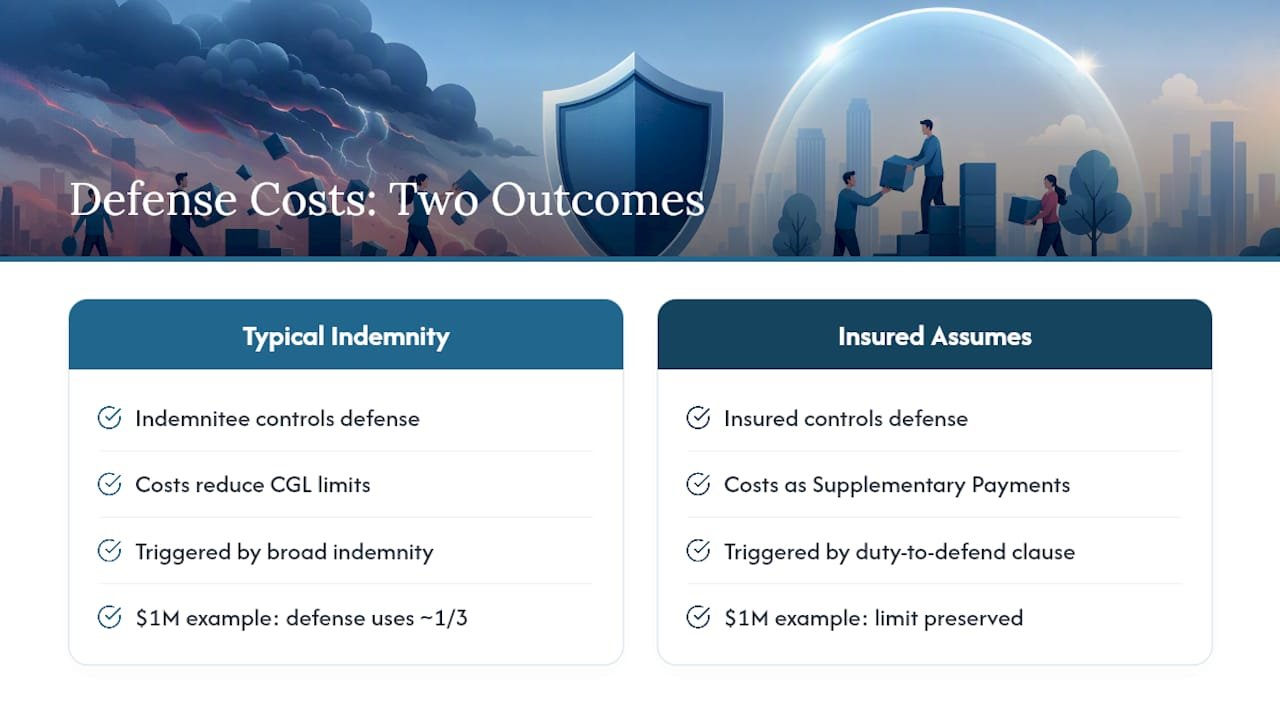
This distinction has real financial teeth on a large contract. A $1 million CGL limit sounds solid until legal defense for a multi-year construction dispute chews through a third of it before damages are even discussed. If you’re regularly signing contracts with six or seven-figure exposure, it’s worth confirming this exact defense/damages language with your agent rather than assuming it works in your favor.
What Small Business Owners Should Actually Do About This
Most small and midsize businesses don’t need a standalone contractual liability policy. A well-structured CGL with the insured-contract exception, paired with intermediate or limited indemnity language in your contracts, covers the overwhelming majority of everyday exposure. Standalone coverage tends to matter for large public works or municipal projects where indemnity obligations run far beyond typical limits.
The practical move is simple: read the indemnity clause before you sign, tell your insurer about any new obligation, and match your limits to the size of the contract, not just the size of your business. When state law or an unusually aggressive broad-form clause is involved, get a second set of eyes on it. An insurance agency with extensive experience can help clients understand exactly what their policy does and doesn’t assume. That kind of contract-specific review is where a generic policy summary stops being useful and a real conversation starts.
— Nathan
Get Your Contracts Reviewed Before You Sign, Not After a Claim
Some insurance agencies review the indemnity language in your contracts and match your coverage to it, beyond what a generic online quote tool can offer. When a lease, subcontract, or vendor agreement asks you to assume liability you didn’t expect, a local agent can tell you whether your existing policy handles it or whether you need an endorsement first.
Our agents check whether you need additional-insured endorsements, confirm your limits actually match your contract exposure, and help you decide between a Business Owners Policy (BOP), priced between $500 and $3,500 per year depending on your business, and a standalone commercial liability policy for larger projects. If you’ve got a contract sitting on your desk right now with an indemnity clause you’re not sure about, reach out and get it reviewed before you sign it, not after a claim forces the question.
Primary Sources on Contractual Liability Coverage
- Contractual Liability and the CGL Policy
- What Is Contractual Liability Insurance and How Does It Work?
- Contractual liability insurance
Sources
- Contractual Liability and the CGL Policy
- What Is Contractual Liability Insurance and How Does It Work?
- Contractual liability insurance
FAQ
What Is Contractual Liability Insurance Coverage?
It’s the protection built into a standard CGL policy that covers tort liability you assume on someone else’s behalf through a contract, like agreeing to cover a landlord’s injury claims under a lease. It applies through the “insured contract” exception in the ISO CG 00 01 form and doesn’t extend to pure breach-of-contract damages.
How Much Does Contractual Liability Insurance Cost?
There’s no separate premium for most businesses, since this coverage typically comes bundled into your existing CGL or Business Owners Policy, which runs $500 to $3,500 per year depending on the size and type of your business. Standalone contractual liability coverage for large projects is priced individually based on contract value and risk.
How Much Does a $1,000,000 Liability Insurance Policy Cost?
Pricing depends heavily on your industry, revenue, claims history, and location, so there’s no single flat rate. A Commercial Liability policy through Daly & Alexander is quoted individually. Current pricing details are available directly through Daly & Alexander’s commercial liability page.
What Is a Contractual Liability Endorsement in Insurance?
It’s a policy addition that either broadens or clarifies coverage for indemnity obligations you’ve taken on in a specific contract. Standard and blanket versions exist, with blanket endorsements covering all qualifying contracts automatically rather than requiring each one to be listed by name.