
Business interruption coverage replaces lost net income and helps pay fixed costs like payroll, rent, and loan payments while your business recovers from a covered physical loss. It’s built for small businesses with a storefront, inventory, or supplier dependencies, and it comes with real limits: payouts generally require direct physical damage, plus waiting periods and time caps on how long the policy pays.
TL;DR:
- Coverage generally requires direct physical damage to your property, and a 24–72 hour waiting period may apply; ordinary sales declines do not qualify.
- Use twelve months of financial records to set limits, then match the restoration period to your worst case recovery timeline, including seasonal peaks and supplier delays.
- A supplier or major customer’s shutdown is covered only with contingent business interruption, and only when property damage results from a peril your policy covers.
- Flood and earthquake losses usually need separate coverage, while civil authority claims generally require nearby physical damage; virus exclusions and policy wording also affect eligibility.
- Extra expense coverage may reimburse above normal costs, such as temporary rent or equipment, even when those costs do not reduce your income loss.
Table of Contents
- What business interruption coverage typically pays for
- Period of restoration, waiting periods, and what counts as a covered loss
- How to estimate how much business interruption coverage you need
- What determines cost: underwriting factors and endorsements
- Common exclusions and the pandemic-era coverage debate
- Related coverages: extra expense, contingent BI, and extended BI
- How to buy business interruption coverage and what to ask your agent
- How we support small businesses with business interruption needs
- Why underinsurance is the real risk
- Get a business owners policy review from our Savannah team
- FAQ
- Sources
What business interruption coverage typically pays for
When a covered event shuts your doors, business interruption coverage steps in to replace the income you would have earned, based on your past financial performance. It doesn’t just cover profit. It also keeps your fixed costs moving so your business is still standing when the doors reopen.
Most policies are built around a handful of core categories:
- Lost net income, calculated from your historical revenue and expense records, not projections.
- Continuing fixed expenses, including payroll, rent or lease payments, taxes, and loan obligations.
- Extra expense, which is a related but separate coverage for above-normal costs incurred to keep operating.
Picture a kitchen fire that closes a restaurant for two months, or a hurricane that damages a retail roof and halts sales for weeks. Both scenarios typically trigger standard business interruption coverage because the loss stems from direct physical damage to your own property. A supplier’s warehouse burning down is a different story: that type of loss only counts if you’ve added contingent business interruption coverage, which we’ll cover later.
Period of restoration, waiting periods, and what counts as a covered loss
Three terms decide whether and how long your policy pays, and they trip up a lot of small business owners.
The period of restoration is the timeframe your policy covers, typically running from the date of loss until your property is repaired or replaced with reasonable speed. Standard periods are often limited in length unless you add an endorsement to extend them, which matters for businesses facing long rebuilds or supply delays.
Most policies also include a waiting period, sometimes called a time deductible, often 24 to 72 hours before coverage kicks in. A short closure that resolves in a day might not trigger a payout at all.
Finally, coverage is triggered by direct physical loss or damage, not simply a drop in business. A slow month or a canceled event isn’t a covered loss on its own. The physical damage requirement is the dividing line between a covered disruption and ordinary bad luck.

How to estimate how much business interruption coverage you need
Sizing your coverage starts with your own numbers, not a generic industry figure. A reasonable approach looks like this:
- Pull twelve months of financials, including gross revenue, payroll, and fixed monthly costs like rent and loan payments.
- Estimate your realistic recovery timeline, factoring in how long it would take to rebuild, replace equipment, or find a temporary location.
- Adjust for seasonality and supplier dependencies, since a loss during your peak season or a key supplier’s shutdown can push your maximum probable loss well beyond a flat average.
- Match your limit and restoration period to that worst-case scenario, not the average one.
A seasonal business, a specialty contractor with a long equipment lead time, or a business with a single irreplaceable supplier usually needs a longer restoration period or a higher limit than a simple average suggests. Underestimating here is the single most common gap we see in coverage reviews.
What determines cost: underwriting factors and endorsements
Premiums for business interruption coverage are shaped by your location’s risk profile, your industry, your revenue size, your claims history, and your building’s construction type. A wood-frame restaurant in a flood-prone area pays differently than a professional office in sturdy, newer construction.
Endorsements raise the price too. Extended period of restoration, contingent business interruption, extra expense, and utility or service interruption endorsements all add cost because they widen what’s covered. On the other side, choosing a longer waiting period, investing in preventive controls like sprinkler systems, or diversifying your supplier base can all help bring the premium down.
Common exclusions and the pandemic-era coverage debate
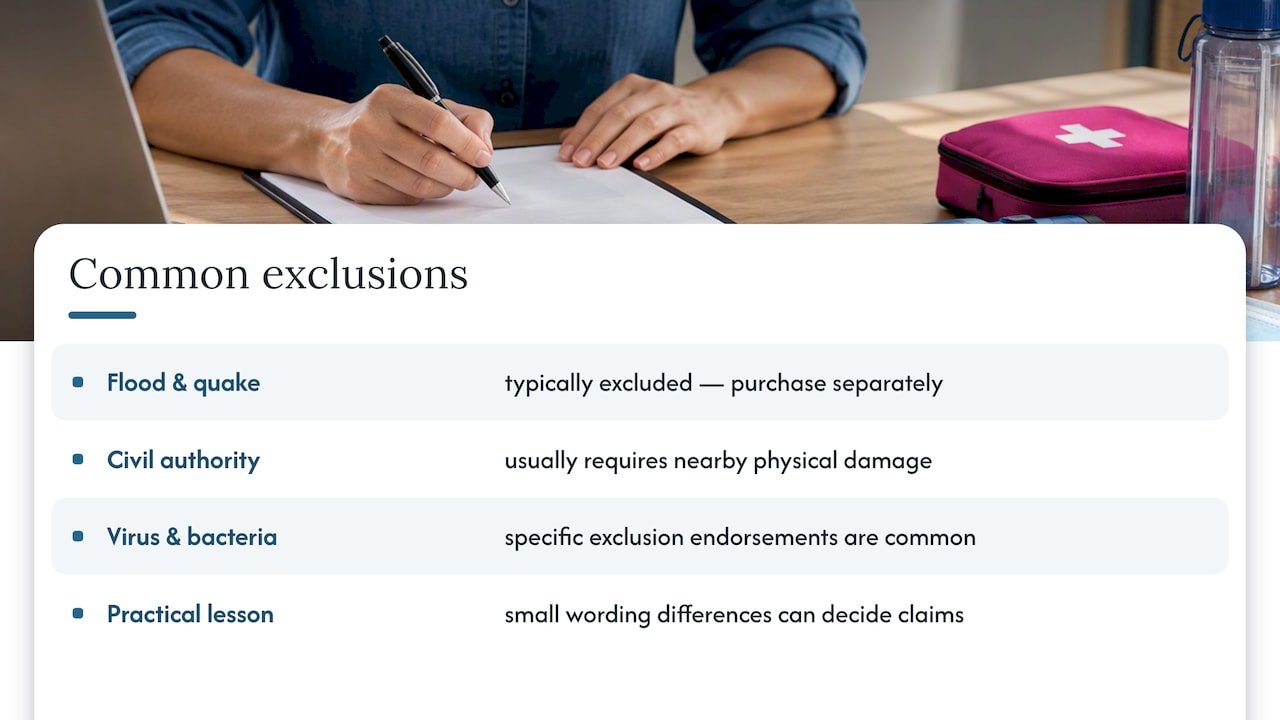
Standard business interruption forms exclude more than most owners expect. Flood and earthquake losses are typically excluded unless purchased separately, and civil authority coverage, which pays when a government order blocks access to your property, usually requires physical damage nearby, not just an order on its own.
Virus and bacteria exclusions are the biggest flashpoint. Many policies carry a specific exclusion endorsement for losses tied to viruses or bacteria, and insurers have generally argued these policies were never designed to cover pandemic-driven shutdowns. That position produced extensive litigation and a wave of proposed state legislation during COVID-19, with outcomes varying by jurisdiction and by the exact policy wording in play. None of this is legal advice, and if you’re weighing a claim or a coverage dispute tied to a pandemic-era loss, read your policy’s exact language and talk to a qualified professional. The practical lesson for small business owners is simpler: small differences in wording can decide whether a claim is paid, so know what your specific policy says before you need it.
Related coverages: extra expense, contingent BI, and extended BI
Three endorsements commonly pair with business interruption coverage, and each solves a different problem.
- Extra expense coverage reimburses reasonable, above-normal costs, like temporary rent or rental equipment, needed to keep operating. It’s distinct from lost income because it can be payable even when those costs don’t reduce your overall business income loss, though policy language on that point varies.
- Contingent business interruption covers losses caused by damage to a key supplier or customer’s property, provided that damage stems from a peril your own policy covers.
- Extended business interruption bridges the gap between the day repairs finish and the day revenue actually climbs back to normal, since customers rarely return the instant you reopen.
Pro Tip: If your business depends on one supplier or one major customer, ask specifically about contingent business interruption. Standard BI alone won’t respond to their loss, only yours.
How to buy business interruption coverage and what to ask your agent
Business interruption coverage usually arrives in one of two ways: bundled into a Business Owners Policy or added as an endorsement to a standalone commercial property policy. Either path, a few questions make the difference between adequate coverage and an unpleasant surprise at claim time.
- What’s the waiting period, and does it fit how quickly a short closure would hurt your cash flow?
- What’s the standard period of restoration, and is extending it an option?
- Does the policy carry a virus or bacteria exclusion, and does extra expense or contingent BI coverage come included or as an add-on?
- What coinsurance requirement applies, since underinsuring can reduce your payout even on a covered claim?
Before you sit down with an agent, gather your financial statements, payroll records, and key supplier contracts. Our commercial property insurance guide walks through how business income coverage fits alongside building and contents protection if you want the fuller picture first.
How we support small businesses with business interruption needs
We build business interruption coverage into our Business Owners Policy offerings, with endorsements added based on each client’s actual exposure rather than a one-size template. Our agents walk clients through a coverage review, help select appropriate restoration periods and endorsements, and provide support when a claim occurs, as policy details matter then. We offer guidance on documentation and timeline questions that arise during a disruption, helping clients manage these challenges during stressful times.
Why underinsurance is the real risk
Most small businesses that get burned by a disruption weren’t uninsured, they were underinsured: a restoration period too short for their actual rebuild timeline, or no contingent coverage for the one supplier they couldn’t operate without. Business interruption coverage only does its job when it’s sized to your real recovery timeline, not a generic average. Read your policy wording closely, and bring your agent in before a loss, not after.
— Nathan
Get a business owners policy review from our Savannah team
A coverage gap in your business interruption limits usually surfaces at the worst possible moment: mid-claim, mid-closure, with payroll due. We review your Business Owners Policy coverage against your real revenue, payroll, and recovery timeline, and walk you through which endorsements actually fit your operation.
If you’re ready to see where your current coverage stands, reach out to our agents for a business income review or a fresh quote.
This article is general information, not a substitute for advice from a qualified financial advisor. Consult a qualified financial professional about your own circumstances before acting on anything here.
FAQ
What is an example of a business interruption policy?
A common example is a retail shop damaged by a fire: the policy replaces the net income lost while the shop is closed and repaired, and continues covering rent, payroll, and loan payments during that restoration period. Coverage generally requires that the damage come from a peril the policy covers, not a general slowdown in business.
What are the types of business interruption cover?
Core business interruption coverage pays lost net income and continuing expenses after direct physical damage to your property. Related types include extra expense coverage for above-normal operating costs, contingent business interruption for losses tied to a supplier or customer’s property, and extended business interruption for the period after repairs finish but before revenue fully recovers.
What is the difference between extra expense coverage and business interruption insurance?
Business interruption insurance replaces income you lost because operations stopped, while extra expense coverage reimburses the reasonable, above-normal costs you spent to keep operating, like a temporary location or rental equipment. The two often pair together in the same policy but respond to different parts of a loss.
Is business interruption the same as loss of income?
Business interruption insurance is sometimes marketed as business income insurance, and the two terms generally describe the same coverage: lost net income plus continuing fixed expenses during a covered suspension. It is not the same as a general drop in sales with no physical damage behind it, since that type of loss typically falls outside standard coverage.
Sources
- Business interruption and business owner policy | NAIC
- Do I need business interruption insurance? | Triple-I (III)
- Waiting period (time deductible) | IRMI