
Flood contents coverage pays to repair or replace your personal belongings after a flood: furniture, clothing, electronics, washers and dryers, and more. Under the National Flood Insurance Program (NFIP), it is bought separately from building coverage, carries its own deductible, and tops out at $100,000 for residential policies. Renters can buy it alone. Homeowners usually pair it with building coverage, though how you set it up depends on your property.
If you live near the Savannah River, the marsh, or a short drive from Tybee Island, you already know water is part of life here. Here is what contents coverage does, what it leaves out, and how to decide how much you need.
TL;DR
- Contents coverage protects your belongings. Building coverage protects the structure and its systems. Under the NFIP, you buy them separately and each has its own deductible.
- NFIP contents limits are up to $100,000 for residential policies and $500,000 for non-residential ones.
- Claims are paid on the value of your items at the time of damage, not what you paid for them.
- Renters can buy a contents-only NFIP policy. Most NFIP policies have a 30-day waiting period before they take effect.
- Standard homeowners policies do not cover flood damage, so contents need their own flood coverage.
Table of Contents
- What flood contents coverage actually is
- What belongings are covered
- What flood contents coverage does not cover
- How a contents claim is valued
- Contents versus building coverage: which do you need?
- Limits, deductibles and the waiting period
- Why your homeowners policy will not help
- How much contents coverage should you carry?
- Our perspective
- Get your contents covered in Savannah
- FAQ
- Sources
What flood contents coverage actually is
Think of your home in two layers. The first is the building: foundation, walls, wiring, plumbing, and the furnace. The second is everything you could carry out the door if you had time: the couch, the TV, the clothes in the closet.
Flood insurance treats those layers as two coverages. Building coverage handles the physical structure, including electrical and plumbing systems, while contents coverage handles what is inside. They are purchased separately and carry separate deductibles. You can have one, the other, or both, depending on who you are and what you own.
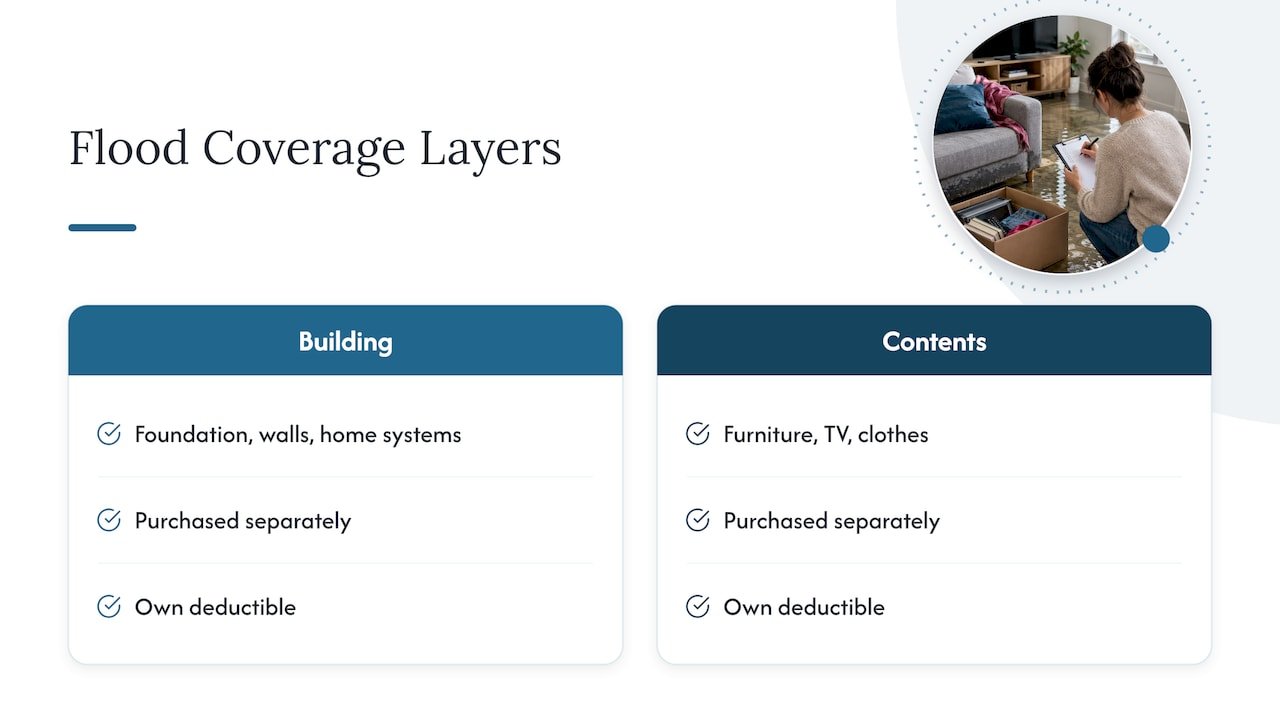
That separation matters on claim day. A flood can ruin a living room full of furniture and leave the walls repairable, or the reverse. Each coverage responds to its own kind of loss, and each deductible applies on its own.
What belongings are covered
The NFIP’s contents coverage includes the ordinary things that fill a home. According to the program’s agent resources, it includes clothing, furniture and electronic equipment, curtains, portable air conditioners, microwaves and dishwashers, and washers and dryers.
A quick walk-through of a typical Savannah home shows how fast that adds up:
- Living areas: sofa, rugs, TV, gaming consoles, lamps, bookshelves and the books on them
- Bedrooms: mattresses, dressers, bedding, and every piece of clothing and every pair of shoes
- Kitchen and laundry: portable appliances, microwave, dishwasher, washer and dryer
- Home office: computers, monitors, printers, desks
- Window treatments: curtains
Most people underestimate the total. Try this: pick a room and list everything in it with a rough replacement price. A single bedroom often runs into the thousands. Multiply that across a house and the $100,000 ceiling stops looking abstract.
Items with special limits
Some valuables are covered but capped. Original artwork and furs are limited to $2,500 per item. If you own pieces worth more than that, a flood policy alone will not make you whole. A separate personal articles policy is built for jewelry, art and other high-value items, and we explain what it covers in our post on personal articles insurance in Savannah.
What flood contents coverage does not cover
Know the exclusions before you need the claim. The NFIP’s contents coverage excludes currency, precious metals, valuable papers, most self-propelled vehicles, and outdoor property such as fences and pools.
In plain terms:
- Cash and precious metals: keep these off the list of things flood insurance will replace.
- Valuable papers: deeds, titles and similar documents are not covered as contents. Store copies digitally and keep originals somewhere high and dry or off-site.
- Cars and similar vehicles: these belong on an auto policy with comprehensive coverage, which is the usual route for flood damage to a vehicle. Boats, RVs and golf carts have their own policies too.
- Outdoor property: fences, pools and similar items sit outside contents coverage.
This is the kind of detail that surprises people after the fact. Reading your declarations page now is cheaper than reading it after a loss.
How a contents claim is valued
This is the part most people get wrong. NFIP contents are covered for their value at the time of damage, not their original cost. That means depreciation is part of the math. A five-year-old television is valued as a five-year-old television, not as a new one.
What that means for you:
- Expect a gap between payout and replacement cost. If you plan to replace everything with new items, budget for the difference.
- Document what you own. Photos or a short video of each room, with serial numbers on electronics, make a claim faster and harder to dispute.
- Keep receipts for big purchases. They help show age, brand and condition.
- Store your inventory off-site. A cloud folder works. A phone sitting in a flooded house does not.
The deductible also reduces what you receive. Your policy’s declarations page lists your specific limits and deductibles, and FEMA’s summary of coverage points policyholders to that page and to their agent for review.
Contents versus building coverage: which do you need?
The answer depends on how you live.
| Your situation | Building coverage | Contents coverage |
|---|---|---|
| Homeowner, own the structure | Yes, protects the house | Yes, protects belongings |
| Renter | Not your policy to carry (landlord’s) | Yes, contents only |
| Condo owner | Often through the association’s policy, review your unit’s coverage | Yes, for your belongings |
| Landlord with furnished rental | Yes, for the structure | Yes, for furnishings you supply |
If you own a home and your mortgage requires flood insurance in a high-risk zone, the requirement is about the structure. Contents coverage is a choice you make on top. Many families skip it to save on premium and then discover how much a flood costs in furniture alone. Our flood insurance guide walks through programs and requirements in more depth.
Can you buy contents only?
Yes, in the right situation. Renters can buy an NFIP contents-only policy to cover personal items in a rental unit damaged by a flood. The same brochure notes that your landlord’s insurance, if any, will not cover your belongings. That is why a Savannah renter in an apartment near the river or a low-lying neighborhood should look at it alongside a standard renters policy, which does not cover flood on its own.
If you own your home, whether a contents-only setup fits depends on your mortgage, your property and your carrier. Ask an agent before you assume.
Limits, deductibles and the waiting period
The numbers worth knowing for NFIP policies:
- Residential contents limit: up to $100,000
- Non-residential contents limit: up to $500,000
- Deductible: separate from building coverage
- Waiting period: most NFIP policies have a 30-day wait after purchase before they go into effect
FEMA’s own guidance explains the reason for the wait: it encourages people to keep a policy in force instead of buying when a storm is on the radar. In a coastal market where hurricane season is a fact of life, buying early is the only practical approach. A policy bought the day a storm is named usually will not respond to that storm.
If your belongings are worth more than the NFIP limits, or you want coverage terms the federal program does not offer, there are private options. We compare them in private flood versus NFIP in Savannah. For high-value homes, excess flood coverage adds a layer above the primary limits.
Why your homeowners policy will not help
The most common misunderstanding is simple: people assume their homeowners policy covers flood. FEMA states that standard homeowners policies do not cover flood damage. Federal disaster aid is only available after a presidential disaster declaration, and it typically arrives as a loan that must be repaid with interest.
For localized flooding that never reaches that threshold, FEMA notes that aid will be limited and insurance may be the only source of help for cleanup and repairs. A heavy afternoon storm that backs up streets and floods a ground floor can fall into exactly that category.
Water damage also has consequences beyond the repair bill. If you ever sell a house that has flooded, there are disclosure questions to sort out first, and water damage disclosure and cash-sale options are worth understanding before you list.
Two related coverages are easy to confuse with flood:
- Water and sewer backup: often an endorsement on a homeowners policy. See what water and sewer backup coverage is.
- Flood: rising water from outside, covered under a separate flood policy.
Knowing which one applies to a given loss is half the battle.
How much contents coverage should you carry?
A practical way to land on a number:
- Walk the house with your phone. Record every room, open closets and drawers.
- Price replacement. Estimate what each category would cost today, then remember that the claim pays value at time of loss, which is lower.
- Consider which floors are at risk. Belongings in a ground-floor room or garage are more exposed than those upstairs.
- Separate the high-value items. Anything over the per-item caps for art and furs belongs on a different policy.
- Compare with the cap. If your total is near or above $100,000, ask about private or excess options.
The goal is not the biggest policy. It is a policy that matches what you would actually have to replace.
Our perspective
We have been helping Savannah families and businesses for over 45 years, and the same pattern shows up after every wet season: people insured the building and forgot the things inside it.
Contents coverage is where most of a household’s day-to-day life lives. Furniture, clothes, computers and appliances are what you need again the week after a flood, and they are what a standard homeowners policy will not pay for when the water comes from outside. We think of contents coverage as part of the plan, not an add-on you think about later.
Because we work with multiple carriers, we can look at NFIP and private options side by side and build coverage around your home, your belongings and your budget. When a claim happens, our job is to stay on your side and help you through it.
Nathan
Get your contents covered in Savannah
We place flood coverage for homeowners, renters, condo owners and landlords across Savannah and the surrounding area. An agent can review your situation, explain your options and put a policy in place before the next storm season, not after it.

Start with flood insurance in Savannah, GA or browse everything we offer on our services page. If you own a commercial building, see our commercial flood coverage.
FAQ
Does flood contents coverage apply if I rent?
Yes. Renters can buy an NFIP contents-only policy that covers personal items in the rental unit. Your landlord’s flood policy, if there is one, covers the building and not your belongings.
Is contents coverage included automatically with building coverage?
No. Under the NFIP, building and contents coverage are purchased separately and each has its own deductible. When you request a quote, specify both so nothing is left out by accident.
How much does the NFIP pay for flood-damaged belongings?
It pays the value of the item at the time of damage, not what you originally paid, up to your policy limit and after your deductible. Residential contents limits go up to $100,000. Your declarations page shows your own numbers.
What belongings does flood insurance not cover?
Contents coverage excludes currency, precious metals, valuable papers, most self-propelled vehicles and outdoor property like fences and pools. Original artwork and furs are limited to $2,500 per item.
How soon does a new policy start?
Most NFIP policies have a 30-day waiting period after purchase. Buy well ahead of hurricane season rather than waiting for a forecast.
Sources
- Types of Coverage, NFIP Agents
- NFIP Flood Insurance for Renters Brochure
- FEMA, Flood Insurance (waiting period and aid)
- FEMA, Summary of Coverage
- FEMA, homeowners policies and disaster assistance
- Water damage disclosure and cash-sale options