
A blanket additional insured endorsement is a change to your commercial general liability (CGL) policy that gives additional insured status to any person or business you have agreed, in a written contract, to cover. You don’t name each party on the policy. The endorsement does the work when the contract requires it. That sounds simple, and mostly it is, but the wording of the endorsement and of your contract decides who is actually protected.
This guide explains how the endorsement works, how it differs from a scheduled one, what the common form numbers mean, and what venues, landlords and general contractors usually ask you to carry.
TL;DR
- A blanket endorsement adds parties to your CGL policy automatically, but only when a written contract requires you to add them.
- A scheduled endorsement names each party individually. A blanket one describes them by category or by contract.
- A certificate of insurance is proof of coverage, not the coverage itself. The endorsement on the policy is what creates additional insured status.
- Form wording varies. Some blanket forms require a direct contract with you, while broader ones do not.
- Before you sign a venue or client contract, send it to your agent so the endorsement matches what it demands.
Table of Contents
- What a blanket additional insured endorsement does
- When coverage actually kicks in
- Form numbers and why they matter
- A certificate of insurance is not the endorsement
- What venues usually ask for
- Common mistakes to avoid
- Who needs one
- Our perspective
- Get your contract reviewed before you sign
- FAQ
- Sources
What a blanket additional insured endorsement does
An additional insured is a person or organization that gets coverage under your liability policy for claims tied to your work or operations. Think of a property owner whose building you are working in, or a venue hosting your event. If someone is hurt and sues them over something connected to what you did, your policy can respond for them as well.
There are two ways to set that up. A scheduled endorsement lists each party by name. A blanket endorsement covers any party you are contractually required to add, without listing them one by one. According to a comparison of scheduled and blanket endorsements, blanket forms don’t require the policyholder to name every entity, and a general description of the types of parties is enough.
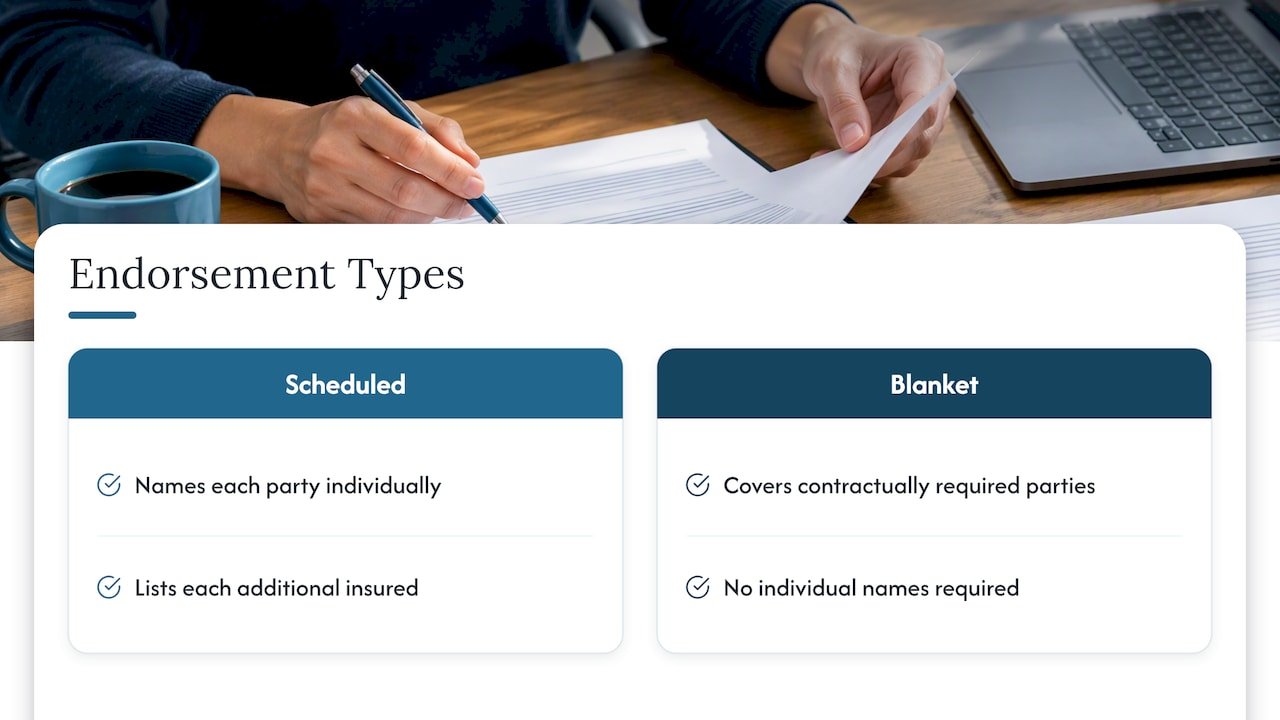
You may also hear this called an automatic additional insured endorsement. It is the same idea: status switches on automatically once the contract condition is met.
Blanket vs. scheduled at a glance
| Scheduled | Blanket (automatic) | |
|---|---|---|
| How parties are added | Named on the endorsement | Added automatically when a written contract requires it |
| Paperwork each time | Ask your agent to add each party | Usually none, if the contract meets the form’s wording |
| Best for | One or two known parties, or a party that insists on being named | Many contracts, recurring clients, frequent venues |
| Main risk | Delays, or forgetting to request it | A contract that doesn’t satisfy the wording |
If you sign contracts often, a blanket endorsement saves time. If one counterparty wants to see its own name, a scheduled endorsement may still be needed. PIIAC’s Chris Boggs notes that some additional insureds ask to be specifically listed by name, so the two approaches often sit side by side.
When coverage actually kicks in
The trigger for a blanket endorsement is a written agreement. IRMI explains that an automatic endorsement generally confers status when the named insured and the other party agree in writing that the party will be added as an additional insured. For the endorsement wording IRMI discusses, the written contract also has to be executed before the loss and has to require the additional insured status.
In practice, that means three things:
- There has to be a contract. A handshake or an email that says “just add us” may not meet the wording. Check what your form requires.
- The contract has to require additional insured status. A contract that only asks for a certificate of insurance may not do it.
- The contract has to be signed before something goes wrong. Signing after an accident is too late under the wording IRMI cites.
IRMI also warns that blanket endorsements may not cover everyone. Coverage depends on outside contract documents and their exact language, so you can’t tell who is covered by reading the policy alone.
Where the coverage ends
Most blanket forms are tied to your work. Coverage generally concerns third-party liability arising from what the named insured does, subject to the endorsement’s wording. It does not turn the venue or the property owner into a second policyholder for everything. Some forms also end the additional insured’s status when your operations for that party are completed. Ongoing exposure after a job is finished is a separate question, and our guide to products and completed operations covers why contractors can face claims years later.
Form numbers and why they matter
If you have ever asked “what is the form number for a blanket additional insured endorsement,” the honest answer is that there isn’t just one. Insurers use their own forms, and many follow the ISO (Insurance Services Office) series. Two examples show how much the wording can differ.
- ISO CG 20 33. Courts have read some blanket forms of this kind to require direct “privity of contract,” meaning a direct written contract between you and the additional insured, to trigger coverage, according to Jones Day.
- ISO CG 20 38. Broad-form automatic endorsements like this one reach further. They can grant status to parties required by contract even without a direct contract with the named insured.
The practical difference shows up in layered contracts. Say you are a caterer hired by an event planner, who was hired by the venue. The venue requires everyone on site to add it as an additional insured. If your form requires a direct contract with the venue, you may not be covering the venue at all. A broader form might.
Your carrier’s form may carry a different number, or a different version date of the same form, so ask your agent to read the wording against your contracts instead of relying on the number alone.
A certificate of insurance is not the endorsement
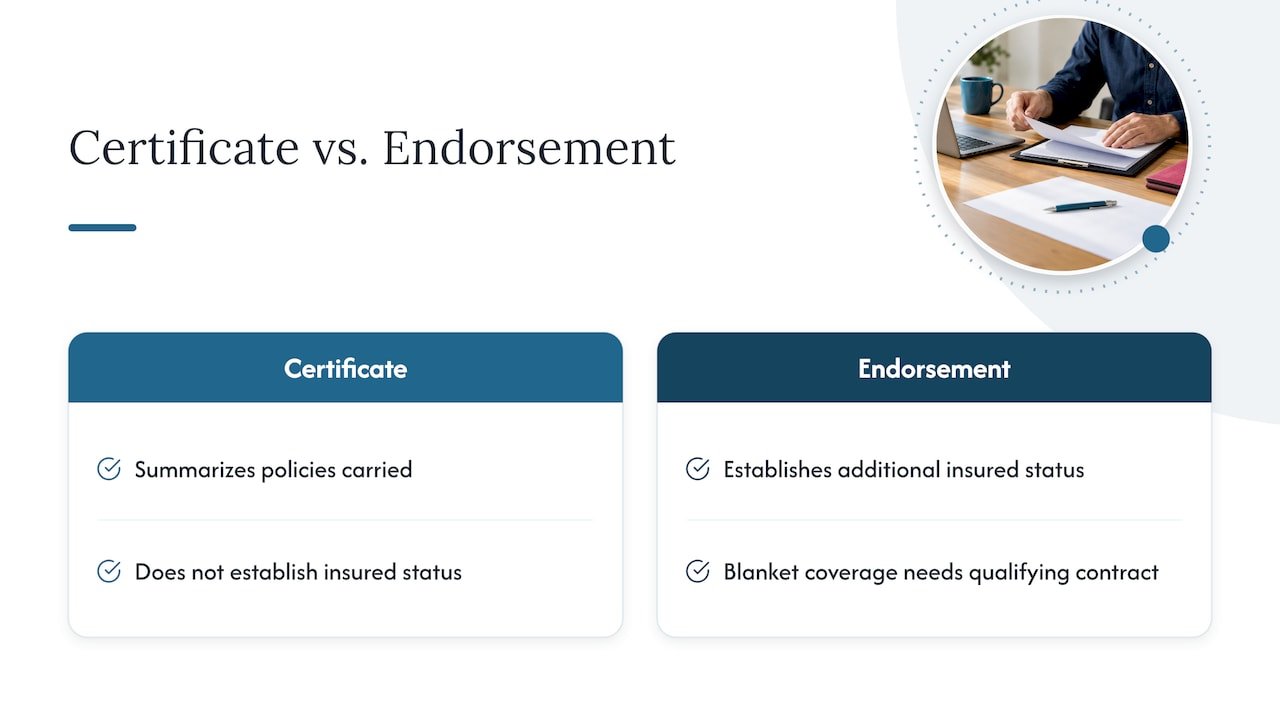
This is the most common misunderstanding. A certificate of insurance (COI) is a summary document showing what policies you carry. It is useful, and venues always ask for one. But Jones Day cautions that accepting a certificate as proof is a common misstep, because only the policy endorsement establishes additional insured status.
So when a venue’s manager says “just send the certificate,” the sensible follow-up is: does my policy have an endorsement that makes you an additional insured? If you have a blanket endorsement and a qualifying contract, the answer is yes, and the certificate can say so. If not, the certificate may promise something the policy doesn’t deliver.
We break the distinction down further in our article on additional insured vs. certificate holder. If you are on the other side of the table, hiring a contractor for your own property, this homeowner’s guide to contractor certificates of insurance shows what to ask for.
What venues usually ask for
Event organizers search for venue insurance requirements because the contract arrives with a list of demands. Requirements vary from venue to venue, so read yours closely. Public venues publish theirs, and they make a good picture of what to expect.
Seattle Center’s insurance addendum, effective in 2026, asks for $1,000,000 of CGL coverage per occurrence, including premises and operations and contractual liability coverage. It also asks for host liquor coverage if alcohol is served, and it requires the City to be an additional insured on a primary and noncontributory basis.
The City of Ventura, California, asks contractors for liability coverage that applies on a primary, non-contributing basis in relation to any insurance or self-insurance available to the City and its officers, employees, agents or volunteers.
These are other cities, and a Savannah venue, hotel, private estate or marina will set its own limits. But the pattern is common, and you can expect to see some version of these items:
- A minimum CGL limit per occurrence. Often a round figure such as $1,000,000, though your venue may ask for more.
- Additional insured status for the venue owner, operator and sometimes its officers or employees.
- Primary and noncontributory wording. This means your policy pays first and the venue’s own insurance doesn’t have to chip in.
- Liquor coverage if alcohol is served or sold.
- Waiver of subrogation, which stops your insurer from pursuing the venue after paying a claim. Our piece on three checks for a waiver of subrogation explains what to confirm before agreeing.
- Workers’ compensation for any staff you bring.
Matching the endorsement to the contract
A blanket endorsement only helps if its wording lines up with the demands. Before you sign, ask four questions:
- Does the contract require additional insured status in so many words?
- Does the endorsement cover the venue’s entity type, such as an owner, lessor, manager or municipality?
- Does the endorsement cover “primary and noncontributory” wording if the venue requires it? Many do not by default.
- Is the limit the contract asks for at or below your policy limit?
If any answer is no or maybe, you need either a different form or a scheduled endorsement for that venue.
Common mistakes to avoid
Signing first and asking later. The contract has to be in place before a loss, so a late call to your agent can leave a gap. Send the contract before you sign it.
Treating the certificate as the finish line. A certificate that lists the venue doesn’t create coverage on its own.
Assuming one endorsement fits every contract. Indemnity clauses, primary wording and waiver language are all separate. Our guide on contractual liability insurance for small businesses covers the liability you take on by contract, which the endorsement does not replace.
Forgetting the policy limit. Additional insureds share your limit. If you have several clients on the same policy, one big claim can use up what the others were counting on. Some businesses add an umbrella or excess layer for that reason. See our excess liability guide.
Who needs one
Business owners who regularly sign contracts with these requirements tend to be good candidates:
- Contractors and trades working on other people’s property
- Event vendors, caterers, photographers and planners
- Property managers and landlords who hire vendors
- Retailers and restaurants leasing space
- Small businesses with a landlord who requires additional insured status
If that sounds like you, the CGL policy is where the endorsement lives. Our commercial liability insurance guide walks through what the base policy covers, and business insurance essentials shows how it fits with the rest of a small business program.
Our perspective
Most of the blanket endorsement problems we see don’t start with the insurance. They start with a contract that nobody sent us until the day before the event or the job.
At Daly & Alexander, our agents have more than 45 years of experience helping people in Savannah and the surrounding area. Our approach is simple: we read the requirements with you, compare them to your policy wording, and tell you plainly what matches and what doesn’t. We work with multiple carriers, so if one form falls short of what a venue asks for, we can look for one that fits.
Our advice is to treat the contract as part of your insurance. Send it over early, ask for the endorsement wording rather than just a certificate, and keep a copy of both. It takes a few minutes and spares you a hard conversation after a claim.
Nathan
Get your contract reviewed before you sign
If a venue, landlord or client has sent you an insurance requirements page, bring it to us. We can look at your current commercial general liability policy, check whether a blanket additional insured endorsement is on it, and talk through what your contract is really asking for. If you don’t have a policy yet, we can help you build one around the contracts you actually sign.
Start with our commercial liability insurance in Savannah, or look at our Business Owners Policy, which bundles liability and property coverage for small businesses. Our published BOP range is $500 to $3,500 per year, and your price depends on your business. For events, vacation rentals and other situations, see all of our coverage options.
FAQ
What is the difference between blanket and scheduled additional insured coverage?
A scheduled endorsement names each additional insured on the policy. A blanket endorsement adds any party you are required by written contract to cover, with no individual names. Blanket is quicker for frequent contracts, and scheduled can help when a party insists on being named.
Does a blanket endorsement cover a venue automatically?
Only if the endorsement’s conditions are met. Under the wording IRMI discusses, that means a written contract signed before the loss that requires you to add the venue as an additional insured. Check your form, since some require a direct contract with you and others are broader.
Is a certificate of insurance enough to make someone an additional insured?
No. A certificate summarizes your coverage, but the endorsement on the policy is what establishes additional insured status. Ask your agent to confirm the endorsement is there before you promise it to a venue.
Can professional liability have additional insureds?
Sometimes, but it is less common than on general liability, and the terms depend on the carrier. If a contract asks for it, send the requirement to your agent so they can ask your carrier what is available.
Sources
- Additional Insured Status—Automatic or Wet Blanket? (IRMI)
- Don’t Sleep on This: New York High Court Addresses Scope of Blanket Additional Insured Endorsements (Jones Day)
- Certificates of Insurance: FAQs and Answers (PIIAC)
- Scheduled Endorsement vs. Blanket Endorsement
- Seattle Center insurance addendum, effective 2026
- City of Ventura general insurance requirements
- Contractor Certificate of Insurance: A Homeowner’s Guide