
Umbrella insurance is extra liability coverage that sits on top of your auto, homeowners, renters or boat policy. When a claim against you is bigger than the liability limit on one of those policies, the umbrella can pay the rest, including legal defense costs. It is built for the rare, expensive event: a serious crash, a dog bite, a guest who is badly hurt at your home. It does not repair your own car or house, and it does not cover everything you could be sued for. Here is how it works, what it usually covers, where the gaps are, and how to pick a limit.
TL;DR
- An umbrella policy adds liability protection above your auto, home and other primary policies, and can also pay defense costs.
- It typically covers bodily injury, property damage and personal injury claims you are legally responsible for.
- It generally does not cover your own home, vehicle or injuries, punitive damages, or most business and intentional-act claims.
- Limits commonly start at $1 million and rise in $1 million steps, and you usually need minimum limits on the underlying policies first.
- A local agent can match the limit to your assets and your Savannah-area risks, from the pool to the boat.
Table of Contents
- How umbrella insurance works
- What umbrella insurance covers
- What umbrella insurance does not cover
- Umbrella policy limits and underlying requirements
- How much umbrella coverage do you need?
- Who tends to need an umbrella in Savannah
- Before you buy: a short checklist
- Our perspective
- Talk to a local agent about your umbrella
- FAQ
- Sources
How umbrella insurance works
Think of your primary policies as the first layer of protection. Your auto policy has a liability limit. So does your homeowners policy. If you cause an accident and the other driver’s medical bills and lawsuit climb past that limit, you would normally owe the difference out of pocket.
An umbrella policy is the second layer. Personal umbrella insurance pays for costs that exceed the limits of your primary policies, such as auto, homeowners or boat insurance. The National Association of Insurance Commissioners describes it as coverage for liability and defense costs beyond your primary auto, homeowners or renters insurance, and notes it can also respond to some claims your primary policy does not cover.
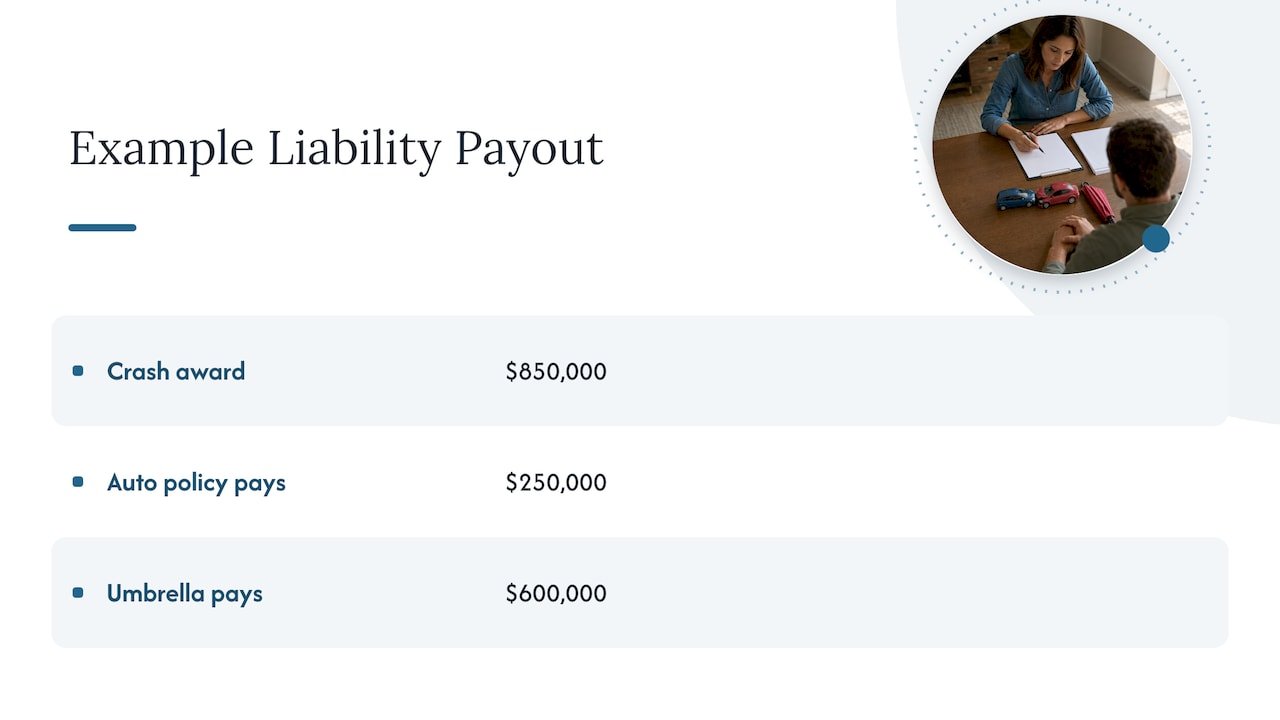
A simple example: you are at fault in a crash and the injured driver is awarded $850,000. Your auto policy pays its $250,000 liability limit. A $1 million umbrella would pick up the remaining $600,000, subject to its terms. Without it, that balance could be collected from your savings, your home equity or your future wages.
Some policies include a retained limit, which is the amount you pay before the umbrella begins to respond. NerdWallet’s 2026 guide explains that this can apply, so ask your agent to point to it in the policy rather than assuming there is none.
What umbrella insurance covers
Most personal umbrella policies respond to three broad kinds of claims for which you are legally responsible. The NAIC lists bodily injury, property damage and personal injury as the core categories.
Bodily injury
This is the claim people picture first. The Texas Department of Insurance lists a serious at-fault auto accident, a dog bite, a child hurt in a yard, pool or trampoline, and a guest who falls and is injured at your home among common examples. Savannah adds its own versions: a guest slipping on a wet porch after a summer storm, a visitor hurt on your dock, a passenger injured on your boat near Wilmington Island.
How injury claims are paid after a crash can be confusing, and it affects how large a claim can get. This overview of how bodily injury and PIP pay helps explain why serious injuries can outgrow a basic auto liability limit.
Property damage
If you damage someone else’s property and the cost exceeds your primary limit, the umbrella may help. Think of a car fire that spreads to a neighbor’s garage, or a boat that collides with a dock. The damage is to other people’s property, not yours.
Personal injury
In insurance language, “personal injury” is different from bodily injury. It covers non-physical harms such as libel, slander, defamation and invasion of privacy, depending on the policy wording. A heated post about a neighbor or a former contractor is the kind of situation this can matter for.
Legal defense costs
Lawsuits are expensive even when you win. NerdWallet notes that umbrella insurance typically covers associated legal costs as well as damages. The Texas Department of Insurance adds that these policies may pay large medical and repair bills that a court or insurer says you are responsible for. Ask how defense costs are treated: whether they sit inside your limit or on top of it.
What umbrella insurance does not cover
Exclusions are where people get surprised. The NAIC says umbrella insurance generally does not pay for damage to your own home or vehicle. Its example is hail damage to your car that your auto policy does not cover: the umbrella will not step in. It also identifies punitive damages as excluded.
Here is a practical checklist of common gaps to review with your agent:
- Your own property. Fire, wind, theft and flood damage to your home or belongings belong to your homeowners, flood or personal articles policies.
- Your own injuries. Your medical bills come from health insurance, medical payments or personal injury protection, not the umbrella.
- Punitive damages. Penalties meant to punish, which the NAIC lists as excluded.
- Business activities. NerdWallet’s guide points out that exclusions can leave significant gaps for business, contracts, intentional acts, boating or other specialized risks. A personal umbrella is not a substitute for commercial liability.
- Intentional acts. Harm you cause on purpose is not insured.
- Contractual liability. Obligations you take on in a lease or agreement may be limited.
- Specialty exposures. Boats, RVs, golf carts, rental properties and motorcycles are sometimes handled with conditions or require a specific underlying policy.
If you own a business, the better fit is separate commercial protection. Our guides to commercial umbrella insurance and commercial liability explain how those layers work.
Umbrella policy limits and underlying requirements
Limits are the maximum the umbrella will pay. The Texas Department of Insurance says coverage usually starts around $300,000 and pays up to at least $1 million. In practice, many carriers sell personal umbrellas starting at $1 million, and limits climb in $1 million increments from there. Exact options vary by carrier, so your agent will show you what is available to you.
You generally cannot buy an umbrella on its own. NerdWallet notes it generally requires existing primary insurance and may require higher underlying limits or placement with the same carrier. That has two practical effects:
- If your auto or home liability limits are low, you may need to raise them before the umbrella can be issued.
- Those increases add a modest amount to your primary premiums, on top of the umbrella premium itself.
The required underlying limits differ by carrier, so ask for the minimums in writing before you decide. Raising liability on a homeowners policy is often one of the cheaper changes. Our auto insurance coverage guide shows how the liability numbers on an auto policy are structured.
How much umbrella coverage do you need?
There is no single right number, but there is a sensible way to think about it. The more you own, the more a lawsuit can reach. Massachusetts puts it plainly: the more assets you have, the more you are at risk for damages from a lawsuit. A common rule of thumb is to match the limit to your net worth, and that is a reasonable starting point.
To refine it, add these questions:
- What could be taken? Home equity, savings, investments and a portion of future income.
- How likely is a large claim? Teen drivers, a pool, a trampoline, a dog, a boat, a long daily commute or frequent entertaining all raise the odds.
- Do you rent out property? A vacation or long-term rental adds guests and tenants to your exposure. Rentals often need their own landlord or vacation rental policy underneath.
- Do you have public visibility? Social media, volunteer boards and coaching roles can bring personal injury claims.
Households with modest assets can still benefit. If a judgment would force you to sell your home or garnish income, a $1 million policy is a small price against that outcome.
Who tends to need an umbrella in Savannah
Life near the water is the draw, and also part of the risk. In and around Savannah, these are the situations where we most often see an umbrella make sense:
- Homeowners with a pool, dock or large yard. Guests, children and neighbors all visit in warm months.
- Boat, golf cart and RV owners. These are popular in Chatham County, and each brings its own liability exposure.
- Landlords and short-term rental hosts. Tenants and guests mean more people on your property.
- Families with teen drivers. New drivers raise the chance of a serious accident.
- Professionals and higher earners. You have more to protect and are a larger target for a claim.
Note that flood damage to your own home is not an umbrella matter. Savannah homeowners should handle that with a separate flood policy, and our flood insurance guide explains the options.
Before you buy: a short checklist
A few minutes of preparation makes the quote conversation faster and the coverage more accurate.
- List your policies. Auto, home, renters, boat, RV, motorcycle and golf cart, with their current liability limits.
- Add up your assets. Home equity, savings, retirement and investments.
- Note your exposures. Pool, dog, teen drivers, rentals, a home office or side business.
- Ask about underlying minimums. Find out which limits you must carry first.
- Ask how defense costs work. Inside or outside the limit, and whether a retained limit applies.
- Read the exclusions. Especially anything involving watercraft, rentals or business activity.
If your home policy is also due for review, comparing home insurance quotes side by side helps you see how coverage and premium shift together. For Georgia details, our homeowners insurance page for Savannah is a good place to start.
Our perspective
Most people think of an umbrella as something for the wealthy. In our experience, it is more often a tool for ordinary families who have worked hard for a home, a boat and a little savings, and who would feel a lawsuit for years.
What we try to do is make the policy fit the person. We look at your auto and home limits first, because the umbrella only works well when the layers underneath it are set properly. Then we look at how you actually live: the pool, the dock, the kids learning to drive, the rental you are thinking of buying.
Our agents are local and have more than 45 years of experience behind them. We work with multiple carriers, so we can compare options and explain the exclusions in plain language before you commit. If something does happen, we stay on your side through the claims process.
Nathan
Talk to a local agent about your umbrella
Daly & Alexander Insurance offers personal umbrella policies alongside homeowners, auto, boat, RV, motorcycle, golf cart and rental coverage, so the layers can be reviewed together. We will look at your current liability limits, suggest a coverage amount that fits your assets, and explain what is and is not included. Read more on our Savannah umbrella insurance page, or see everything we offer on our services page.

If you already carry an umbrella and want a second look, bring the policy. We can walk through the limits and exclusions with you. You can also read our broader piece on umbrella insurance as extra protection for more detail.
FAQ
What does umbrella insurance cover?
It covers liability above your primary policy limits, typically for bodily injury, property damage and personal injury claims you are legally responsible for. It can also pay legal defense costs. It does not cover damage to your own home or vehicle.
Is umbrella insurance worth it?
It is worth considering if a large lawsuit would threaten your home, savings or income. The premium is usually small compared with the extra limit it adds. Households with a pool, boat, teen driver or rental property often have the clearest need.
What are the limits on an umbrella policy?
Limits commonly start at $1 million and increase in $1 million steps, though some policies start lower. You usually must carry minimum liability limits on your auto and home policies first. Your agent can tell you the exact requirements for each carrier.
Does an umbrella policy cover my business?
A personal umbrella generally does not cover business activities, so a business needs its own commercial liability or commercial umbrella coverage. If you run a small business or rent out property, ask your agent how the policies should fit together.
Sources
- Personal Umbrella and Excess Liability Insurance, Mass.gov
- What’s an umbrella policy?, NAIC
- Umbrella policy: What is it and when do you need one?, Texas Department of Insurance
- Umbrella Insurance: Coverage & How It Works (2026 Guide), NerdWallet
- How Much Umbrella Insurance Do I Need?, Ramsey Solutions
- Before You Settle: How Bodily Injury and PIP Pay in the U.S.
- Texas Home Insurance Premium Up? How to Compare Quotes