
As a first-time buyer, the insurance you need is a homeowners policy, usually an HO-3, in force by closing day and sized to rebuild your house, not just to satisfy your lender. A local agent who works with multiple carriers can line up quotes, explain the fine print and add flood coverage if your address calls for it. That is what our team at Daly & Alexander Insurance does for Savannah-area buyers, backed by over 45 years of experience.
TL;DR
- Your lender will require homeowners insurance, and you choose the company. The policy must be in place at closing.
- Most new homeowners buy an HO-3 (Special Form), which covers the house against all perils except those the policy names as exclusions, such as flood and earthquake.
- Insure the home for its full rebuild cost, not its purchase price and not just the mortgage balance.
- Standard policies leave out flood. Near Savannah’s rivers, marsh and coast, ask about flood coverage before you close.
- Compare at least three quotes on the same coverage, and look hard at the deductible type.
Table of Contents
- What homeowners insurance covers
- What your lender requires, and what it does not
- How to get your first policy, step by step
- How much coverage you need
- Choosing a deductible
- Exclusions and add-ons to review before you sign
- Flood: the gap in a standard policy
- What affects your premium, and how to lower it
- Get covered before closing
- FAQ
- Sources
What homeowners insurance covers
A homeowners policy bundles several protections. According to the NAIC’s consumer guide, it covers:
- Dwelling: the house and attached structures, such as a garage.
- Other structures: a fence, shed or detached garage.
- Personal property: furniture, clothes, electronics.
- Loss of use: hotel and living costs while repairs are made.
- Personal liability and medical payments: if someone is hurt on your property or you damage someone else’s.
The same guide says the Special Form is the most popular type, covering all perils except named exclusions, typically flood and earthquake. New York’s Department of Financial Services also says the Special Form (HO-3) is the most widely used and the type a mortgage lender may require. If you want the HO-3 compared with the broader HO-5, see our guide on questions to ask your agent about HO-3 vs HO-5.
What your lender requires, and what it does not
The CFPB notes that lenders typically require homeowners insurance as a condition of the loan, and that you can choose your insurer. The Wisconsin Office of the Commissioner of Insurance explains that most lenders want a policy in force at closing, with a copy of the policy and the cover page showing coverage amounts, and the lender listed as loss payee, meaning the lender is paid first if the house is damaged (OCI guide).
Two points trip up first-time buyers:
- You are not obliged to use the insurer your lender suggests. The DC Department of Insurance says so directly.
- The lender’s minimum is built to protect the lender. A requirement equal to the mortgage balance may leave you short. The Wisconsin guide warns that if the home is destroyed and the policy only pays off the loan, you may not recover the equity you have put in.
Homeowners insurance is not mortgage insurance
Private mortgage insurance (PMI) is separate coverage that protects a lender on a conventional loan if the borrower defaults. You usually pay for it, but it insures the lender, not you or your house. It does nothing to repair a roof after a storm. You still need a homeowners policy.
How to get your first policy, step by step
The CFPB’s shopping guidance lays out the process. Here it is with the places it tends to go wrong.
- Start once your offer is accepted. Do not wait for the closing disclosure. Underwriting a property can take time, and a policy must be bound (active) when you close.
- Gather the property details. Address, year built, roof age and type, square footage, and updates to electrical, plumbing and heating all affect the price.
- Request written quotes from several sources. The NAIC shopping tool recommends at least three. Because we place coverage with multiple carriers, one conversation with our agents can produce several options side by side on the same coverage terms. Start on our homeowners insurance page.
- Compare like with like. Same dwelling limit, same deductible, same endorsements. A cheap quote often hides a higher deductible or a missing coverage.
- Share the quotes with your loan officer to confirm they meet lender requirements, as the CFPB advises.
- Choose, pay and send final documents. Give the lender the policy and cover page, with the lender named as loss payee.
How much coverage you need
Dwelling: insure the rebuild cost
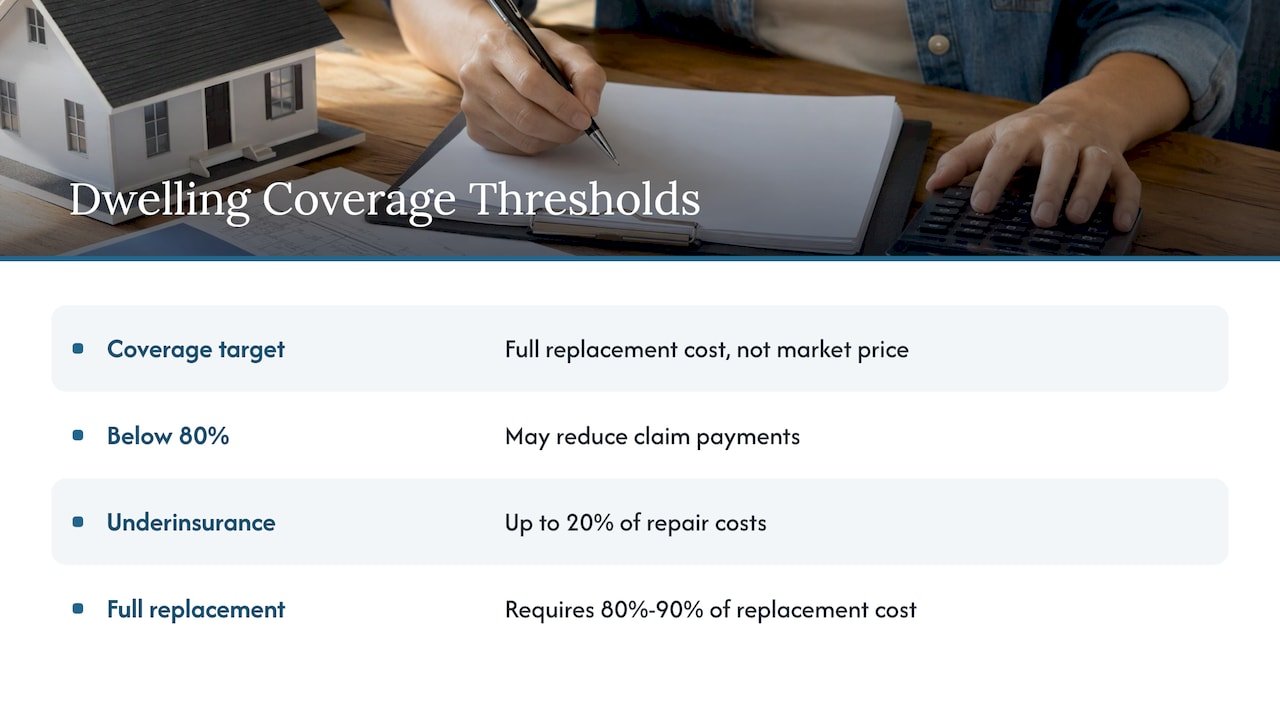
The NAIC guide says dwelling coverage should equal the home’s full replacement cost, which is what it would cost to rebuild today with similar materials, not what you paid. Market price includes land and location value that an insurer never has to replace.
There is a penalty for guessing low. The NAIC notes that below 80% of replacement cost, the insurer may reduce claim payments. The Louisiana Department of Insurance warns that under-insuring below 80% can make you a co-insurer responsible for up to 20% of repair costs. Wisconsin’s homeowners guide adds that full replacement-cost coverage requires insuring the building at 80% to 90% of replacement cost.
The other limits follow from it
Per the NAIC’s Table 2, typical limits are:
| Coverage | Typical limit |
|---|---|
| Other structures | 10% of dwelling limit |
| Personal property | 50% of dwelling limit |
| Loss of use | 20% of dwelling limit |
| Liability and medical payments | Your choice |
Example: a $150,000 dwelling limit gives $75,000 of personal property coverage. Liability is your decision, and it should reflect what you could lose in a lawsuit. If your assets exceed your liability limit, ask about a personal umbrella policy, one of the endorsements the NAIC lists. Our guide to the coverages on your declarations page walks through each letter, Coverage A through F.
Contents: actual cash value or replacement cost
Wisconsin’s guide explains that contents are usually paid at actual cash value, meaning depreciated value, and that replacement cost for contents costs extra. Jewelry, art and other valuables may need a separate scheduled personal property endorsement.
Choosing a deductible
A deductible is what you pay out of pocket on each claim before the policy pays. The NAIC explains that a $1,000 deductible carries a lower premium than the same policy at $500. The Oklahoma Insurance Department cautions that higher deductibles save premium but cost more per claim, and the NAIC adds that a higher deductible makes sense only if you can afford it after a loss. Pick the number you could pay from savings the week after a storm.
Percentage deductibles on the coast
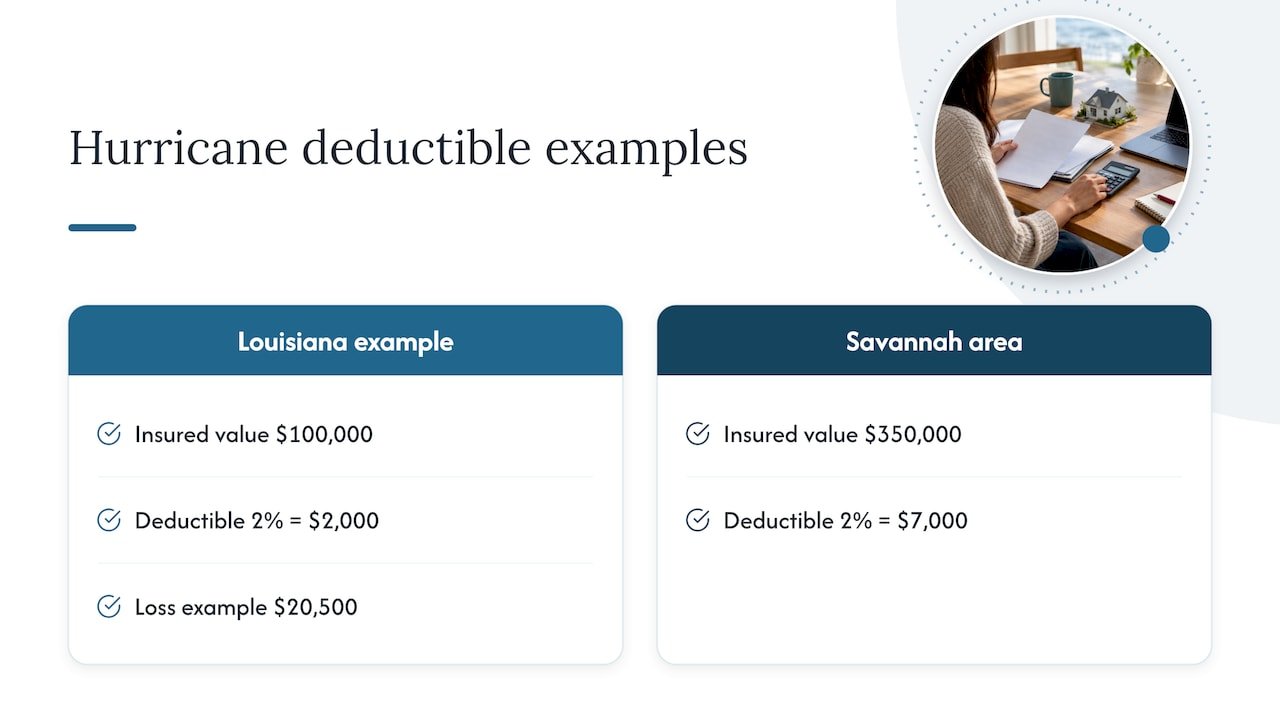
Some policies carry a separate hurricane or named-storm deductible, expressed as a percentage of the home’s insured value rather than a dollar amount. Louisiana’s insurance department gives the math: at 2% on a $100,000 home, you pay $2,000 even on a $20,500 loss. On a $350,000 Savannah-area home, the same 2% is $7,000. Before you choose, read our explainer on the hurricane deductible.
Exclusions and add-ons to review before you sign
The NAIC shopping tool suggests asking what is not covered: sewer or drain backup, mold, wind, flood, sinkholes, earthquakes, food spoilage from power outages, equipment breakdown and deterioration. Ask, too, whether the policy has one deductible or several.
Endorsements the NAIC lists for new owners to consider:
- Guaranteed replacement cost, which pays to rebuild even above the limit if underwriting conditions are met.
- Inflation guard, which raises the dwelling limit each year.
- Ordinance or law, which pays to rebuild to current building codes. See what ordinance or law covers.
- Scheduled personal property for valuables.
- Personal umbrella liability.
For how open-peril and named-peril wording changes what is paid, read our guide to open peril vs. named peril.
Flood: the gap in a standard policy
The CFPB points out that homeowners insurance typically does not cover flood damage, and that flooding causes $8 billion in U.S. damages in an average year. The NAIC adds that flood coverage is written mostly through the National Flood Insurance Program. In a coastal city built around rivers, marsh and tidal creeks, that matters: a house outside a mapped high-risk zone can still flood. Our flood insurance guide covers the programs and requirements, and our flood insurance team in Savannah can quote it with your homeowners policy. If your home’s value exceeds standard flood limits, see excess flood coverage.
What affects your premium, and how to lower it
The CFPB lists the main cost drivers: coverage amount and rebuild cost, the disaster risk of your area, property traits (size, condition, roof type, electrical, year built, mitigation features), your deductible and claims history. Premiums vary widely by company for the same house, so comparing quotes is the biggest lever.
The Oklahoma publication lists discounts worth asking about:
- Impact-resistant roofs
- Dead-bolt locks and approved burglar alarms
- Smoke alarms and sprinkler systems
- Updated heating, electrical and plumbing
- Bundling auto with the same company
- Claims-free years and continued renewals
During your home inspection, note the age of the roof and mechanical systems. They are the details underwriters ask about first.
Our perspective
First-time buyers often treat insurance as a closing-day form. We see it as the first big decision about protecting what you just bought. Our agents work with multiple carriers, so you are not limited to one company’s rates, and we build coverage around your house, not a template.
Our advice is simple: ask for the rebuild cost, not the lender minimum, understand your deductible before you need it, and look at flood while you still have time to choose. When a loss happens, our team supports you through the claims process, because we see ourselves as your advocate, not just a policy reseller.
Nathan
Get covered before closing
We write homeowners, flood, umbrella, auto and personal articles coverage for Savannah-area owners, and we can bundle them so one agent knows your whole picture. Tell us the address and your closing date, and we will start the quotes. See our homeowners insurance or all services.

If you want to understand a policy line by line first, our guide to understanding your homeowners policy is a good place to start.
FAQ
When should I buy homeowners insurance after my offer is accepted?
Start as soon as your offer is accepted so quotes are in hand well before closing. Lenders generally require a policy in force at closing, with the cover page showing coverage amounts and the lender as loss payee.
Does my lender choose my insurance company?
No. Lenders require coverage, but you choose the insurer. Share your quotes with your loan officer to confirm they meet the lender’s requirements.
Is mortgage insurance the same as homeowners insurance?
No. PMI protects the lender if you default on a conventional loan. Homeowners insurance protects your house, belongings and liability. You may need both.
Does homeowners insurance cover flood damage?
Typically not. The CFPB notes that homeowners policies usually exclude flood, so you need separate flood coverage, mostly written through the National Flood Insurance Program. Ask about it before closing, especially near the coast.
Sources
- NAIC: A Consumer’s Guide to Home Insurance
- NY DFS: Homeowners Insurance, Choosing a Policy
- CFPB: Shop for homeowner’s insurance
- Wisconsin OCI: Guide to Insurance Needs When Buying a Home
- Wisconsin OCI: Consumer’s Guide to Homeowners Insurance
- DC Department of Insurance: Consumer’s Guide
- NAIC: A Shopping Tool for Homeowners Insurance
- Louisiana Department of Insurance: Homeowners guide
- Louisiana Department of Insurance: Homeowners 101
- Oklahoma Insurance Department: Home insurance publication