
Commercial auto insurance is a form of vehicle insurance specifically designed to cover automobiles, trucks, vans, trailers, and other motorized vehicles used in connection with a business or commercial activity. It provides liability coverage for bodily injury and property damage caused by commercial vehicles and their operators, as well as physical damage coverage for the vehicles themselves, under a policy structure calibrated to the higher risk profile and greater financial exposure of business vehicle use.
Commercial auto insurance is the appropriate coverage whenever a vehicle is used primarily for business purposes, regardless of who owns the vehicle. A delivery van, a contractor’s pickup truck, a salesperson’s company car, a service technician’s work vehicle, and a fleet of semi-trucks all require commercial auto coverage because personal auto insurance explicitly excludes coverage when vehicles are used for business purposes.
State Minimum Commercial Auto Requirements
Like personal auto insurance, commercial auto insurance is legally required in virtually every U.S. state for any vehicle operated on public roads. Minimum commercial auto liability limits are typically set at the same level as personal auto minimums, though federal regulations impose significantly higher minimums for specific commercial vehicle categories.
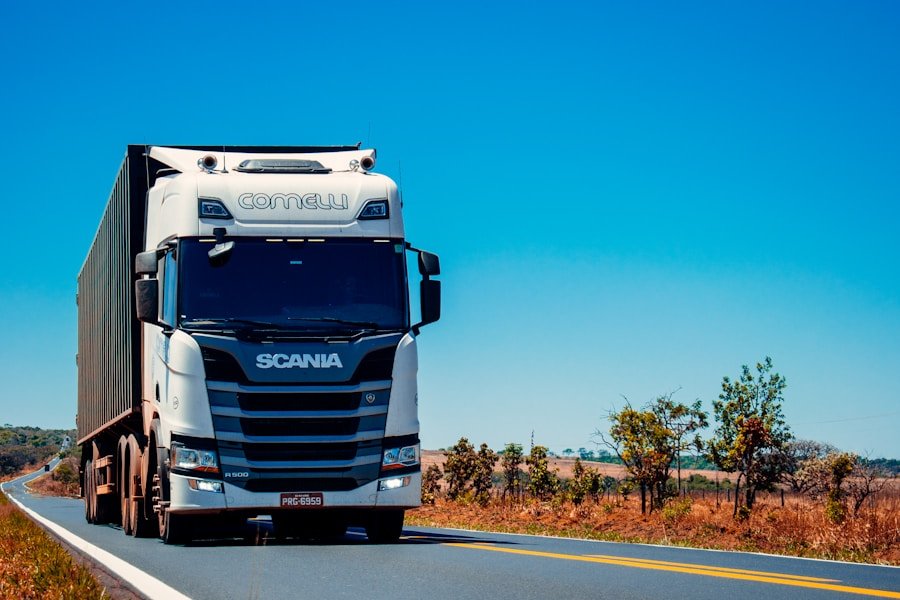
FMCSA minimum liability for commercial trucking — the Federal Motor Carrier Safety Administration (FMCSA) requires commercial motor vehicles in interstate commerce to carry minimum liability limits based on cargo type: $750,000 for general freight; $1,000,000 for oil transport; $5,000,000 for hazardous materials. These are minimum requirements — not adequate coverage limits for most operations.
State commercial vehicle minimums — states set their own minimum liability limits for intrastate commercial vehicles; these vary by vehicle weight, passenger capacity, and vehicle type; confirm applicable minimums with your state’s motor vehicle authority.
Commercial Auto vs. Personal Auto Insurance
Commercial auto insurance and personal auto insurance cover the same types of vehicles but are entirely different products with different coverage structures, different underwriting approaches, different liability limits, and fundamentally different assumptions about how the vehicle is used and by whom. Using a personal auto policy for a business vehicle is not a cost-saving strategy — it is a coverage gap that will be discovered at the worst possible moment.
The Policy Form Difference
Personal auto policies use the Insurance Services Office (ISO) Personal Auto Policy (PAP) form. Commercial auto policies use the ISO Business Auto Policy (BAP) form or carriers’ proprietary commercial auto forms. These are fundamentally different policy forms with different coverage structures, different definitions, and different exclusions.

The most important structural difference is the treatment of “who is an insured.” The personal auto policy defines insureds based on household membership. The commercial auto policy defines insureds based on authorization to operate a covered vehicle in connection with the business. This distinction is critical when an employee is driving and an accident occurs: the commercial auto policy responds; the personal auto policy does not.
Why Business Use Creates Elevated Risk
Higher mileage and more frequent driving — commercial vehicles are typically driven far more miles per year than personal vehicles; more miles means proportionally more exposure to accidents, regardless of driver quality.
Multiple and variable drivers — personal auto policies are rated for specific, known drivers in the household; commercial vehicles may be driven by many employees with varied experience, training, and records that are difficult to underwrite through a personal policy.
Higher-stakes claims environment — commercial vehicle accidents are more likely to be litigated aggressively because the defendant is a business (often perceived as having deep pockets); plaintiff attorneys pursue commercial vehicle claims more vigorously than personal accident claims.
Cargo and delivery liability — vehicles used for delivery, transport, or service create additional liability exposures — damage to cargo, harm caused by unloading operations — that personal policies are not designed to cover.

Higher vehicle values and types — commercial fleets often include larger, more expensive vehicles (vans, trucks, specialty vehicles) that personal policies were not designed to insure for the relevant values and risk profiles.
Business entity as the liability defendant — when a commercial vehicle accident generates a lawsuit, the business entity (not just the driver) is typically named as a defendant; personal policies insure individuals, not business entities.
The Specific Exclusion Language
Standard personal auto policy forms use exclusion language that specifically removes coverage for any vehicle used in a business or occupation other than farming or a private passenger vehicle used by the named insured or a family member. The exclusion covers both liability and physical damage coverage. Do not rely on a delivery endorsement as a substitute for commercial auto insurance for any regular business use.
Who Needs Commercial Auto Insurance
Any business that owns, leases, borrows, or whose employees regularly use vehicles for business purposes needs commercial auto insurance. The need extends to any business activity involving vehicle use, including single-owner businesses with one vehicle and businesses that do not own vehicles but whose employees drive their personal cars for work.
Who Clearly Needs Commercial Auto Insurance
Trucking and transportation companies — any business operating commercial motor vehicles (CMVs) in interstate or intrastate commerce must have commercial auto insurance meeting applicable FMCSA and state minimum requirements.
Delivery and courier businesses — same-day delivery, last-mile logistics, package delivery, food delivery fleets, and any other delivery operation requires commercial auto coverage for every vehicle in the delivery operation.
Construction and contractor companies — contractors whose employees drive pickup trucks, vans, or specialty vehicles to job sites, carry tools and equipment, or transport workers need commercial auto coverage for all such vehicles.
Service businesses with mobile employees — plumbers, electricians, HVAC technicians, landscapers, pest control operators, and any other service business whose employees drive to customer locations require commercial auto coverage.
Retail businesses with delivery vehicles — any retailer that makes deliveries needs commercial auto for the delivery vehicles, even if they also have retail locations.
Companies with sales representatives — businesses that provide company vehicles or reimbursements to sales representatives who drive for work need commercial auto coverage for those vehicles and activities.
Nonprofit organizations with program vehicles — nonprofits that own or operate vehicles for programs, events, or staff use need commercial auto coverage regardless of their nonprofit status.
Any business with a company-owned vehicle — if the vehicle is titled in the business name or used primarily for business, a commercial auto policy is required regardless of vehicle type or use frequency.
The Sole Proprietor Driving Their Personal Vehicle for Business
A sole proprietor who uses their personal vehicle exclusively for their business faces a dilemma: the vehicle is titled personally, but its primary use is commercial. The personal auto policy will not cover accidents occurring during business use; but a commercial auto policy can be written for a personal vehicle used commercially. The appropriate structure depends on the extent of business use and should be discussed with a licensed commercial lines agent.
Understanding BAP Coverage Symbols
The Business Auto Policy (BAP) uses a system of numeric symbols to define which vehicles are covered under each coverage section of the policy. Understanding these symbols is essential to ensuring the BAP provides the intended coverage.
Symbol 1 (Any Auto) — the broadest coverage; applies to all autos — owned, non-owned, hired, and borrowed. Typically used for liability coverage in most commercial programs.
Symbol 2 (Owned Autos Only) — covers only autos the business owns; does not cover hired or non-owned autos; used when the business has no employee personal vehicle exposure.
Symbol 7 (Specifically Described Autos) — covers only vehicles listed on the schedule; used for physical damage (collision and comprehensive) because you can only insure for physical damage vehicles you specifically own and schedule.
Symbol 8 (Hired Autos Only) — covers only vehicles hired (rented or borrowed) for the business; does not cover owned or non-owned autos; typically combined with Symbol 9.
Symbol 9 (Non-Owned Autos Only) — covers autos used in the business but not owned, hired, or borrowed by the business — typically employees’ personal vehicles used for work.
Named Insureds and Additional Insureds
The distinction between named insureds and additional insureds in a commercial auto policy is one of the most practically important concepts for businesses that regularly provide certificates of insurance to customers, contractors, or lenders.
The Named Insured Hierarchy in a Business Auto Policy
First Named Insured — the first entity listed on the declarations page; has the most complete policy rights including the right to cancel the policy, receive all notices, and receive unearned premium returns.
Other Named Insureds — additional business entities, subsidiaries, or affiliated companies also listed on the declarations; have coverage rights but fewer administrative rights than the first named insured.
Employees as Insureds — under most BAP forms, employees are automatically insureds while operating a covered vehicle in the course of their business duties; employees do not need to be individually listed.
When Additional Insured Status Is Required
Vehicle leasing companies — vehicle lessors routinely require the lessee to add them as an additional insured on the commercial auto policy covering the leased vehicle.
General contractors — GCs often require subcontractors to add the GC as an additional insured on the subcontractor’s commercial auto policy for work-related vehicle accidents.
Government contracts — municipal, county, state, and federal contracts often require adding the government entity as an additional insured on commercial auto policies.
Customers and clients — service businesses may be required by major commercial customers to add the customer as an additional insured as a condition of the service contract.
Occurrence vs. Claims-Made Commercial Auto
The vast majority of commercial auto insurance policies are written on an occurrence basis. Commercial auto insurance is almost universally written on an occurrence basis because auto accidents are events with relatively clear and immediate injury manifestation.
The occurrence basis means that if a commercial vehicle accident happens during the policy period — even if the claim is not filed until months later or even after the policy has been cancelled — the policy in force on the date of the accident responds.
When a claims-made commercial auto policy is cancelled or not renewed, a tail endorsement (extended reporting period) must be purchased to preserve coverage for claims arising from accidents that occurred during the policy period but are reported after cancellation.
Excess Commercial Auto Coverage
Commercial auto liability claims can reach verdicts of millions of dollars — particularly in cases involving serious injuries from large commercial truck accidents. A single catastrophic accident can produce a judgment that dwarfs even a well-structured primary commercial auto policy’s limit.
The Trucking Liability Catastrophe Problem
The commercial trucking industry provides the clearest illustration of why excess commercial auto coverage is essential. “Nuclear verdicts” — awards of $10 million or more — are increasingly common in commercial truck accident litigation, driven by plaintiff attorney strategies targeting trucking companies’ safety practices, driver hiring, training, and vehicle maintenance.
FMCSA minimum requirements of $750,000 in liability for general freight carriers are dramatically insufficient for serious accidents. Most large trucking companies carry $1 million to $5 million in primary commercial auto liability, supplemented by excess commercial auto layers bringing total limits to $10 million, $25 million, or more.
Hired and Non-Owned Auto (HNOA) Coverage
Not every business that needs commercial auto coverage owns the vehicles its employees drive for work. Many businesses have employees who drive their personal vehicles for work errands, customer visits, or deliveries. Hired and non-owned auto (HNOA) coverage fills the gap when employees drive personal or rented vehicles for business purposes.
The Employer’s Liability in Employee Personal Vehicle Accidents
When an employee causes an accident while driving their personal vehicle for a business errand, both the employee and the employer may be liable under the legal doctrine of respondeat superior — the employer is vicariously liable for the actions of employees acting within the scope of their employment.
The employee’s personal auto policy is the primary coverage for their personal vehicle, but if the limits are insufficient for the claim or if the personal policy has a business use exclusion, the business’s non-owned auto coverage becomes critical. Non-owned auto coverage is not optional for any business whose employees drive their personal vehicles for work.
How Commercial Auto Fits the Complete Program
Commercial auto insurance is one of the foundational components of a comprehensive business insurance program. It operates in parallel with — and coordinates with — commercial general liability, workers’ compensation, excess liability, and other commercial coverages.
Key Coordination Points Between Commercial Auto and Other Policies
Commercial auto and CGL — standard CGL policies exclude auto liability; commercial auto fills this gap. The two policies must be structured so that every vehicle operation is covered by commercial auto and no auto claim falls through to the CGL unexpectedly.
Commercial auto and workers’ compensation — when an employee is injured in a vehicle accident at work, workers’ comp covers the employee’s medical bills and lost wages; commercial auto liability covers third parties injured in the same accident; both policies may be active simultaneously on the same incident.
Commercial auto and commercial umbrella — confirm that the umbrella specifically lists commercial auto as an underlying policy; the umbrella attachment point must exactly match the commercial auto primary limit.
HNOA and employee personal policies — HNOA provides excess coverage over the employee’s personal auto policy for business use claims; ensure employees understand that their personal auto policy is the primary coverage when they use their personal vehicle for work.
Annual Commercial Auto Program Review Checklist
Update vehicle schedule — add newly acquired vehicles promptly; remove sold or disposed vehicles; confirm all leased or titled vehicles are properly scheduled or blanket covered.
Review driver authorization list — confirm all employees who drive for business purposes are listed or authorized; review MVR records annually; implement a formal driver qualification program.
Confirm FMCSA filing status — if any vehicles are subject to FMCSA jurisdiction, confirm that Form MCS-90 is properly filed and current.
Review HNOA exposure — assess whether employees are driving personal vehicles for business purposes and confirm that HNOA coverage is adequate for the scope of that exposure.
Evaluate excess / umbrella adequacy — as fleet size grows and vehicle values and litigation environments change, review total liability capacity to ensure excess limits remain adequate for worst-case claim scenarios.
Disclaimer: The information contained in this article is intended for general informational and educational purposes only and should not be construed as legal, financial, or insurance advice. Commercial auto insurance requirements, federal and state vehicle regulations, coverage terms, exclusions, and underwriting guidelines vary significantly by vehicle type, business type, carrier, and jurisdiction and are subject to change. FMCSA regulations and minimum liability requirements described in this article are based on information available as of the article’s preparation and may have changed. It is the sole responsibility of the reader to verify current FMCSA and state motor vehicle insurance requirements applicable to their specific operations. Daly Insurance, Inc. and Daly & Alexander Insurance make no representations or warranties of any kind regarding the completeness, accuracy, or reliability of any content published online or offline, and expressly disclaim all liability for any errors, omissions, or inaccuracies. Coverage availability, terms, and pricing are subject to underwriting approval and vary by carrier, state, and individual circumstance.
Daly Insurance, Inc. | Daly & Alexander Insurance | www.dalyandalexander.com | Licensed Insurance Professionals