
Accident forgiveness is a policy feature that stops your insurer from raising your rate after a qualifying first at-fault accident. It’s usually worth having when it’s free through tenure or cheap to add, and it tends to matter most for high-mileage drivers or anyone likely to face a steep surcharge. Rules and availability vary by state and by carrier, so it’s worth confirming exactly how yours works before you count on it.
TL;DR:
- Accident forgiveness generally covers only the insurer’s surcharge, not the accident record itself, which remains visible to other insurers and agencies.
- Earned forgiveness requires three to five years of claim-free driving with the same carrier before it activates and usually resets after a claim is forgiven.
- The benefit typically applies only once per driver or policy within a three- to five-year period, with major violations like DUI voiding the protection.
- Paid forgiveness endorsements cost between $60 and $150 annually, often making sense for high-mileage or multi-driver households facing steep surcharges.
- Confirm state availability, whether coverage is per driver or policy, and understand small-accident caps before relying on accident forgiveness to offset potential surcharges.
Table of Contents
- What accident forgiveness actually covers: earned versus purchased
- How it works day to day, and where it stops applying
- Who qualifies, and why you should check your state before assuming
- What it costs, and how that stacks up against a real accident surcharge
- A short checklist before you buy or rely on accident forgiveness
- How Daly & Alexander reviews accident forgiveness for Savannah drivers
- What actually matters when you weigh this coverage
- How Daly & Alexander can help you compare your options
- Sources
- FAQ
What accident forgiveness actually covers: earned versus purchased
Insurers offer forgiveness two ways. Some grant it as a loyalty perk once you’ve stayed claim-free for a set number of years. Others let you buy it as an endorsement added to your policy for a flat fee. Both do the same basic job: they block the surcharge that would normally follow a qualifying at-fault accident.
Programs differ on the details. Some apply per driver on your policy, others apply per policy no matter who was behind the wheel. Many carriers also split forgiveness into two tiers: a small-accident version with a dollar cap on claim size, and a larger version with no cap.
Here’s the part people miss: forgiveness prevents the insurer’s surcharge, not the accident itself. The crash still shows up on your driving record and with the DMV, and other insurers who pull that record later will see it. According to the National Association of Insurance Commissioners, consumers should confirm eligibility, tenure requirements, and state availability before assuming the benefit applies. Some states restrict or prohibit the feature entirely, so what your neighbor in another state has may not be available to you.
How it works day to day, and where it stops applying
Forgiveness only helps if it was already active before the crash happened. You cannot call your insurer after a fender bender and ask them to retroactively apply it. According to LendingTree’s reporting on the coverage, most earned programs require 3 to 5 years of continuous, claim-free driving with the same carrier before you qualify, and the benefit usually resets once you use it.
A few operational details worth checking:
- Use limits: many programs allow only one forgiven accident within a 3 to 5 year window, and small-accident tiers cap the payout amount.
- Exclusions: DUI, reckless driving, and other major violations typically void the benefit, no matter how long you’ve been claim-free.
- Carrier switches: earned forgiveness usually doesn’t transfer if you change insurers, so shopping around can mean starting the clock over.
- Renewal impact: the accident may still affect other discounts, like a safe-driver credit, even when the surcharge itself is waived.
None of this makes the feature useless. It just means the fine print decides whether it actually helps when you need it.
Who qualifies, and why you should check your state before assuming
Carriers tend to reserve forgiveness for drivers who’ve built up a track record: long tenure with the same company and a clean violation history. Some insurers extend a version of it to parents insuring a teen driver, treating the first fender bender as a learning curve rather than a rate hike.
Availability isn’t uniform across the country. State insurance departments regulate how these endorsements can be structured, and some states limit or prohibit certain versions of the benefit outright. WalletHub’s 2026 review of carrier programs notes that structure and pricing vary widely from insurer to insurer, and that a handful of states carve out exceptions.
Before you assume you have it, or assume you can buy it:
- Ask your agent directly whether your state permits the version your carrier offers.
- Check your state insurance department’s consumer pages for any restrictions.
- Confirm in writing whether forgiveness is per driver or per policy, since that changes who on your policy is protected.
What it costs, and how that stacks up against a real accident surcharge
Pricing varies, but paid accident forgiveness endorsements commonly run somewhere in the range of about $60 to $150 per year, depending on the carrier and state, according to consumer finance reporting. That same reporting found that a first at-fault accident typically raises premiums by tens of a percent and that the increase often sticks around for 3 to 5 years before it drops off.
A first at-fault accident can raise your premium noticeably and keep it elevated for years, per consumer finance reporting, which is exactly the cost forgiveness is designed to offset.
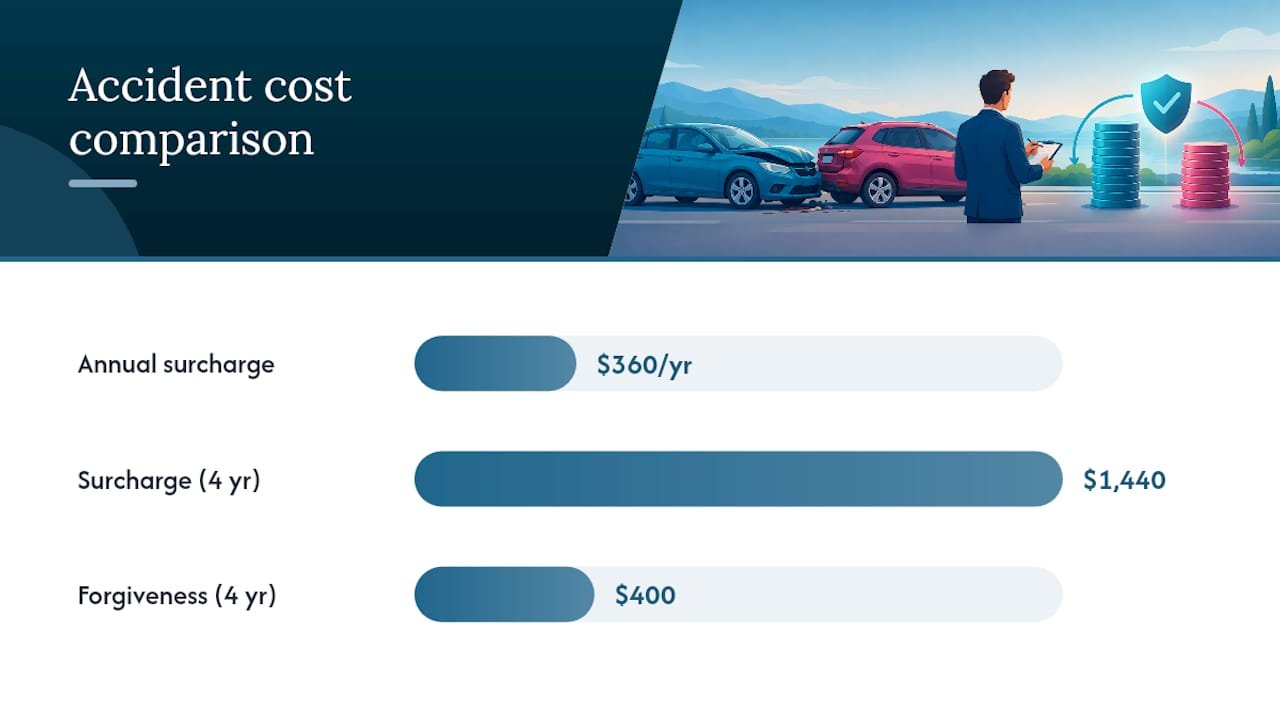
Here’s a simple way to run the math. That’s roughly $360 a year in extra premium, or about $1,440 over the surcharge period. If your accident forgiveness endorsement costs $100 a year, you’d spend $400 over that same 4-year stretch. Even one qualifying accident during that window would make the endorsement a clear financial win. If you never file a claim, you’ve spent $400 for peace of mind, which is a different calculation for every household.
Earned forgiveness, when your carrier gives it to you free after several years of clean driving, is close to a no-downside benefit. The math above only matters when you’re deciding whether to pay for it.
A short checklist before you buy or rely on accident forgiveness
Run through this before you assume the coverage will help you when it matters:
- Confirm whether it’s per driver or per policy on your household’s coverage.
- Ask about small-accident dollar caps versus the full, uncapped version.
- Verify your tenure and clean-record requirements to qualify.
- Get the exact price difference between quotes with and without the endorsement.
- Ask what resets the clock, such as a claim, a lapse in coverage, or switching carriers.
- Get the exclusion list in writing, especially around violations.
Get two actual quotes, one with the endorsement and one without, and compare the full policy cost side by side rather than eyeballing the monthly difference. NerdWallet’s guidance also notes that insurers can revoke forgiveness eligibility after a major violation, so ask what would cause you to lose it.
Pro Tip: Multiply your current annual premium by your carrier’s typical percentage increase after an at-fault claim, then multiply that by the number of years the surcharge lasts. Compare that total to what the endorsement would cost you over the same years, using your own numbers, not a generic estimate.
How Daly & Alexander reviews accident forgiveness for Savannah drivers
When a client asks about accident forgiveness, our agents start by checking whether Georgia permits the specific version the carrier is offering, since availability and structure aren’t the same everywhere. From there, we read the actual endorsement wording rather than the marketing summary, because caps, exclusions, and per-driver versus per-policy rules live in that fine print.
We then model what a realistic surcharge would look like against the endorsement’s price, using the client’s actual premium and driving habits, so the comparison is grounded in their situation rather than a generic average. Our agents also walk clients through alternatives when forgiveness isn’t a fit, and our claims support stays involved if an accident does happen.
What actually matters when you weigh this coverage
Accident forgiveness earns its keep for high-mileage drivers, multi-driver households, and anyone insuring a new teen driver, since those groups face the highest odds of a claim triggering a real surcharge. It matters far less for a low-mileage driver with a long clean record who’s unlikely to need it in the first place.
The move that actually helps: call your agent, get quotes with and without the endorsement, and ask for the exclusion list in writing. Forgiveness changes your premium outcome, not your driving record.
— Nathan
How Daly & Alexander can help you compare your options
Working with a local agent means someone actually reads the endorsement wording with you instead of leaving you to guess at what’s covered. Daly & Alexander compares accident forgiveness terms across the carriers we work with, checks how Georgia’s rules apply to your policy, and runs the multi-year cost comparison using your real premium, not a generic estimate.
| What we check | Why it matters |
|---|---|
| State availability | Confirms Georgia permits the specific version your carrier offers |
| Per-driver vs. per-policy | Determines who on your policy the benefit protects |
| Small-accident caps | Shows whether a fender bender would actually qualify |
| Multi-year cost comparison | Compares endorsement price against your likely surcharge |
If a repair estimate is part of your decision, our B&M Auto Care financing partner page is a useful reference for understanding how repair costs interact with small-accident thresholds. To see where accident forgiveness fits into your broader policy, visit our Auto Insurance in Savannah, GA page or request a quote directly and we’ll walk through your options with you.
Sources
- The Time to Get Smart about Accident Forgiveness is Before Hitting the Road for the Holidays — NAIC
- Is Accident Forgiveness Ever Worth It? — LendingTree
- Best accident forgiveness companies of 2026 — WalletHub
This article is general information, not a substitute for advice from a qualified financial advisor. Consult a qualified financial professional about your own circumstances before acting on anything here.
FAQ
Which insurance company gives accident forgiveness?
Availability and structure vary by carrier and by state, and WalletHub’s 2026 review notes that program features differ widely across insurers. Rather than assume a specific company offers it in your state, ask your agent to confirm current eligibility and terms for your policy.
Is it worth paying for accident forgiveness?
It’s often worth it when the endorsement is cheap relative to the surcharge you’d otherwise face, especially for high-mileage or higher-risk drivers. If your carrier offers it free after a clean-driving tenure, according to NAIC guidance, there’s little reason to turn it down.
How much does accident forgiveness cost?
Paid endorsements commonly cost around $60 to $150 per year, depending on the carrier and state, according to consumer finance reporting. Earned versions, granted after a claim-free tenure, typically come at no extra cost.
How many times can you use accident forgiveness?
Most programs limit you to one forgiven accident within a set window, often every 3 to 5 years, per LendingTree’s reporting on program terms. Some carriers also cap the benefit for small claims separately from larger, uncapped accidents.