
A business owner’s policy (BOP) bundles general liability with commercial property and business-interruption coverage in one package. General liability alone protects you against third-party claims like injury or property damage, but nothing else. If you have inventory, equipment, or a physical storefront, or if a short closure would hurt your income, you likely need a BOP. If you’re a low-asset service business, general liability may be enough. Either way, a quick conversation with your agent settles it fast.
TL;DR:
- A business owner’s policy often costs less than separate general liability and property coverage combined, mainly because it bundles these lines at reduced rates.
- Eligibility for a BOP depends on industry, revenue, assets, and claims history; high-hazard or high-revenue businesses typically require a commercial package policy instead.
- Standard BOP coverage includes general liability, commercial property, and business interruption, but excludes professional liability, auto accidents, and employee injuries.
- Owners should assess their physical assets, downtime risk, and customer contact to determine if a BOP is necessary, avoiding overlapping coverage by reviewing existing policies before renewal.
- The most common mistake is stacking a standalone general liability policy and a BOP later, leading to overlapping limits, so owners should document exposures and seek tailored advice.
Table of Contents
- BOP vs General Liability: What’s Actually Covered
- What Is a Business Owner’s Policy (BOP)?
- What Is General Liability Insurance (GL/CGL)?
- Coverage, Cost, and Eligibility: What Really Changes Your Decision
- Do You Need a BOP or Is General Liability Enough?
- What Won’t a BOP or GL Cover?
- Why Does a BOP Sometimes Cost Less Than Buying Separately?
- How an Agent Actually Evaluates Your BOP Need
- The Biggest Mistake Small Owners Make
- Get Your BOP or Liability Quote Reviewed
- Sources
- FAQ
BOP vs General Liability: What’s Actually Covered
Here’s the coverage gap in plain terms, side by side.
What a typical BOP includes:
- General liability (bodily injury, property damage, advertising injury claims from others)
- Commercial property (your building, equipment, inventory, signage)
- Business interruption (lost income and ongoing expenses if you’re forced to close)
What standalone general liability covers:
- Third-party bodily injury and property damage claims
- Advertising injury and some product liability exposure
- Nothing tied to your own building, equipment, or income
What neither one covers, typically:
- Professional errors or omissions (you need a separate professional liability policy)
- Commercial auto accidents
- Employee injuries (that’s workers’ compensation)
One more wrinkle worth knowing upfront: BOPs aren’t available to every business. Larger operations, higher-hazard trades, and companies above a certain revenue threshold often get pushed toward a commercial package policy instead, since insurers use BOP eligibility rules to keep the product aimed at smaller, lower-risk accounts.
What Is a Business Owner’s Policy (BOP)?
A BOP is a packaged commercial policy built from three core parts: general liability, commercial property, and business interruption (sometimes called business income coverage). Investopedia notes that BOPs are designed for small to mid-size businesses and typically exclude professional liability and workers’ compensation, which have to be purchased separately.
Most owners don’t stop at the base package. Common endorsements added to a BOP include:
- Equipment breakdown coverage, which handles mechanical or electrical failures that the base property coverage usually excludes
- Spoilage coverage, valuable for restaurants and anyone holding refrigerated inventory
- Crime coverage, protecting against employee theft or forgery
Eligibility depends on your industry class code, revenue, employee count, and prior claims. A construction firm running heavy machinery or a company generating several million dollars in revenue may not qualify for a standard BOP at all, pushing them toward a commercial package policy instead.
What Is General Liability Insurance (GL/CGL)?
General liability insurance, sometimes called commercial general liability (CGL), covers claims that third parties bring against your business. That includes:
- Bodily injury, like a customer slipping and falling at your job site
- Property damage, such as your crew accidentally damaging a client’s fence
- Advertising injury, covering claims of copyright infringement or defamation in your marketing
- Product liability, if something you sold caused harm
GL alone works well for consultants, freelance service providers, and mobile businesses with little or no fixed property. A landscaper who parks a truck and mows lawns, for example, has real liability exposure but minimal building or inventory risk. GL protects you when someone else gets hurt or their property gets damaged because of your work. It does nothing if your own equipment is stolen or a fire shuts down your shop for two months.
Coverage, Cost, and Eligibility: What Really Changes Your Decision
Property and business interruption coverage matter most for anyone with a physical footprint. Retailers, restaurants, and salons keep inventory and equipment on-site, and a burst pipe or kitchen fire can shut the doors for weeks. Forbes Advisor’s breakdown of commercial property coverage explains how that coverage works alongside business interruption to keep income flowing during repairs.
Pricing tradeoffs matter too. MoneyGeek’s comparison shows a BOP often costs less than buying general liability and commercial property as two separate policies. The common mistake: owners buy a standalone GL policy, then add a BOP later without realizing the BOP already contains general liability, paying twice for overlapping coverage.
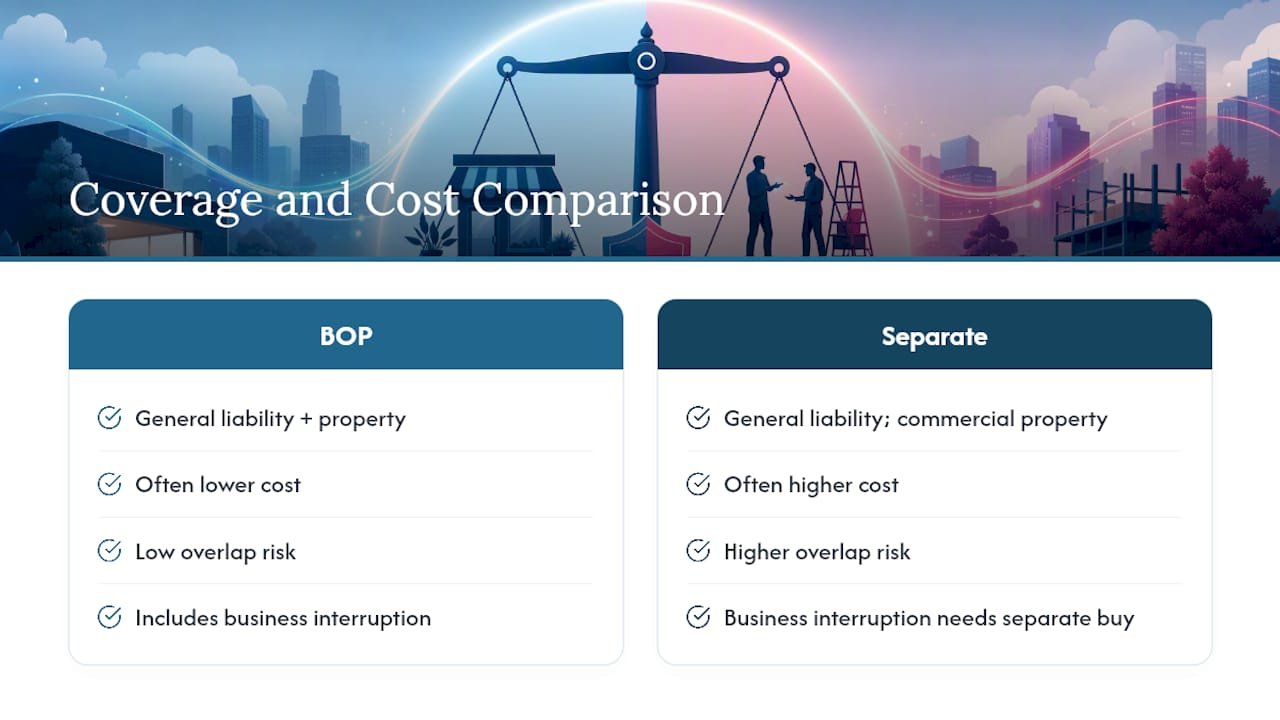
Underwriting can also exclude you from a BOP. High-hazard classes, businesses above certain revenue caps, and companies with a rough claims history often get routed toward a commercial package policy with liability written separately.
Pro Tip: Before your next renewal, pull your loss runs and check whether you’re paying for two liability policies that overlap. It’s a five-minute review that can save real money.
Do You Need a BOP or Is General Liability Enough?
Run through this before your next quote meeting:
- Check your physical assets. Do you own or lease a space, equipment, or inventory worth protecting? If yes, lean toward a BOP.
- Estimate your downtime cost. If a fire, storm, or burst pipe closed you for a month, would you lose meaningful revenue? That’s a business-interruption question, and it points to a BOP.
- Weigh customer contact. Businesses where clients visit your premises carry more slip-and-fall exposure, another point in favor of bundled coverage.
Bring five questions to your agent: What’s my property replacement cost? What’s my average monthly revenue? Does my class code even qualify for a BOP? What endorsements fit my specific risk? And would adding an endorsement like those offered through BidBlock to an existing policy be cheaper than buying a second one? Often, the answer isn’t a new policy at all. It’s an endorsement on the one you have.
What Won’t a BOP or GL Cover?
Neither policy is a catch-all. A standard BOP typically excludes professional liability (errors in advice or services), commercial auto accidents, and workers’ compensation for injured employees. Many BOPs also leave out cyber liability and pollution exposure, which is exactly why those show up as add-on options rather than base coverage.
Worth adding, depending on your trade:
- Equipment breakdown coverage for mechanical or electrical failures the base property section skips
- Cyber liability if you store customer payment or personal data
- Liquor liability if you serve alcohol
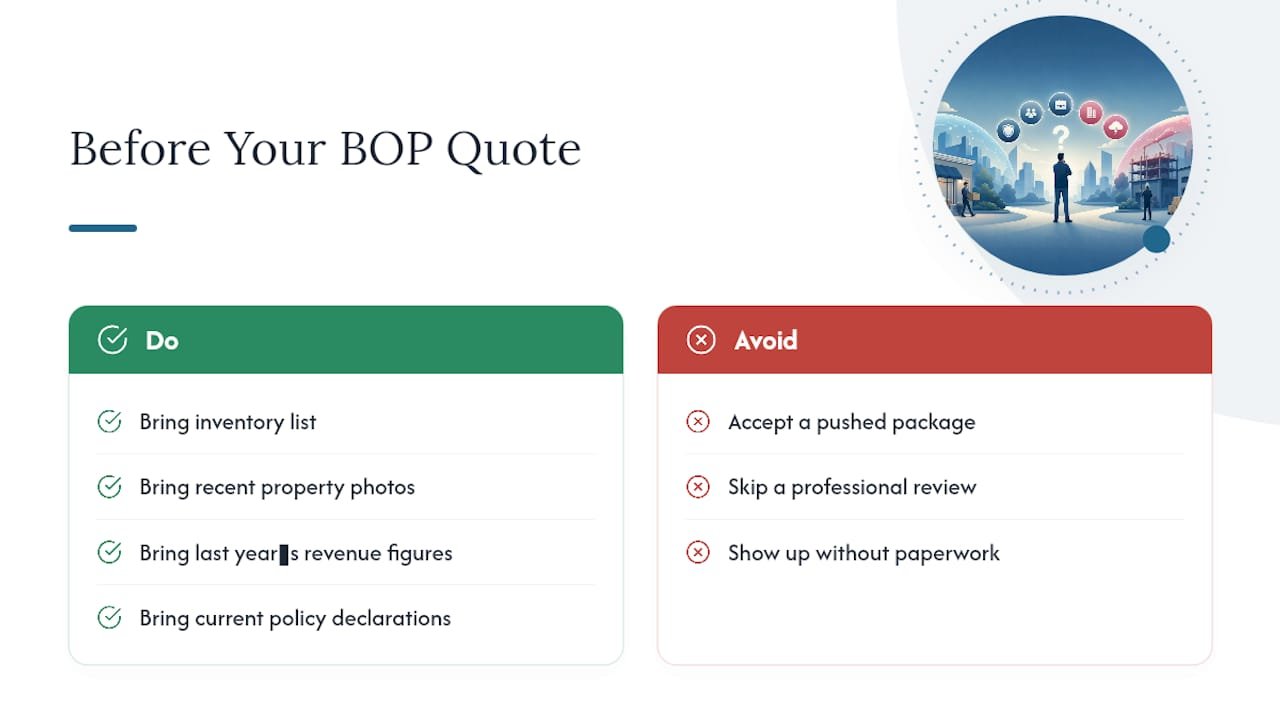
Document your exposures before your quote meeting, not after. A photo inventory, recent revenue figures, and your current declarations page let your agent quote accurately instead of guessing.
Why Does a BOP Sometimes Cost Less Than Buying Separately?
Premiums for both BOPs and standalone GL policies are shaped by the same handful of variables: class code, payroll or revenue, coverage limits, location, claims history, and property value for BOPs. Because a BOP bundles multiple coverage lines, carriers often price it below the combined cost of buying general liability and commercial property as two separate policies, which is the core reason MoneyGeek’s comparison treats bundling as the default recommendation for eligible businesses.
Ways to trim the premium without cutting corners:
- Bundle every eligible coverage line into one BOP instead of buying separately
- Raise your deductible if your cash reserves can absorb a modest loss
- Install basic risk controls like fire suppression or security systems, which several carriers reward with lower rates
How an Agent Actually Evaluates Your BOP Need
Experienced local agents walk every BOP conversation through the same lens: what would you lose if the doors closed tomorrow? A retail shop with inventory gets a different recommendation than a solo consultant working from a laptop. Bring your revenue numbers, a property photo inventory, and your current declarations page, and the conversation moves fast.
The Biggest Mistake Small Owners Make
Most confusion comes from stacking coverage instead of scoping it. Owners buy standalone general liability, then add a BOP later, paying for overlapping limits nobody needed. Document your actual exposures first: property value, revenue at risk, foot traffic. Then let an agent model a real loss scenario instead of buying based on a neighbor’s anecdote. Match your limits to what rebuilding and surviving downtime would genuinely cost, not a round number that sounded safe.
— Nathan
Get Your BOP or Liability Quote Reviewed
Get professional help to compare your current general liability and property coverage against a bundled BOP and find out which one fits, without pushing a package you don’t need. If you’re weighing a business owner’s policy against standalone commercial liability, bring your inventory list, recent property photos, last year’s revenue figures, and your current policy declarations to your quote meeting. That paperwork is what turns a rough estimate into an accurate one. Ready to see where you stand? Get a BOP quote from Daly & Alexander and find out in one conversation whether you’re over-insured, under-insured, or right where you should be.
Sources
Coverage definitions and pricing context draw on Investopedia, MoneyGeek, and Forbes Advisor, alongside Daly & Alexander’s business insurance guide.
- General liability vs. BOP: How to decide — MoneyGeek
- Business Owner’s Policy (BOP): Definition, Coverage, and Exclusions — Investopedia
FAQ
What Won’t a BOP’s Liability Coverage Cover?
A BOP’s liability section skips professional errors and omissions, employee injuries (that’s workers’ compensation), and commercial auto accidents. Many BOPs also exclude cyber liability and pollution unless you add a specific endorsement, per Investopedia’s breakdown of common BOP exclusions.
Which Businesses Can’t Get a BOP?
High-hazard trades, businesses above a carrier’s revenue or employee threshold, and companies with a rough claims history often get excluded from standard BOP eligibility. These businesses typically move to a commercial package policy where liability, property, and other lines are underwritten separately.
What Does BOP General Liability Typically Cover?
BOP liability coverage handles third-party bodily injury, property damage, advertising injury, and product liability claims, the same core protections found in a standalone general liability policy. The difference is that a BOP wraps that liability coverage together with commercial property and business interruption in one package, as Investopedia explains.
What Is the Difference Between a BOP and a Commercial Package Policy?
A BOP is a pre-packaged bundle of general liability, property, and business interruption coverage sold to eligible small and mid-size businesses at one combined price. A commercial package policy lets larger or higher-risk businesses that don’t qualify for a BOP build similar coverage lines separately, each underwritten and priced on its own.
Should I Buy Both a BOP and Standalone General Liability?
Usually not. A BOP already contains general liability coverage, so buying a separate GL policy on top of it typically means paying twice for overlapping protection, according to MoneyGeek’s analysis. The better move is asking your agent whether an endorsement on your existing policy covers the gap instead.