
Bundling home and auto insurance usually saves money, but “usually” isn’t “always.” Most U.S. The catch is: coastal homes, wildfire zones, and high-risk drivers can flip that math. Before you assume bundling wins, run a combined-quote comparison this year and check the total, not the headline percentage.
TL;DR:
- Bundling is most beneficial in states with high baseline premiums, like Florida or Louisiana, where even small discounts translate into large dollar savings.
- High-risk drivers or homes with unique coverage needs often find standalone policies cheaper than bundles, especially if specialized underwriting or endorsements are required.
- Comparing total annual premiums from bundled and separate quotes, with matching coverage limits, offers a more reliable savings estimate than relying solely on discount percentages.
- A single-loss deductible feature can save hundreds of dollars in a major claim and varies between policies, so confirm its availability before choosing a bundle.
- Re-shopping annually and after major life changes ensures that bundled policies remain the most cost-effective option for your household.
Table of Contents
- What Bundling Home and Auto Insurance Actually Means
- How Much Do You Actually Save by Bundling?
- When Bundling Home and Auto Insurance Costs You More
- How to Compare Bundled vs. Separate Quotes
- Bundle Features Worth Asking Your Agent About
- How Often Should You Re-Shop Your Bundle?
- Why Local Agency Guidance Matters for Specialty Cases
- The Honest Verdict on Bundling
- Get a Bundled Quote Reviewed by a Local Agent
- Where This Data Comes From
- Sources
- FAQ
What Bundling Home and Auto Insurance Actually Means
Bundling, sometimes called a multi-policy discount, means buying two or more policies from the same carrier instead of shopping each one separately. The most common pairing is home and auto, though condo and renters policies qualify too, and some carriers may also offer discounts on boats, motorcycles, or umbrella coverage.
Carriers usually apply the bigger percentage discount to your auto premium and a smaller one to your home premium, though a handful of insurers flip that structure. You won’t know which unless you ask directly, since it varies by carrier and state.
The administrative upside is real even before you talk savings: one agent, one renewal date, one bill instead of two separate due dates to track. That simplicity also extends to umbrella policies. Most umbrella carriers require you to hold your underlying auto and home coverage with them, or at least meet their minimum limits, which makes bundling almost a prerequisite for umbrella eligibility rather than just a convenience.
How Much Do You Actually Save by Bundling?
homeowners already bundle their home and auto with the same carrier](https://bundleinsuranceguide.com/insurance-bundling-statistics-2026/) home and auto with the same carrier, and the discount ranges they receive run from roughly 5% to 25%, with most landing in the 10% to 18% range on auto premiums specifically.
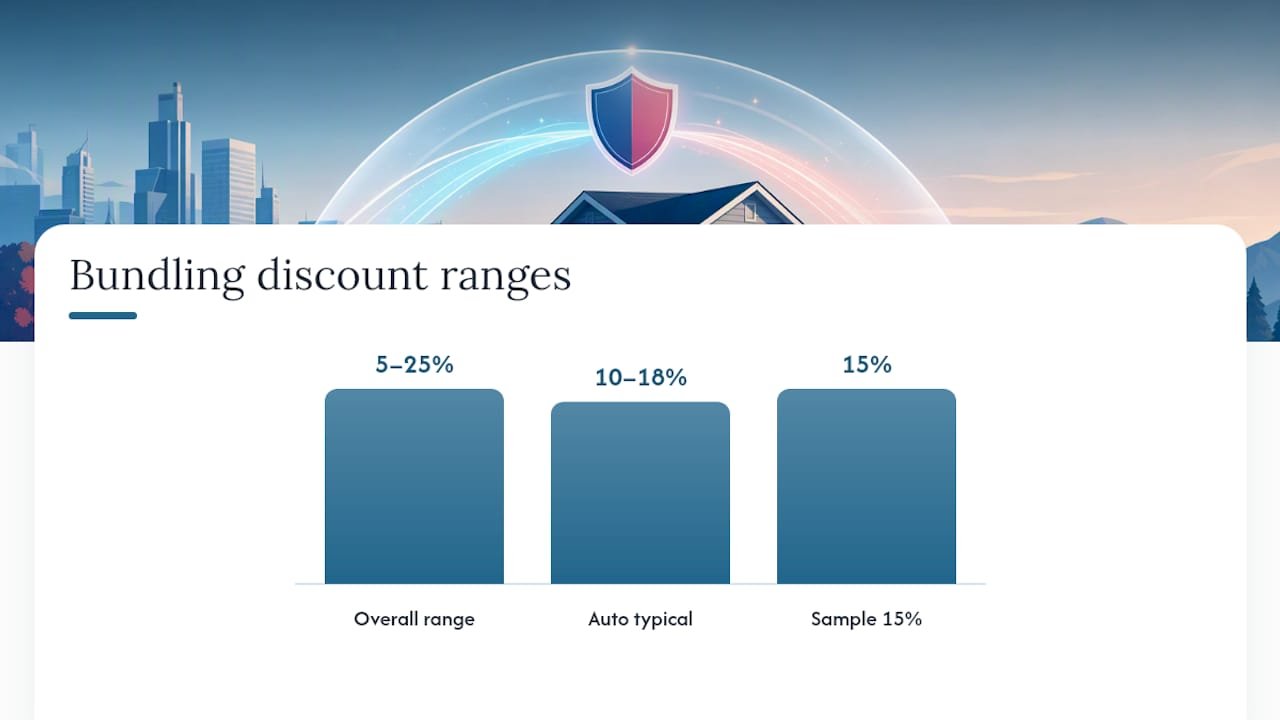
In dollar terms, bundled households commonly save $150 to $700 per year depending on the carrier, the state, and how competitive the standalone rates were to begin with. Using NAIC-informed national average premiums of roughly $1,582 for home and $1,543 for auto as a baseline, a household applying a 15% combined discount would save somewhere in the $233 to $546 range annually, depending on which policy absorbs the bigger cut.
State variation matters more than most people expect:
- Coastal and hurricane-exposed states like Florida and Louisiana often show wider bundle savings on paper, because base home premiums start so high that even a modest percentage discount produces a large dollar figure.
- Texas homeowners frequently see strong bundle incentives tied to hail and wind risk, though the base rates behind those discounts can still be steep.
- States with lower baseline premiums show smaller dollar savings even when the percentage discount looks identical, since there’s less premium to discount in the first place.
That last point is the one worth sitting with.
When Bundling Home and Auto Insurance Costs You More
Bundling isn’t universal, and pretending otherwise is where people lose money. Specialty home markets change the math considerably. If you own a home in a coastal hurricane zone, a wildfire corridor, or anywhere requiring specialized underwriting, a standalone specialist carrier often beats a bundled package because mainstream insurers price these risks conservatively or decline to write them at full value.
Your driving record matters just as much. A driver with a recent DUI, multiple at-fault claims, or a lapse in coverage may find that a high-risk auto specialist offers a materially lower rate than any bundled combination, since the bundled carrier’s auto pricing wasn’t built around that risk profile.
High-value homes run into a similar wall. If your home needs scheduled personal property coverage, extended replacement cost, or specialty endorsements that a mainstream bundled carrier doesn’t offer at all, the “discount” becomes irrelevant. You’re not comparing apples to apples anymore.
Watch for two concrete red flags: a standalone quote that beats your bundled total by more than $200 to $300 a year, or a bundled policy that simply can’t offer an endorsement your home genuinely needs, like elevated water backup limits or scheduled jewelry coverage. Either one is a sign to walk away from the bundle discount and price coverage separately.
How to Compare Bundled vs. Separate Quotes
Running this comparison properly takes about 90 minutes, and it’s the only reliable way to know which approach actually costs less for your household. A direct, dollar-for-dollar comparison beats guessing based on advertised percentages every time.
- Gather your current premiums and coverage limits. Pull your declarations pages for both home and auto, and note your exact deductibles, liability limits, and any endorsements currently attached.
- Request a bundled quote with identical limits. Don’t let an agent quote you lower limits to make the bundle look cheaper. Match every number to what you currently carry.
- Get at least two standalone quotes for each policy. Price your home and auto separately with two different carriers, then add the two totals together to get your standalone baseline.
- Compare the combined totals side by side, not the percentages. Look past the discount headline and check for coverage gaps: replacement cost language, liability limits, and missing endorsements can make a cheaper total inadequate.
- Weigh non-price factors and set a re-shop date. A single-loss deductible, one point of contact for claims, and simplified billing all carry real value that doesn’t show up in the premium number alone.
Pro Tip: Before comparing any numbers, line up your coverage details side by side first. A homeowners policy with a lower replacement-cost percentage can look cheaper and still leave you underinsured after a major loss.
Bundle Features Worth Asking Your Agent About
The percentage discount is the easy part to compare. The features that actually change your experience during a claim are harder to spot unless you ask directly.
- Single-loss deductible. If a storm damages both your roof and your car in the same event, some bundled policies let you pay only one deductible instead of two. On a policy with a $1,000 home deductible and a $500 auto deductible, that feature alone can save you $500 in a single claim.
- Which policy gets the discount. Ask whether the discount applies to auto, home, or both, and whether it compounds with other reductions like a claims-free discount or a security-system credit.
- Loyalty and telematics programs. Many carriers layer additional discounts on top of the bundle for multi-year loyalty, telematics-based safe driving programs, or accident forgiveness.
- Umbrella eligibility. Confirm your bundled limits meet the carrier’s minimum requirement for umbrella coverage, since falling short by even a small margin can disqualify you.
One detail that trips people up: a brokered home policy and a carrier-written policy can behave differently during a claim, even under the same bundle. An independent agency places your home coverage with whichever carrier fits your risk best, which sometimes means your “bundle” partner for claims support is the agency itself, not the carrier’s call center.
How Often Should You Re-Shop Your Bundle?
Set a calendar reminder for one year from today and treat it as non-negotiable. Re-shopping annually is the simplest defense against the slow discount erosion that happens as carriers adjust base rates behind the scenes, often without changing the advertised bundle percentage at all.
Certain events should trigger an immediate re-shop instead of waiting for your annual date:
- A recent claim on either policy, since it can shift your risk tier
- Home renovations that change square footage, roof age, or replacement cost
- Moving to a new address, especially across county or state lines
- Adding a new driver, particularly a teenager
- Any renewal notice showing a rate increase above what feels typical
Working with an agent rather than a direct-to-consumer site has one clear advantage here: an agent can request a full re-rating across multiple carriers in one conversation, instead of you filling out five separate online forms. That’s less about convenience and more about actually seeing your real options.
Why Local Agency Guidance Matters for Specialty Cases
Bundle math looks clean on a spreadsheet until your home sits near a marsh, your roof is older than the policy assumes, or your teenager just got a license. That’s where a local agent earns their keep. Daly & Alexander Insurance has spent more than 45 years helping Savannah-area homeowners sort through exactly these edge cases, coordinating endorsements, confirming whether a single-loss deductible actually applies to your specific bundle, and flagging when a specialty home carrier beats a bundled discount outright.
That local knowledge matters more here than in most markets. Roof age alone can shift a Georgia homeowners quote significantly, and a bundled discount doesn’t mean much if the carrier behind it won’t cover an older roof at full replacement cost. An agency that writes policies across dozens of carriers can place your home with a specialist while still keeping your auto policy in a discount-eligible bundle elsewhere, something a single direct carrier simply can’t offer.
The Honest Verdict on Bundling
The data supports a simple conclusion most guides dance around: bundling is a good default, not a universal rule. For a typical household with a standard home and a clean driving record, the math usually favors the bundle, and the single-loss deductible alone can justify it after one bad storm season.
Where conventional advice falls short is treating the percentage discount as the finish line. You have to run it yourself.
If you take one thing from this article, make it the re-shop habit. Rates drift, risk tiers shift, and the bundle that made sense three years ago may not be the cheapest option today. Prioritize the total combined premium and the coverage details behind it, then let the discount percentage be the tiebreaker, not the deciding factor.
— Nathan
Get a Bundled Quote Reviewed by a Local Agent
An independent insurance agency serving the Savannah area can pull bundled and standalone options across multiple carriers in one sitting, confirm whether a single-loss deductible applies to your specific combination, and flag when a specialty home carrier will actually save you more than a bundle would.

If you’re ready to see your real numbers, here’s where to start:
- Request a bundled home and auto quote comparing your current coverage side by side
- Schedule a coverage review if your roof, driving record, or address has changed in the past year
- Ask directly about single-loss deductible availability and umbrella eligibility before you renew
A quick call gets you actual comparison numbers instead of a guess, and there’s no obligation attached to asking.
Where This Data Comes From
Savings figures and discount ranges in this article draw from Home & Auto Bundle Statistics 2026 and Bundling Home and Auto Insurance: How Much Do You Save in 2026?. Coastal and specialty-market cautions come from AOL’s bundling analysis, and the comparison method draws on a real-dollar bundle vs. separate analysis. Readers can also explore Daly & Alexander’s homeowners policy guide for coverage-matching details.
This article is general information, not a substitute for advice from a qualified financial advisor. Consult a qualified financial professional about your own circumstances before acting on anything here.
Sources
- Home & Auto Bundle Statistics 2026: Savings Data, Discount Rates & Trends
- Bundling Home and Auto Insurance: How Much Do You Save in 2026?
- Is bundling insurance worth it — or just a clever upsell? – AOL
- Car and Homeowners Insurance Quotes: Bundle vs. Separate — A Real-Dollar Analysis
FAQ
Is It Wise to Bundle Home and Auto Insurance?
For most households, yes. Bundling typically saves 10% to 18% on auto premiums and 5% to 10% on home premiums, plus perks like a single-loss deductible. It’s less wise if you own a coastal or high-value home, or carry a high-risk driving record, since specialist carriers can beat the bundled total.
What Is the Best Combined Home and Auto Insurance Approach?
There’s no single “best” carrier for everyone, since the right combination depends on your home’s risk profile and driving history. The most reliable approach is comparing a bundled quote against two standalone quotes for the same coverage limits, then choosing whichever combined total is lowest without sacrificing needed endorsements.
What Should You Avoid Telling Your Insurance Company?
Avoid guessing at facts you’re not sure about, like square footage, prior claims, or driving violations, since inaccurate answers can affect your coverage later. Stick to accurate, specific information and let your agent ask clarifying questions rather than volunteering speculation.
What Is the 80% Rule in Homeowners Insurance?
If your dwelling coverage falls below that threshold, an insurer may reduce your claim payout proportionally, even for a partial loss.
How Do I Know If My Bundle Discount Includes a Single-Loss Deductible?
Ask your agent directly, since not every bundled policy includes it automatically even when both policies are with the same carrier. Your insurance agent can confirm this detail in writing before you switch, so you know exactly what you’re getting.