
Employers liability coverage pays your legal defense, settlements, and judgments when an injured employee sues your business for negligence, and it typically arrives as Part Two of your workers’ compensation policy rather than as a separate purchase. Workers’ comp handles the no-fault medical bills and lost wages; employers liability coverage steps in when a lawsuit alleges you did something wrong. For a small business, that distinction can be the difference between a manageable claim and a legal bill that threatens the whole operation.
TL;DR:
- Employers liability coverage typically pays for legal defense and settlement costs when an employee sues for negligence, beyond workers’ comp benefits.
- The coverage limits are commonly set as 100/500/100, with higher limits being negotiable based on industry risk, payroll size, and claims history.
- Most small businesses inadvertently underestimate their EL needs because coverage is bundled into workers’ comp premiums and rarely reviewed annually.
- Four states operate monopolistic workers’ comp programs that do not include employers liability coverage, requiring additional stop-gap policies.
- Employers should verify payroll accuracy, understand their state’s rules, and review limits annually with an agent to ensure proper coverage aligned with their risk profile.
Table of Contents
- What Does Employers Liability Coverage Cover?
- How Does EL Relate to Workers’ Comp, EPLI, and General Liability?
- How Are EL Limits Quoted, and What Drives the Price?
- What Are the Monopolistic State Exceptions?
- How Do You Choose the Right EL Limits?
- How Daly & Alexander Helps Small Employers Navigate EL
- What Small Employers Should Do Next
- Get Your Employers Liability Coverage Reviewed
- Sources
- FAQ
What Does Employers Liability Coverage Cover?
Employers liability coverage responds when an employee (or their family) sues your business over a work injury and workers’ comp benefits alone don’t resolve the claim. It pays for attorneys, court costs, settlements, and judgments tied to that lawsuit, which is often described as employee liability protection separate from the no-fault workers’ comp system.
Real claims tend to fall into a few recognizable categories:
- Third-party-over suits, where an injured worker sues an equipment maker or contractor, who then sues your business, claiming you contributed to unsafe conditions.
- Dual-capacity claims, where an employee argues your company owed them a duty separate from being their employer, such as also being the manufacturer of the product that hurt them.
- Consequential bodily injury, covering claims from a spouse or family member who suffers harm connected to the employee’s injury, like emotional distress from caring for an injured worker.
- Loss of consortium, a spouse’s claim for lost companionship or support after a serious workplace injury.
Employers liability coverage won’t touch everything, though. It typically excludes intentional acts, criminal conduct, and punitive damages in most states. It also stays out of employment practices claims entirely, since discrimination, harassment, and wrongful termination fall under a different product.
How Does EL Relate to Workers’ Comp, EPLI, and General Liability?
A standard U.S. workers’ compensation policy has two parts, and understanding the split matters more than most business owners realize. Part One is workers’ compensation itself: no-fault medical and wage-replacement benefits for injured employees, regardless of who caused the accident. Part Two is employers liability, which pays out when the injury triggers a lawsuit alleging negligence rather than a straightforward benefits claim.
That leaves two other policies people often confuse with EL:
- Employment Practices Liability Insurance (EPLI) covers discrimination, harassment, wrongful termination, and retaliation claims. It’s a completely different exposure from a workplace injury.
- General liability coverage handles third-party claims from customers, vendors, or the public, not your own employees.
Coordinating all three matters because a single incident can trigger more than one policy at once. A workers’ compensation insurance policy that includes EL still won’t respond to a harassment complaint or a customer’s slip-and-fall in your store.
How Are EL Limits Quoted, and What Drives the Price?
Employer liability limits are usually shown as three numbers, something like $100,000 per accident, $500,000 policy aggregate, and $100,000 per employee. The 100/500/100 structure caps what the insurer pays for a single accident, sets a ceiling across all claims in a policy period, and limits payout per injured worker, and it’s a common starting point rather than a fixed standard.
Nearly one in five small businesses face some form of employee litigation, which is exactly the exposure employers liability coverage is designed to absorb.
Higher limits are almost always negotiable, and several factors push your premium up or down:
- Payroll size, since larger payrolls mean more workers and more potential claims.
- Industry class code, because a roofing crew and an accounting office carry very different risk profiles.
- Claims history, where prior lawsuits or workers’ comp claims raise your rate.
- Chosen limits, since $500,000 aggregate costs less than $1 million.
- Jurisdiction, as state rules and litigation trends vary widely.
Employers liability coverage is typically bundled into your workers’ comp premium rather than priced as a stand-alone line, which is part of why so few business owners think about it until they need it.
What Are the Monopolistic State Exceptions?
Four states run their workers’ comp programs differently: North Dakota, Ohio, Washington, and Wyoming. In these monopolistic states, employers must buy workers’ comp through the state fund, and that fund doesn’t include employers liability coverage the way a private insurer’s policy does.
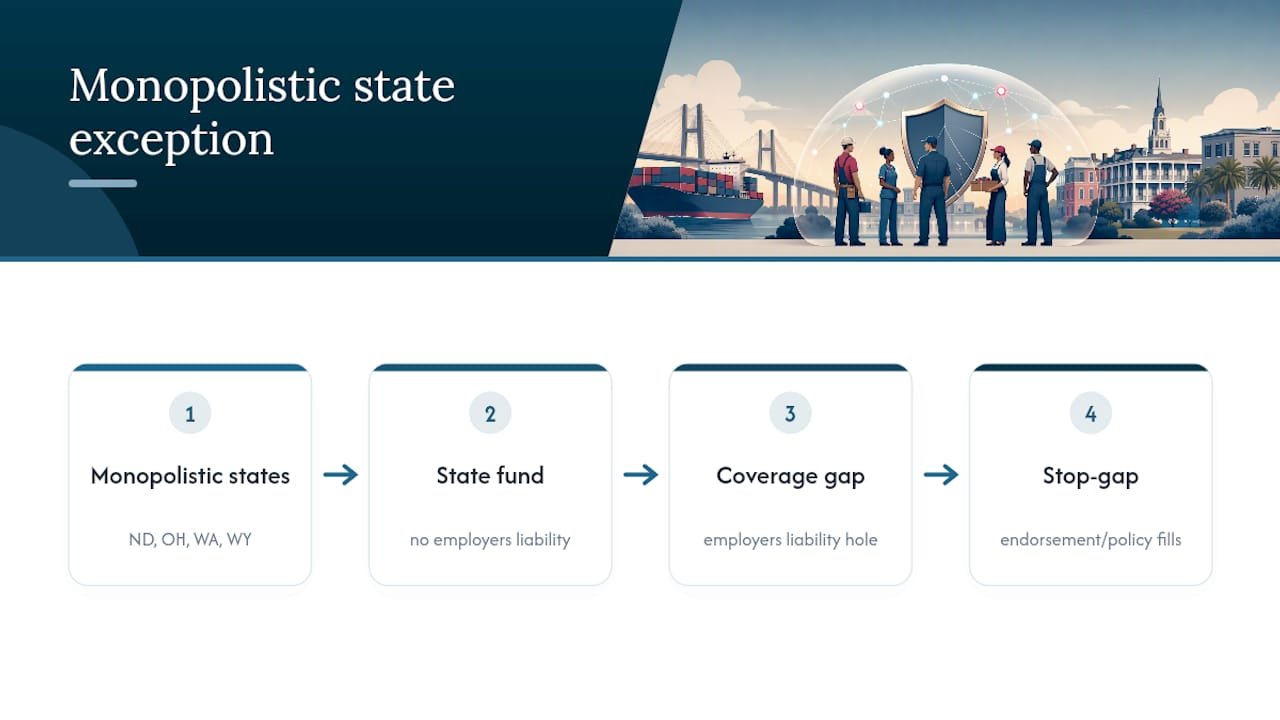
That gap is where stop-gap coverage comes in. It’s a separate endorsement or policy that fills the employers liability hole the state fund leaves open. If you operate in any of these four states, or you have employees working there even occasionally, verify with your agent whether you need stop-gap coverage added. Multi-state employers especially need to check every jurisdiction rather than assume the rules match what they know at home.
How Do You Choose the Right EL Limits?
Picking a limit isn’t guesswork if you ask the right questions and look at the right numbers first.
- Evaluate your industry risk. Construction, healthcare, and manufacturing carry higher injury severity than retail or professional services.
- Check your payroll and class codes. Your insurer uses these to calculate both your workers’ comp and EL premium, so errors here cost you either way.
- Review contract requirements. Many commercial leases and vendor contracts specify minimum EL limits you must carry to do business.
- Look at past claims. A history of injuries or lawsuits should push you toward higher limits, not lower ones.
- Coordinate with an umbrella policy. If your EL limits aren’t enough for a worst-case scenario, excess coverage can extend protection above your primary policy.
When you talk to an agent, ask specifically whether defense costs are paid inside or outside your policy limits, since that single detail changes how fast a $500,000 aggregate can get consumed by legal fees alone. Ask about endorsements, how EL coordinates with your workers’ comp, what limits are actually available for your class code, and whether any retroactive date restrictions apply.
Pro Tip: Review your coverage every year, not just when you renew. Payroll changes, new hires, and a shifting risk profile can all make last year’s limits too thin. The Small Business Administration recommends this kind of annual reassessment precisely because workers’ comp alone doesn’t protect against every kind of lawsuit.
How Daly & Alexander Helps Small Employers Navigate EL
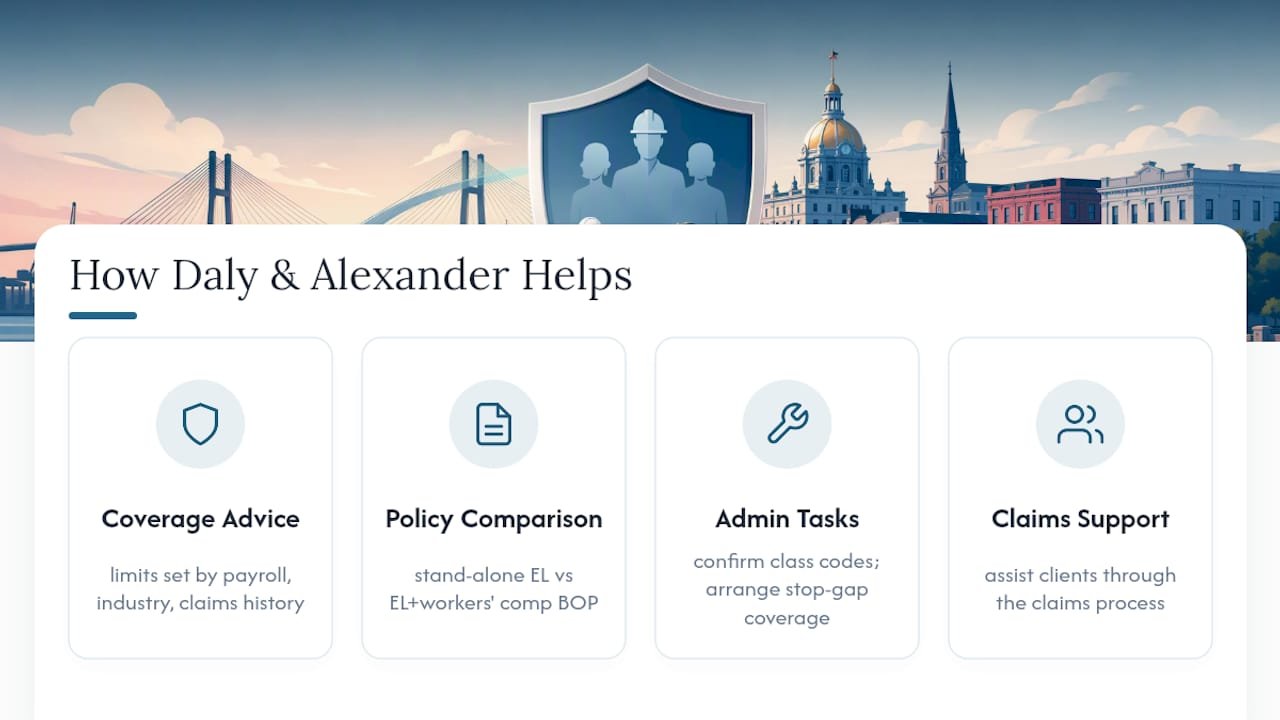
Backed by more than 45 years of experience in property and casualty insurance, the agency works with employers in the area to determine appropriate coverage limits based on payroll, industry, and claims history. That often means comparing a stand-alone approach against bundling EL and workers’ comp into a Business Owners Policy, whichever fits the business better.
Agents also handle tasks such as confirming class codes, coordinating stop-gap coverage where applicable, and advising clients on umbrella options when a single incident could exceed standard limits. When a claim occurs, claims support is designed to assist clients through the process rather than leave them to handle it alone.
What Small Employers Should Do Next
If you employ anyone, carry employers liability coverage. In most states it comes bundled with your workers’ comp policy, so the real work is making sure your limits and stop-gap coverage (if applicable) match your actual risk. Start with three moves: verify your payroll and class codes are accurate, confirm your state’s rules on monopolistic funds, and call an agent for a limits review before you assume your current policy is enough.
— Nathan
Get Your Employers Liability Coverage Reviewed
Most small business owners find out their EL limits are too low only after a claim lands on their desk, and by then it’s too late to fix cheaply. The agency works directly with employers to build coverage tailored to actual payroll, industry risk, and claims history rather than using generic templates.
A Business Owners Policy, priced between $500 and $3,500 a year depending on your business, often bundles employers liability, workers’ comp coordination, and general liability into one package, which usually costs less than piecing the same protection together separately. If your exposure runs higher, whether from payroll size, industry, or contract requirements, commercial liability coverage can extend your limits further. Consult with an agent to review payroll, class codes, and claims history to receive recommendations that match your risk rather than generic limits.
Sources
- Employers Liability Insurance – Investopedia
- Employers Liability Insurance – Forbes Advisor
- Insurance
FAQ
What Is Employers Liability Coverage?
Employers liability coverage pays legal defense costs, settlements, and judgments when an employee sues your business for negligence related to a workplace injury. It usually comes as Part Two of a workers’ compensation policy, not as a stand-alone product.
What Isn’t Covered by Employers Liability?
Employers liability coverage doesn’t cover intentional acts, criminal conduct, or punitive damages in most states. It also stays out of employment practices claims like discrimination, harassment, or wrongful termination, which require a separate EPLI policy.
How Much Does a $1,000,000 Liability Policy Cost?
There’s no single published rate, since cost depends heavily on payroll, industry class code, claims history, and state. Dalyandalexander’s Business Owners Policy starts around $500 to $3,500 a year for many small businesses, though higher limits or higher-risk industries push that number up.
What Is an Example of an Employers Liability Claim?
A common example is a dual-capacity claim, where an injured employee sues your company not just as their employer but also as the manufacturer of a product that caused their injury. Consequential bodily injury and loss of consortium claims from an employee’s family are also typical triggers for EL coverage.