
An umbrella policy is a type of excess liability insurance, but not every excess policy is an umbrella. Federal risk-management guidance puts it the same way. Excess liability stacks more limit on top of one underlying policy and follows that policy’s terms. An umbrella can sit over several policies, and it may also broaden what is covered. Here is how to tell them apart, what each costs and which one fits your home, your rentals or your business.
TL;DR
- Excess liability raises the limit on a specific underlying policy and generally follows that policy’s terms.
- Umbrella can sit over several policies at once (auto, home, boat, business) and may add coverage the underlying policies lack.
- Modern forms often blend the two, so the policy wording matters more than the label.
- A $1 million personal umbrella or excess layer typically costs about $200 to $300 a year in the U.S.
- Neither one replaces your home, auto or business property coverage.
Table of Contents
- The short answer: how they differ
- How each one works in practice
- Personal vs. commercial: where each shows up
- What neither one covers
- What it costs
- Which one fits you?
- Our perspective
- Talk to a Savannah agent about your limits
- FAQ
- Sources
The short answer: how they differ
Both products pay only after your primary liability policy has paid its full limit. Both protect you from a lawsuit or claim that is bigger than your base coverage. The difference lies in how far they reach.
| Feature | Excess liability | Umbrella |
|---|---|---|
| Sits over | Usually one specific underlying policy | Several underlying policies |
| Terms | Follows the underlying policy (“follow form”) | May have its own, broader terms |
| Gap-filling | Generally none | May cover some things the underlying policy does not |
| Typical use | Simple limit increase | Broad, household-wide or business-wide protection |
The Insurance Risk Management Institute (IRMI) explains that traditional excess follows the underlying terms, while an umbrella may be broader, for example with a wider coverage territory. IRMI also notes the line is blurring, because many insurers now issue forms that contain both a follow-form excess part and a broader umbrella part.
What does that mean for you? Don’t buy on the label. Ask to see the form and ask one question: does this policy follow the underlying coverage exactly, or does it have its own terms?
How each one works in practice
Layers and exhaustion
Your primary policy pays first, up to its limit. Personal umbrella and excess policies respond only after those primary limits are used up, and an umbrella may offer broader coverage that carries its own deductible.
Here is a simple picture. Say your auto liability limit is $250,000 and you cause a serious crash with $900,000 in damages. Your auto policy pays $250,000. A $1 million umbrella or excess policy can then respond to the remaining $650,000, as long as the claim is covered under its terms.
Vertical and horizontal protection
The American Bar Association describes umbrella coverage as potentially giving vertical excess protection and horizontal gap-filling coverage. Vertical means more limit on top of a policy. Horizontal means it can step in where a claim falls outside the underlying policy. A pure excess policy usually offers the vertical part only.

Retentions and missing underlying policies
If you skip a required underlying policy, the umbrella does not simply fill in. For personal policies, the missing underlying limit may act as a deductible you pay yourself. On the commercial side, California’s Department of Insurance gives an example where the insured pays the first $10,000 before the umbrella responds when there is no matching underlying policy.
Personal vs. commercial: where each shows up
For families and homeowners
In personal insurance, you will almost always hear “umbrella.” The NAIC says a personal umbrella can cover bodily injury, property damage and personal-injury liability, plus defense costs, beyond your auto, homeowners or renters limits.
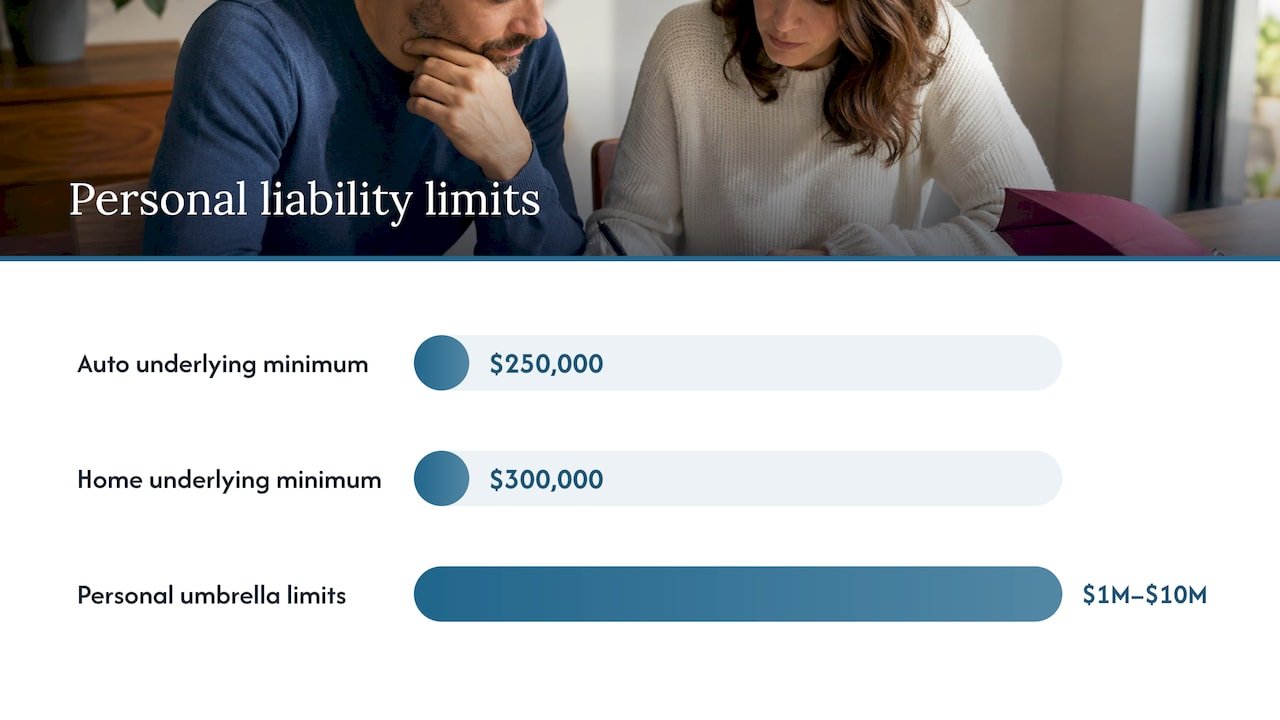
Insurers set minimums for the policies underneath. Triple-I reports that carriers typically want at least $250,000 in auto liability and $300,000 in homeowners liability, and may require boat coverage too. Personal limits commonly run from $1 million to $10 million.
If you live around Savannah, think about the exposures that are easy to overlook: a guest hurt at a backyard oyster roast, a golf cart accident, a boat on the Wilmington River, a teenage driver. Each one can produce a claim bigger than a standard home or auto limit. Our personal umbrella coverage in Savannah page walks through how we set those limits.
For small businesses and property owners
Commercial buyers meet both terms. California’s guide says a commercial umbrella can sit over commercial auto, general liability, workers compensation or other liability policies, and it may address some gaps. Excess is more often used when a lease, contract or lender asks for a higher limit on one line, such as general liability.
Property owners with rentals, vacant buildings or renovations have the same question. Our guides on excess property liability and commercial umbrella insurance cover those setups in more depth. If you are still building the base layer, start with commercial liability coverage or a business owners policy.
What neither one covers
An extra layer of liability is not a cure-all. Know these limits before you buy:
- Your own property. An umbrella does not pay for damage to your own home or car when the underlying property policy does not cover it. The NAIC treats umbrella insurance as a liability and defense-cost layer, not a replacement for property coverage. See how your home policy coverages work to find your base limits.
- Punitive damages. The NAIC lists punitive damages, with drunk-driving cases as examples, among the exclusions.
- Known uninsured exposures. IRMI cautions that an umbrella should not be assumed to drop down over uninsured exposures, and it may exclude uninsured and underinsured motorist and no-fault benefits.
- Sublimits. If an underlying policy has a sublimit, check that payments inside it reduce the underlying aggregate the way the upper layer expects. Do not assume the excess layer will fill the gap.
- Dependent excess. Per PRISM Risk Control, a dependent excess policy generally has no insuring agreement of its own and covers only the hazards the underlying policy names. A certificate of insurance does not show every exclusion.
Those gaps often start in the primary policy. Understanding comprehensive, collision and gap coverage on your auto policy helps you see what the layer above it will and will not pick up.
What it costs
Triple-I says $1 million in umbrella or excess coverage typically runs $200 to $300 per year for a person. Your price depends on your underlying limits, driving records, number of vehicles, boats, rental properties and the limit you choose.
Commercial pricing is higher and more varied. One carrier’s published manual from 2012 listed a $1 million basic limit with minimum premiums of $375 to $850, depending on risk and state, and a $10,000 retained limit where primary coverage is not required. Treat that as a historical reference point, not a current quote. Today’s price depends on your industry, payroll, vehicles and claims history.
We don’t publish umbrella or excess prices because they depend on your underlying policies. We quote them after reviewing what you have.
Which one fits you?
Use these questions to decide:
- Do you need protection across several policies? If you have a home, cars, a boat and rentals, an umbrella is usually the simpler fit.
- Does one contract demand a higher limit on one line? If a lease or lender asks for more general liability only, excess liability may be all you need.
- Do you want broader terms than your base policy? Ask whether the form is a true umbrella with its own coverage grant.
- How much could a lawsuit put at risk? Mass.gov says limits are commonly bought in million-dollar increments and should be high enough to help protect your assets from a liability judgment above your primary limits. Add up your home equity, savings and future earnings.
- Are your underlying limits high enough? If not, the layer above them will not work as intended.
Our perspective
Most people who call us ask for “an umbrella” and are really asking whether they have enough liability limit. We start there. We look at your home, autos, boats, golf carts, rentals and business, and then match the layer to what you actually own and do.
Because we are a local agency with more than 45 years of experience, we place these policies across multiple carriers, so you are not stuck with one form. We read the wording for you: follow form or broader, which underlying limits are required and where the exclusions sit.
If a claim happens, we advocate for you through the process. A good layer of liability coverage is only worth what it pays when you need it.
Nathan
Talk to a Savannah agent about your limits
We help individuals, families, landlords and business owners in Savannah compare umbrella and excess options, check underlying requirements and choose limits that fit. Start with our excess liability coverage in Savannah, browse all of our policies, or reach us through our main site for a review.

FAQ
Is umbrella insurance the same as excess liability?
No, but they are related. An umbrella is a type of excess insurance, while excess liability usually only adds limits to one underlying policy. Many modern forms combine both approaches, so check the wording.
How much does a $1 million umbrella policy cost?
Triple-I says a $1 million personal umbrella or excess layer typically costs $200 to $300 a year. Your actual price depends on your underlying coverage, household and assets. Ask an agent for a quote based on your details.
Do I need underlying policies first?
Yes, in most cases. Personal umbrella and excess policies expect listed auto, home, watercraft or recreational-vehicle coverage at set limits. If you lack one, the missing limit may be treated as a deductible you pay.
Does an umbrella cover my own property damage?
No. It is a liability and defense-cost layer. Damage to your own home or car depends on your underlying property policy.
Sources
- PRISM Risk Control: Introduction to Excess Liability Coverage
- IRMI: Commercial Umbrella Policy, A Few Things To Consider
- Mass.gov: Personal Umbrella and Excess Liability Insurance
- California Department of Insurance: Commercial Insurance Guide
- American Bar Association: Principles of Multi-Layer Insurance Coverage
- NAIC: What’s an Umbrella Policy?
- Triple-I: Liability and safety tips for dog owners
- Triple-I: How much auto coverage do I need?
- Commercial Umbrella Manual (2012)