
Gap insurance covers the difference between your insurer’s actual cash value payout and what you still owe on a loan or lease. You can cancel gap coverage at any time under U.S. consumer protections overseen by the CFPB, and if you’d rather have a local agent walk through the details, we’re happy to help at Daly & Alexander.
TL;DR:
- Gap insurance is most beneficial for vehicles with high early depreciation, long loan terms over 60 months, or when rolling negative equity from previous loans.
- It usually covers only the deficiency balance between the car’s cash value and remaining loan, not deductibles, late fees, or rolled-over negative equity.
- Costs vary: insurer add-ons are typically cheaper and easier to cancel than dealer or lender waivers, which can be financed and accrue interest.
- You can cancel gap insurance at any time and get a refund of unused premiums; always request payoff quotes and check cancellation terms before buying or dropping coverage.
- Review your loan-to-value ratio annually to determine if gap coverage remains necessary, especially once your loan balance falls below the vehicle’s market value.
Table of Contents
- What Gap Insurance Actually Covers
- How a Total-Loss Claim Actually Pays Out
- Who Actually Benefits From Gap Coverage
- Comparing Costs: Insurer Add-On vs. Dealer Waiver
- Your Refund and Cancellation Rights
- How to Decide Whether to Keep or Cancel Gap
- Why Gap Insurance Gets Oversold, and Underused
- Get Help Adding or Reviewing Gap Coverage
- FAQ
- Sources
What Gap Insurance Actually Covers
Gap insurance fills the hole between two numbers: your car’s actual cash value (ACV), which is what your insurer decides the vehicle was worth right before a total loss, and your deficiency balance, which is what you still owe your lender or leasing company. When a car is totaled or stolen and the loan balance exceeds the ACV payout, that leftover amount is the deficiency, and gap coverage is built specifically to pay it.
There are two different products sold under the same name, and the distinction matters:
- Insurer GAP insurance: added to your existing auto policy, regulated as insurance, and generally cancellable with a prorated refund.
- Dealer or lender GAP waiver: technically a debt cancellation agreement, not insurance, often bundled into the loan as a one-time fee.
Most insurers require you to already carry collision and comprehensive coverage before adding gap, and many cap eligibility to vehicles under a few years old, according to Forbes Advisor’s gap insurance guide.
How a Total-Loss Claim Actually Pays Out
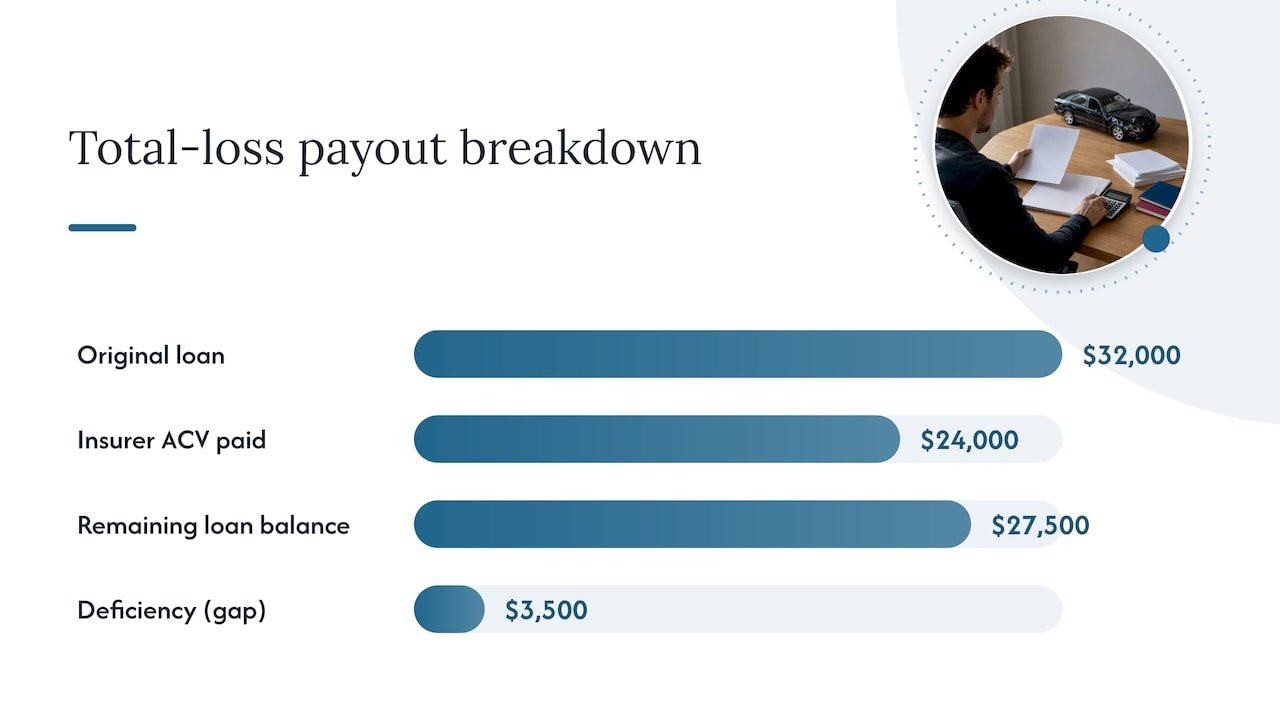
Picture a straightforward example. Say you financed a car for $32,000 with little down, and eighteen months later it’s totaled in an accident. Here’s the order of operations:
- Your insurer determines the car’s actual cash value at the time of loss, say $24,000.
- Your insurer pays that $24,000 to your lender, minus your collision deductible.
- Your lender checks your remaining loan balance, say $27,500.
- The deficiency balance is $3,500, the gap between payout and payoff.
- Your gap coverage pays that $3,500 shortfall, assuming it’s a covered gap.
Gap coverage typically does not pay for your deductible, late fees, or any negative equity rolled over from a previous loan. Those exclusions catch a lot of people off guard, since a rolled-over balance from a trade-in can inflate the deficiency beyond what gap was ever designed to cover.
Timing matters too. The insurer pays actual cash value first, and only after that payout lands does the gap policy step in to cover what’s left, which means a slow claims process on the ACV side delays the gap payout as well.
Who Actually Benefits From Gap Coverage
Gap coverage isn’t universally useful, it’s situational. The following factors tend to create the biggest gap between value and payoff:
- A down payment under 20% of the purchase price
- A loan term longer than 60 months
- A lease, since lease payoffs are often set well above resale value early on
- A vehicle known for fast depreciation, including many EVs and luxury trims
- Rolled-over negative equity from a previous vehicle’s loan
New vehicles lose value fastest in the first two to three years, which is exactly when a loan balance is still high. That combination is where gap earns its cost. Electric vehicles and luxury cars tend to see steeper early depreciation curves than mainstream sedans and trucks, which widens the gap further in those first couple of years.
Pro Tip: Check your loan-to-value ratio once a year. Once your remaining balance drops below your car’s market value, gap coverage has nothing left to protect, and it’s time to drop it.
Many buyers only need gap coverage for the first two to four years of a loan, or for the life of a lease, not the entire financing term.
Comparing Costs: Insurer Add-On vs. Dealer Waiver
Cost and flexibility vary a lot depending on where you buy gap coverage, and the differences add up.
- Insurer add-on gap typically runs from a low to moderate annual cost, billed alongside your regular premium, according to MoneyGeek’s gap insurance research.
- Dealer or lender gap waivers are usually sold as a one-time fee of $400 to $700 or more, often financed directly into your loan.
- Financing that dealer fee means you pay interest on it for the life of the loan, pushing the effective cost higher than the sticker price suggests.
- Insurer add-ons are generally easier to cancel and more likely to come with a prorated refund for unused coverage.
If you already have an auto policy, adding gap is usually a quick call or online request to your insurer. Before you buy from a dealer, ask directly whether the gap waiver is refundable if you pay off the loan early or trade in the car, and get that answer in writing.
Your Refund and Cancellation Rights
Gap insurance is optional in most cases, and lenders generally cannot require it as a condition of financing, according to CFPB guidance on add-on products. If a lender does mandate it, the cost must be folded into your finance charge and reflected in your disclosed APR under Regulation Z, rather than hidden as a separate add-on.
You’re entitled to cancel optional gap coverage and request a refund of the unearned, unused portion of your premium. This isn’t theoretical. The CFPB’s 2023 consent order against Toyota Motor Credit Corporation required significant redress after the company failed to refund unearned gap premiums to borrowers who paid off loans early or had vehicles repossessed.
Enforcement actions like this show that material consumer recoveries are possible when unearned premiums go unrefunded.
If you think you’re owed a refund:
- Request a current payoff quote from your lender in writing.
- Contact the gap administrator and ask for the unearned premium refund calculation.
- If you’re stonewalled, escalate to your state insurance department or file a complaint with the CFPB.
How to Decide Whether to Keep or Cancel Gap
Run through this checklist before you buy, renew, or cancel gap coverage:
- Get your current loan or lease payoff amount from your lender.
- Look up your vehicle’s current market value using Kelley Blue Book or NADA.
- Subtract market value from payoff. If payoff is higher, you’re underwater and gap still has work to do.
- Get a quote from your own insurer for add-on gap and compare it to any dealer waiver cost.
- Ask about cancellation terms and prorated refunds before committing either way.
When you call, keep it simple: ask your lender for a written payoff quote, ask your insurer whether gap is available as a policy add-on and what it costs, and ask any gap administrator directly how a refund is calculated if you cancel early.
Pro Tip: If you’re still underwater but your dealer’s gap waiver fee feels steep, call your own auto insurer first. Ending up with a cheaper, cancellable add-on instead of a financed lump sum is usually the better math.
If a lender or dealer pressures you to buy gap as a loan condition, or refuses to process a refund you’re entitled to, that’s worth reporting to your state insurance department or the CFPB.
Why Gap Insurance Gets Oversold, and Underused
Here’s the uncomfortable truth about gap insurance: it’s sold aggressively right when buyers are least equipped to evaluate it, standing in a dealership finance office after hours of negotiating a car price. That’s precisely when a $500 one-time fee sounds small next to a $35,000 purchase.
The flip side is just as real. Plenty of drivers who’d genuinely benefit from gap coverage never buy it, because nobody mentions it outside the dealership, and by the time they’re shopping insurance online, gap feels like an afterthought add-on buried in a rate quote. The real failure isn’t that gap insurance is a bad product. It’s that almost nobody revisits the decision after year one, when the math has usually already flipped in the driver’s favor. Set a reminder to check your loan-to-value ratio annually, and you’ll likely know exactly when to drop it.
— Nathan
Get Help Adding or Reviewing Gap Coverage
We’ve helped many drivers through this math, comparing payoff balances against actual cash value and figuring out whether gap coverage is worth the premium. If you already have a policy with us, adding a gap endorsement is usually a short conversation, not a new application. If you bought a dealer gap waiver and aren’t sure whether you’re still covered or owed a refund, we can help you review the paperwork and figure out what to ask the administrator.
As an independent agency, we can shop your gap coverage against your existing policy terms rather than just upsell whatever a dealer happens to offer. If deductible costs are part of what’s holding you back from filing a claim, Deductible Assistance is a nonprofit resource worth knowing about too.
Ready to talk through your options? Visit our auto insurance page for Savannah drivers or browse our full range of personal and business coverage to get a personalized quote.
FAQ
Can I purchase just gap insurance by itself?
Standalone gap insurance exists through some insurers and specialty providers, but most drivers add it as an endorsement to an existing auto policy that already includes collision and comprehensive coverage. Check with your current insurer first, since adding it to a policy you already have is usually cheaper than a separate standalone product.
Who sells gap insurance for vehicles?
Gap coverage is sold three ways: as an add-on through your own auto insurer, as a one-time waiver fee through the dealership or lender at purchase, or occasionally through a standalone specialty insurer. Insurer add-ons tend to cost less annually and are easier to cancel than dealer-financed waivers, according to MoneyGeek’s cost comparison.
Which company is best for gap insurance?
There’s no single best provider since pricing and terms vary by insurer, state, and vehicle. The better approach is comparing your own auto insurer’s add-on cost against any dealer waiver fee, and favoring whichever option offers clear cancellation and refund terms; local agents like our team at Daly & Alexander can help you compare those terms directly.
Is it a good idea to get gap insurance on a car?
It’s worth it when you have a small down payment, a loan longer than 60 months, a lease, or a fast-depreciating vehicle, since those situations widen the gap between payoff and actual cash value. It’s usually not worth keeping once your loan balance drops below your car’s market value, which Forbes Advisor recommends checking against Kelley Blue Book or NADA values.
Sources
- What is Guaranteed Asset Protection (GAP) insurance? | CFPB
- CFPB consent order: Toyota Motor Credit Corporation
- Do I need gap insurance if I have full coverage? | MoneyGeek
- Gap insurance guide | Forbes Advisor