
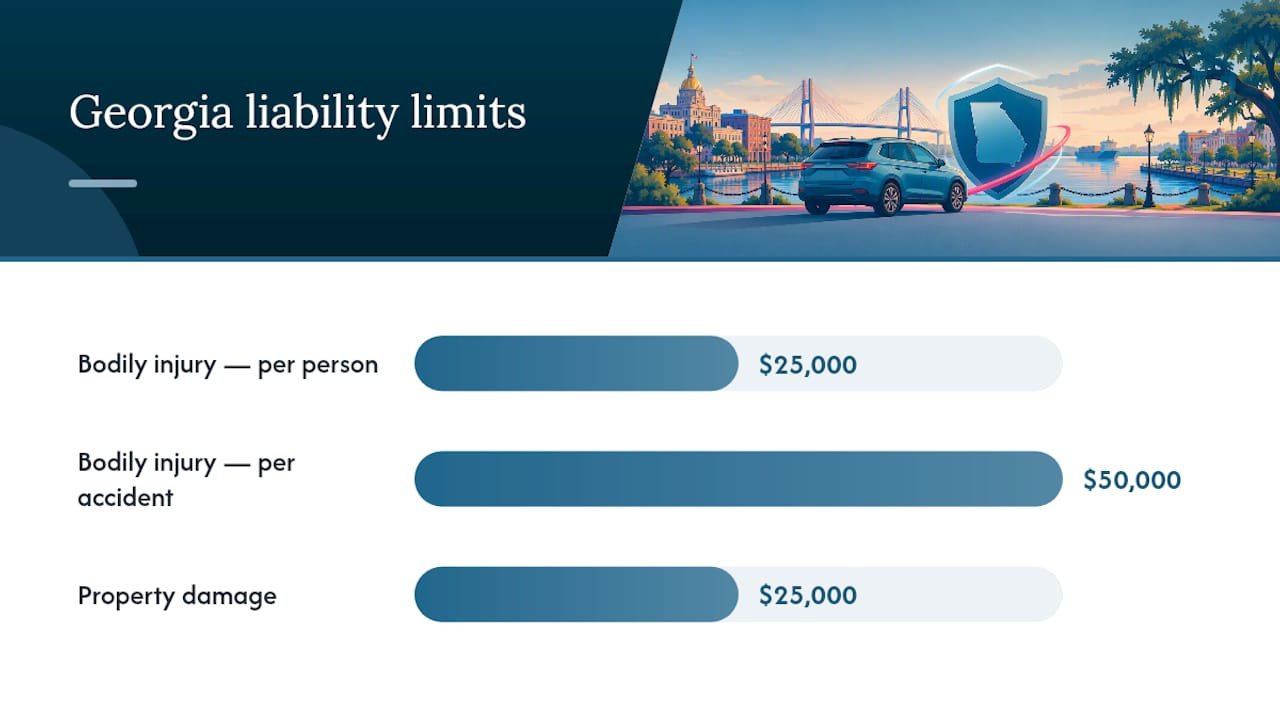
Georgia law sets its auto insurance minimums at 25/50/25: $25,000 in bodily injury liability per person, $50,000 per accident, and $25,000 for property damage. That’s the legal floor set by the Office of the Commissioner of Insurance and Safety Fire, not a safe target. Most drivers, especially anyone with a home, savings, or a paycheck worth protecting, need more than the minimum to stay financially safe after a serious wreck.
TL;DR:
- Most drivers should carry higher limits than the state minimum of 25/50/25 to fully protect their assets in serious accidents.
- Liability coverage only pays for others’ injuries and property damage, leaving your own damages uncovered without additional coverages.
- Georgia’s minimum property damage limit of $25,000 often falls short of actual repair costs, risking out-of-pocket expenses.
- State reporting and penalties for uninsured driving are strict, and failing to cancel coverage before unregistering a vehicle can lead to suspension and legal trouble.
- Raising liability limits to 50/100/50 or 100/300/100 or adding umbrella coverage is advisable for households with significant assets or higher exposure.
Table of Contents
- What Georgia’s Auto Insurance Minimums Actually Cover
- How the Minimums Play Out in Real Accidents
- Proof, Reporting, and Penalties for Driving Uninsured
- Optional Coverages Worth Adding to Your Policy
- Choosing the Right Liability Limit for Your Situation
- A Local Agent’s View on Getting Coverage Right
- Get Your Georgia Auto Coverage Reviewed the Right Way
- Where to Verify Georgia’s Insurance Rules
- Sources
- FAQ
What Georgia’s Auto Insurance Minimums Actually Cover
The 25/50/25 shorthand breaks down into three separate limits, and understanding each one matters more than most drivers realize. The first number, $25,000, is what your insurer pays for bodily injury to one person in an accident you cause. The second, $50,000, is the total your policy pays for all injuries in that same accident, no matter how many people were hurt. The third, $25,000, covers damage to someone else’s car, fence, mailbox, or anything else you hit.
Here’s the part that trips people up: liability coverage never pays for your own injuries or your own vehicle. It’s strictly a third-party coverage. If you rear-end someone at a red light on Abercorn Street, your liability policy pays for their medical bills, their car repairs, and potentially their lost wages if the injury keeps them off the job. It does nothing for your own bumper or your own hospital bill.
Liability coverage in Georgia is built to pay for things like:
- Emergency room visits and ongoing medical treatment for the other driver or passengers
- Lost income if the injured party can’t work during recovery
- Repair or replacement costs for the other vehicle or damaged property
- Legal defense costs if the other party sues you for damages beyond what a quick settlement covers
Because these limits only protect other people, minimum liability coverage leaves your own recovery entirely dependent on coverages you’d have to add separately.
How the Minimums Play Out in Real Accidents
Numbers on a page don’t mean much until you run them against a real crash. Here’s how Georgia’s limits actually perform in three common scenarios.
-
Single-injury collision. You cause an accident and the other driver breaks an arm and needs surgery. Medical bills, physical therapy, and a few weeks of missed work add up to $31,000. Your $25,000 per-person limit covers most of it, but you’re personally on the hook for the remaining $6,000 unless you carry higher limits.
-
Multi-victim accident. You hit a car carrying three people. Combined injury costs reach $65,000. Your $50,000 per-accident cap means your insurer pays $50,000 total, and the remaining $15,000 becomes your responsibility, split however the claimants and courts decide.
-
Property damage scenario. You total a newer sedan valued at $32,000. Your $25,000 property damage limit falls $7,000 short, and that difference comes out of your pocket unless the driver pursues you for it directly.
Each example shows the same pattern: the gap between the minimum and the actual cost becomes your personal debt.
Proof, Reporting, and Penalties for Driving Uninsured
Georgia doesn’t rely on the honor system to keep uninsured drivers off the road. Insurers must electronically report every new policy, cancellation, and vehicle change to the state’s Georgia Electronic Insurance Compliance System (GEICS), managed by the Department of Revenue. Some fleets, self-insured companies, and IRP-registered vehicles are exempt from this reporting, according to the GEICS implementation guide.
Acceptable proof of insurance includes:
- Electronic coverage confirmation through the DOR system
- Insurance binders, valid for up to 30 days
- Fleet insurance cards for commercial vehicles
- Insurance certificates in specific, limited circumstances
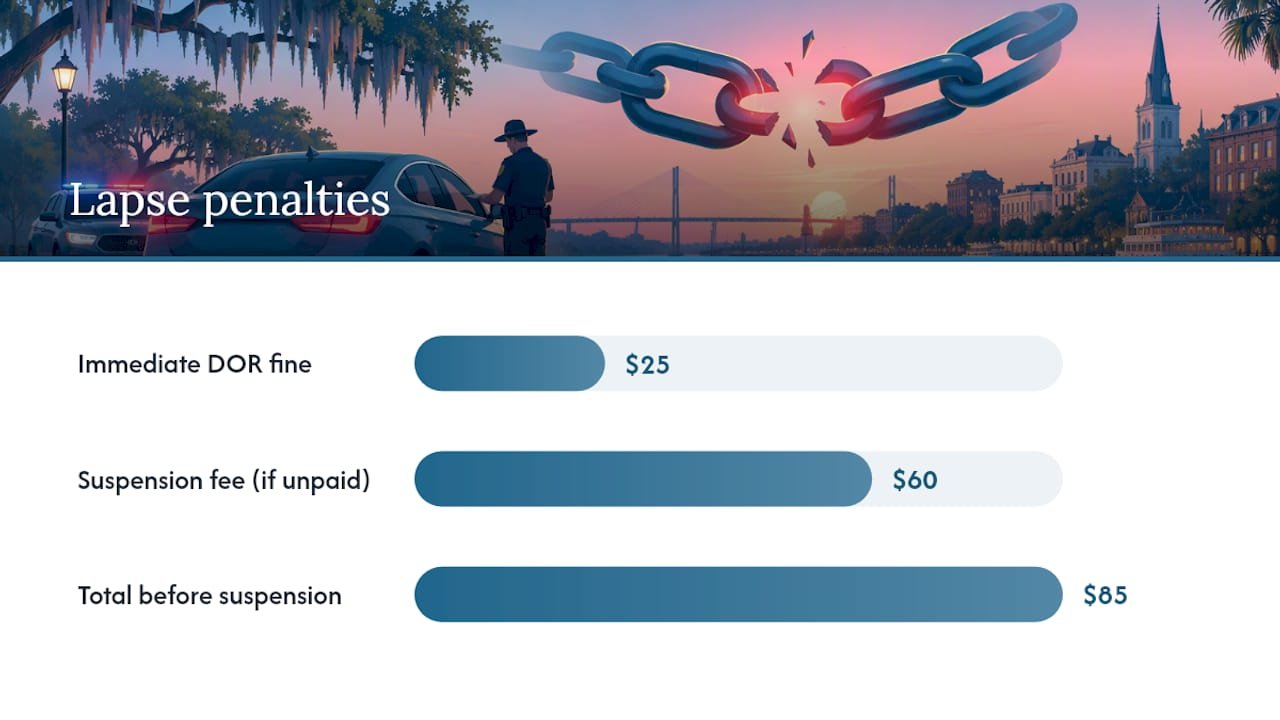
A lapse of just 10 consecutive days without reported coverage triggers state penalties. The Department of Revenue assesses a $25 fine immediately, and if that fine goes unpaid within 30 days, an additional $60 suspension fee follows, bringing the total to $85 before your registration gets suspended. Driving on a suspended registration in Georgia can lead to criminal penalties and vehicle impoundment. If you’re selling a car or it’s been totaled, cancel the registration before canceling the policy. That order matters, because canceling insurance first is exactly what triggers a lapse flag in the system.
Optional Coverages Worth Adding to Your Policy
Liability limits are only the starting point. A handful of optional coverages fill the gaps that 25/50/25 leaves wide open, and each one solves a different problem.
- Uninsured/underinsured motorist (UM/UIM): Steps in when the at-fault driver has no insurance or not enough to cover your losses. Georgia allows drivers to reject UM/UIM in writing, but doing so removes a coverage that often matters most when you need it.
- Collision coverage: Pays for damage to your own vehicle after a crash, regardless of who caused it.
- Comprehensive coverage: Covers non-collision losses like theft, fire, hail, or hitting a deer on a rural highway outside Savannah.
- Medical payments coverage: Pays your own medical bills quickly after an accident, no matter who’s at fault, which matters when hospital bills arrive before any liability claim settles.
- Umbrella or excess liability: Extends your protection beyond your auto policy’s limits, guarding savings and property if a judgment exceeds what your underlying policy pays.
Pro Tip: Before rejecting UM/UIM to save a few dollars a month, ask your agent to run the numbers on a modest limit instead. The premium difference is usually small compared to what you’d owe out of pocket if an uninsured driver totals your car and sends you to the hospital.
For a full breakdown of how these coverages fit together, see this complete auto policy guide.
Choosing the Right Liability Limit for Your Situation
Picking a limit above the state minimum comes down to what you’d stand to lose in a worst-case scenario. Homeowners, business owners, and anyone with meaningful savings have more exposed if a court awards damages beyond their policy limits.
A few factors should guide the decision:
- Assets and income. The more you own or earn, the more a plaintiff’s attorney has an incentive to pursue you personally for the difference.
- Driving frequency and commute. Daily highway driving on I-95 or I-16 carries more accident exposure than occasional local trips.
- Family size. More passengers in your household vehicle raises the odds of a multi-injury claim that hits the per-accident cap.
Many Georgia drivers choose limits of 50/100/50 or 100/300/100 instead of the state’s 25/50/25 floor, since the added premium is often modest compared to the protection gained. Because Georgia operates under a fault-based tort system, higher limits also strengthen your position in settlement negotiations. Insurers with more coverage on the table tend to resolve claims faster and with less risk of a lawsuit reaching into your personal assets. An umbrella policy typically makes sense once your net worth exceeds your auto and home liability limits combined.
A Local Agent’s View on Getting Coverage Right
Reading the statute is one thing. Watching what happens after a real accident is another. Local agents with long experience serving Savannah-area drivers have seen how often the state minimum turns out to be the wrong number for a given household, particularly for families with teen drivers or homeowners carrying significant equity.
A coverage review from a local agent does more than confirm you’re legally compliant. It checks whether your GEICS reporting status matches what you actually carry, flags gaps between your liability limits and your real financial exposure, and walks through whether an umbrella policy makes sense given your assets. That kind of side-by-side comparison is hard to replicate by reading a policy declarations page alone.
— Nathan
Get Your Georgia Auto Coverage Reviewed the Right Way
Meeting Georgia’s 25/50/25 minimum keeps you legal, but it rarely keeps you fully protected. Auto coverage is best approached by reviewing actual driving habits, assets, and family situation instead of defaulting to the cheapest legal option.

A coverage review typically includes a check of your current policy limits, confirmation that your insurer’s GEICS reporting matches what you’re carrying, and a conversation about whether higher liability limits or an umbrella policy fit your situation. If you’re due for a policy check or just want a second opinion on your current limits, reach out for an auto insurance quote in Savannah and ask specifically about umbrella coverage while you’re at it. Bring your current declarations page to the conversation. It’s the fastest way for an agent to spot where you’re exposed.
Where to Verify Georgia’s Insurance Rules
For the official word on limits and enforcement, check the OCI auto insurance page and its consumer guide PDF, along with the DOR’s vehicle insurance requirements and GEICS implementation guide.
Sources
- Auto | Office of the Commissioner of Insurance and Safety Fire
- Vehicle Insurance Requirements | Department of Revenue
- How Much Car Insurance Do I Need in Georgia? (Nolo)
FAQ
What Are the Minimum Auto Insurance Limits in Georgia?
Georgia requires liability limits of $25,000 per person for bodily injury, $50,000 per accident, and $25,000 for property damage, known as 25/50/25 coverage. These are the legal minimums, not a recommended amount, and many drivers carry higher limits to protect their assets.
What Should You Avoid Telling Your Insurance Company After an Accident?
Avoid guessing about fault, speculating on injuries, or giving a recorded statement before you understand the full extent of damage and medical costs. Stick to factual details about what happened and let the claims process, not assumptions, determine liability.
Is Georgia an Expensive State for Car Insurance?
Georgia’s rates run close to the national average, though costs vary widely based on driving record, location, and coverage limits chosen. Drivers in the Savannah area often see different pricing than those in metro Atlanta due to traffic density and claim history in each region.
Who Has the Cheapest Car Insurance in Georgia?
The cheapest policy on paper is usually one built at the state’s 25/50/25 minimum, but the lowest premium often comes with the least protection if you’re in a serious accident. A coverage review from Dalyandalexander can help you compare quotes based on real value, not just the lowest sticker price.