
Loss assessment coverage is the HO-6 endorsement that helps pay your share when your condo or homeowners association bills owners for a special assessment tied to a covered loss, typically damage to shared property, liability in common areas, or a gap in the master policy deductible. It does not cover capital improvements, routine operating shortfalls, or government levies. Before you assume you are protected, check your master policy’s deductible and how many units will split that cost.
TL;DR:
- Most default loss assessment coverage limits are only $1,000, which is insufficient for large special assessments in many buildings.
- Owners should calculate their needed coverage by dividing the master policy’s deductible by the number of units, especially in smaller or high-risk areas.
- Deductible assessments often remain capped unless an endorsement explicitly extends coverage to higher limits or deductible shortfalls.
- Starting July 2026, Fannie Mae limits condo master policy deductibles to $50,000 per unit and requires additional coverage if the deductible exceeds 5% of the master policy.
- Owners should review their HOA’s deductible and reserve data with a local agent to appropriately size their loss assessment coverage and avoid underinsurance.
Table of Contents
- What a loss assessment and loss assessment coverage actually are
- How loss assessment coverage works in practice
- How much coverage you need and what it costs
- Who pays the master deductible and new lender rules for 2026
- How to add or increase loss assessment coverage
- Why a local agent makes sizing this coverage easier
- Why owners stay underinsured longer than they should
- Get your master policy reviewed before you need to file a claim
- FAQ
- Sources
What a loss assessment and loss assessment coverage actually are
A loss assessment is a charge your association bills to unit owners to cover costs the master policy does not fully pay, usually after damage to common property or a liability claim involving shared spaces. Your HO-6 condo policy typically includes a small amount of loss assessment coverage automatically, often just $1,000, and you can raise that limit with an endorsement such as HO 04 35.
Three situations trigger most assessments covered by this endorsement:
- Direct physical damage to common elements, like a roof, lobby, or shared mechanical system.
- Liability arising from an incident in a shared area, such as a slip and fall in a hallway.
- A shortfall between what the master policy pays and the association’s deductible on a covered claim.
Timing matters as much as the trigger. Coverage generally applies when the association charges the assessment during your policy period, not necessarily when the underlying damage happened, so a claim can hinge on the date the board actually levies the charge versus the date of loss, according to PropertyCasualty360. For a deeper look at how HO-6 policies interact with master coverage gaps, see our condo insurance guide.
How loss assessment coverage works in practice
Most HO-6 policies ship with a default loss assessment limit, often $1,000, which sounds reasonable until you realize how little that covers in a large special assessment. Owners commonly buy endorsements that push limits into the $10,000 to $100,000 range, and the incremental premium for that jump is usually modest relative to the protection it buys, according to SoFi Learn.
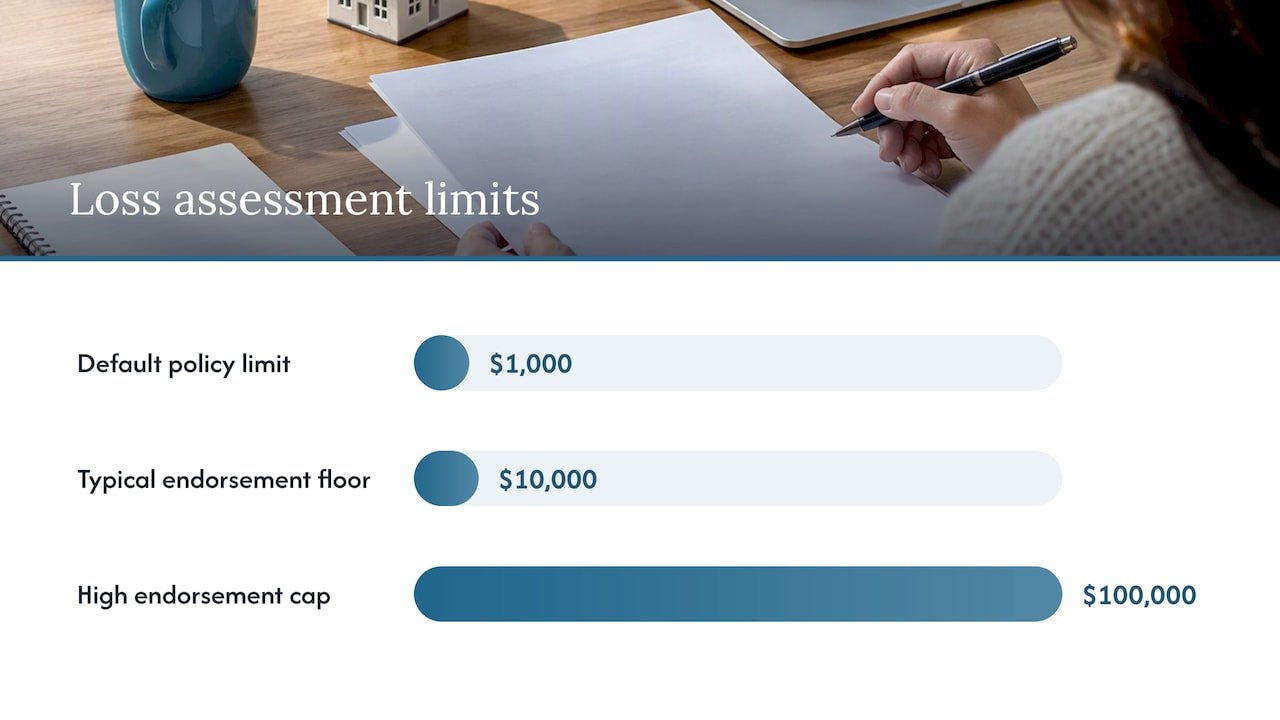
Many HO-6 policies include a default loss assessment limit that is relatively low, while owners who add endorsements may increase coverage limits substantially, often by several multiples of the default amount, according to SoFi Learn. That gap matters because deductible-related assessments often get treated differently than damage assessments.
A few things catch owners off guard:
- Deductible assessments can remain capped at the base $1,000 sub-limit unless you specifically add a deductible endorsement.
- Capital improvements, operational deficits, and government-mandated levies are excluded no matter how high your limit runs.
- Named-peril versus all-risk wording in your endorsement changes what triggers payment at all.
Ask your agent directly whether your endorsement extends to deductible shortfalls or whether that portion still sits under the lower sub-limit, since PropertyCasualty360 notes this distinction trips up plenty of owners during an actual claim.
How much coverage you need and what it costs
Sizing your coverage starts with one calculation: divide the association’s master policy deductible by the number of units in the building. That gives a rough estimate of what you would owe if the board splits a whole-building loss evenly, a method used in industry deductible calculators.
- Find the master policy deductible (ask your HOA or check the declarations page).
- Divide by the total number of units to estimate your even-split exposure.
- Adjust upward if your building is small, since fewer units means a bigger per-unit share.
- Adjust again if you are in a coastal or catastrophe-prone area where deductibles run higher.
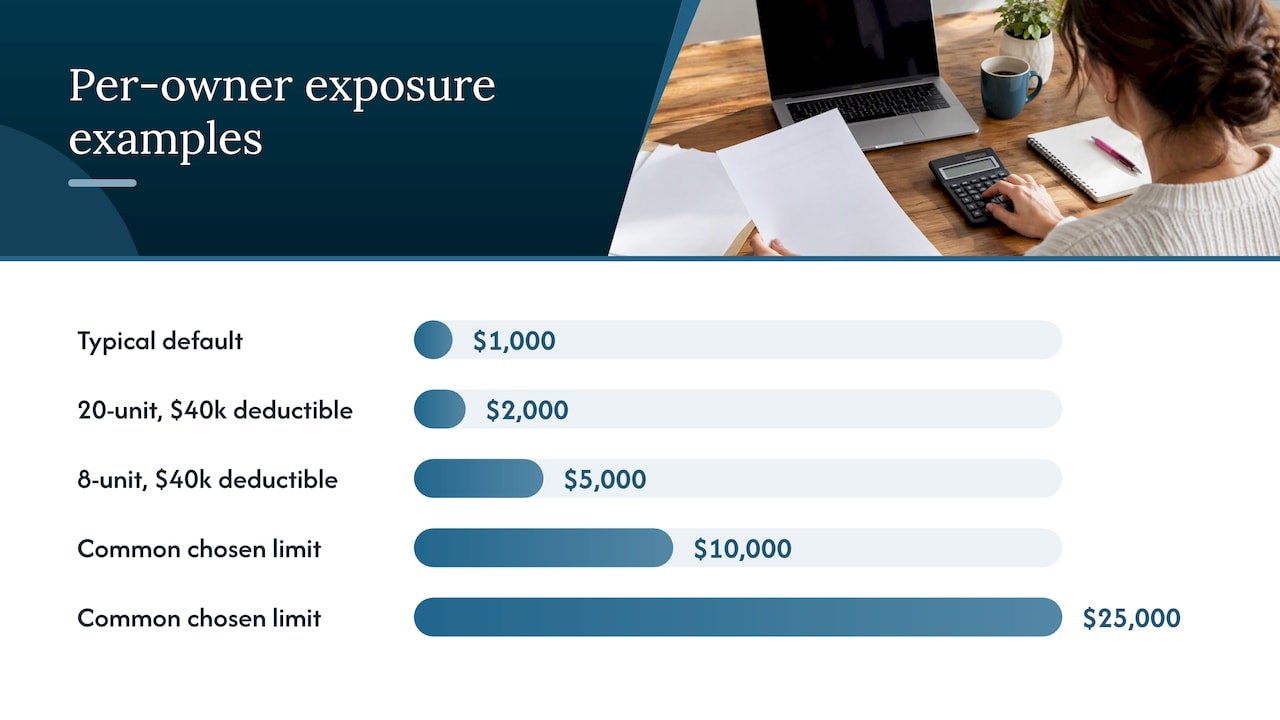
Say a 20-unit building carries a $40,000 wind deductible. Split evenly, that is $2,000 per owner, well above the typical $1,000 default. A smaller 8-unit building with the same deductible pushes each owner’s share to $5,000.
Owners commonly settle on $10,000, $25,000, or $50,000 limits depending on building size and deductible exposure. Lenders may also set a minimum you must carry to close a loan.
Pro Tip: If your building has fewer than 20 units or sits in a coastal flood zone, run the per-unit math before you assume the default $1,000 is enough.
Who pays the master deductible and new lender rules for 2026
Responsibility for the master policy deductible comes down to your association’s CC&Rs, bylaws, and state law. Boards commonly allocate the cost one of three ways: evenly across all units, directly to the units affected, or by drawing down reserves and then levying a special assessment to recover the shortfall, according to LegalClarity.
- Allocation method is set by governing documents, not by insurance carriers.
- Reserve shortfalls often trigger a special assessment rather than an immediate per-unit bill.
- Some associations buy a deductible buy-back policy to soften large deductible exposure.
- State statutes can override association bylaws in how costs get split.
Starting July 1, 2026, Fannie Mae caps per-unit deductibles on condo master property policies at $50,000 and requires borrowers to show supplemental HO-6 or loss assessment coverage when the per-unit deductible exceeds 5% of the master policy’s coverage amount, according to HOA Docs Direct. Lenders document this through Fannie Mae’s Selling Guide and Lender Letter LL-2026-03, which sets coverage sufficiency standards and the checks lenders run before closing. If you are buying or refinancing, ask your HOA for the master policy, certificate of insurance, and deductible figures early so your agent can confirm you meet the threshold.
How to add or increase loss assessment coverage
Getting the right endorsement in place is a short process if you have the right documents on hand.
- Request the master policy and current deductible amount from your HOA or management company.
- Calculate your likely per-unit share using the deductible-divided-by-units method above.
- Ask your agent for specific endorsement names and quotes at a few limit tiers.
- Request a certificate of insurance and updated declarations page if your lender needs proof.
When you talk to your agent, ask whether the endorsement covers deductible assessments outright or whether those stay sub-limited, whether coverage is named-peril or all-risk, and whether you can add the endorsement mid-term without waiting for renewal.
When you talk to your HOA or board, ask for the exact master deductible, the current reserve balance, how assessments get allocated among owners, and whether the association already carries a deductible buy-back policy.
Pro Tip: If your board can’t produce a clear deductible figure or the number seems unusually high for the building’s size, treat that as a reason to buy a higher limit, not a reason to wait.
If the HOA’s documents are vague or the deductible is large relative to building size, that is a red flag worth raising at the next board meeting, and a reason to lean toward the higher end of available endorsement limits in the meantime. For related real estate context on how fees and assessments get structured, see this explanation of condo fees from a partner real estate resource.
Why a local agent makes sizing this coverage easier
We help property owners match coverage to real exposure, and loss assessment endorsements are one of the gaps commonly seen on condo policies. We review your HO-6 and master policy side by side, help place the right endorsement, prepare the certificate of insurance and declarations your lender needs, and stay involved if you ever need to file a claim. We also maintain educational guides on topics like ordinance of law coverage for owners who want to understand what sits outside a standard policy.
Why owners stay underinsured longer than they should
Most owners never touch their declarations page after buying a unit, so the default $1,000 loss assessment limit quietly becomes their only protection, even as master deductibles climb and smaller buildings split costs fewer ways. The fix is not complicated. Pull your HOA’s deductible figure, run the per-unit math, and buy at least what your lender requires or what covers your realistic share, whichever is higher.
— Nathan
Get your master policy reviewed before you need to file a claim
We offer a policy review where we look at your master policy’s deductible, check what your current HO-6 covers, and quote the endorsement limit that matches your building’s exposure. 
If you own a condo in the Savannah area and want a clear answer on where you stand, reach out through our condo insurance page and we will walk through the numbers with you directly.
FAQ
Is loss assessment coverage required?
Loss assessment coverage itself is not universally required by law, but many lenders now require it when a condo’s master policy deductible exceeds certain thresholds. Under Fannie Mae’s July 2026 rules, borrowers must show supplemental coverage when the per-unit deductible exceeds 5% of the master policy’s coverage amount, according to HOA Docs Direct.
How much does loss assessment coverage cost?
The incremental premium for raising your loss assessment limit from the default $1,000 up to $10,000 or higher is typically modest compared to the added protection, according to SoFi Learn. Exact pricing depends on your carrier, building risk, and the limit you choose, so getting a direct quote from your agent is the only way to know your specific cost.
Does Daly & Alexander offer loss assessment coverage?
We help condo owners in the Savannah area review their HO-6 policies and add or increase loss assessment endorsements as part of our condo insurance services. Reach out to us directly for a quote tailored to your building’s deductible and unit count.
What are the exclusions of loss assessment coverage?
Loss assessment coverage excludes assessments for capital improvements, operational deficits in the association’s budget, and government-mandated levies. It also only applies to assessments tied to covered perils and liabilities, not general association expenses, according to PropertyCasualty360.
Sources
- Fannie Mae 2025 condo insurance requirements (HOA Docs Direct)
- Who pays the condo master policy deductible? (LegalClarity)
- Understanding loss assessment coverage (PropertyCasualty360)
- Loss assessment coverage for condos (SoFi Learn)