
A non-owner car insurance policy is liability coverage tied to you as a driver rather than to any specific vehicle, and it makes the most sense if you rent or borrow cars often, or if a state requires you to file an SR-22 but you don’t own a car. It won’t pay for damage to the car you’re driving, so you’ll want to understand that gap before you rely on it alone.
TL;DR:
- Rental counters often charge $7 to $14 daily for supplemental liability, so frequent renters should compare the fees with an annual policy.
- When you borrow or rent a car, the owner’s insurance usually pays first; your policy may cover excess liability, up to its own limits.
- Check whether your credit card or rental company covers collision and theft, because liability coverage will not repair the car you drive.
- Drivers needing an SR 22 or FR 44 can meet filing requirements without a car, but state rules vary and a lapse can threaten driving privileges.
Table of Contents
- What non-owner car insurance covers (and what it doesn’t)
- Who should consider a non-owner policy
- How non-owner policies affect costs and how to save
- How to buy and use a non-owner policy
- Common misconceptions and short case examples
- State-specific legal requirements and regulations
- Impact of driving record and credit score on premiums
- How claims are handled and the claims process
- Duration and renewal process of non-owner policies
- Daly & Alexander perspective: agent guidance for choosing limits and filing SR-22
- Get a quote or SR-22 filing from Daly & Alexander
- FAQ
- Sources
What non-owner car insurance covers (and what it doesn’t)
Think of a non-owner policy as a safety net for the damage you might cause, not the car you’re driving. It centers on liability: bodily injury coverage for people hurt in an accident you cause, and property damage coverage for the other vehicle or property involved. Depending on your state and insurer, you may also be able to add uninsured/underinsured motorist coverage or personal injury protection, which can be worth it if you’re frequently in cars that may not carry their own strong coverage.
What a non-owner policy typically does not include:
- Collision coverage for damage to the vehicle you’re driving
- Comprehensive coverage for theft, weather, or vandalism to that vehicle
- Any coverage that replaces the vehicle owner’s own policy
That last point matters. When you borrow or rent a car, the vehicle owner’s insurance (or the rental company’s) is usually primary, and your non-owner policy acts as secondary protection that kicks in once the primary limits are used up. For a fuller breakdown of how liability, collision, and comprehensive fit together, our auto insurance coverage guide walks through the standard pieces of a policy.
Who should consider a non-owner policy
Not every occasional driver needs one. Here’s how to tell if it fits your situation:
- Frequent renters. If you rent cars several times a year, compare what you’d pay for an annual non-owner policy against the daily liability add-ons at the counter.
- Regular borrowers. If you drive a friend’s or family member’s car but aren’t listed on their policy, permissive use might cover you occasionally, but it’s not something to count on every time.
- Drivers who need an SR-22 but don’t own a car. A non-owner policy is often the fastest, simplest way to satisfy that filing requirement.
- People who rarely drive anything. If you live with the vehicle’s owner and their policy already extends to you, or you drive only once or twice a year, a dedicated policy may be more than you need.
Each case comes down to how often you’re behind the wheel of a car that isn’t legally yours, and how much risk you’re carrying without a policy of your own.
How non-owner policies affect costs and how to save
Price depends on a handful of familiar factors: your driving record, whether you need an SR-22 filed, the liability limits you choose, and the rules in your state. A clean record keeps premiums lower; an SR-22 requirement almost always raises them, since it signals higher risk to insurers.
One figure worth knowing: rental counters often charge roughly $7 to $14 per day for supplemental liability protection. Rent a car for two weeks a few times a year, and those daily charges can add up to more than a full year of a non-owner policy.
A few ways to keep costs down:
- Check whether your credit card already includes rental coverage before paying extra at the counter.
- Get quotes from a few insurers rather than accepting the first number you see.
- Choose higher liability limits only if you’re regularly driving others’ vehicles or need extra protection beyond state minimums.
How to buy and use a non-owner policy
Getting a quote is straightforward once you know what insurers will ask for.
- Share your license and driving history. Insurers will want your license number, years of driving experience, and any violations on record.
- Tell them if you need an SR-22. If a court or state agency has required one, say so upfront. The insurer files it electronically once your policy is active, which is one of the fastest routes to reinstating driving privileges. Our SR-22 insurance guide walks through what that filing involves.
- Decide how you’ll use the policy. If you’re renting, bring proof of coverage to the counter and skip the daily liability add-on, though you’ll still want to weigh a collision damage waiver or check your credit card’s rental protection, since neither a non-owner policy nor most cards guarantee physical damage coverage.
Pro Tip: Call your credit card issuer before your next rental to confirm exactly what their collision coverage includes, since the fine print varies more than people expect.
Common misconceptions and short case examples
A few mix-ups come up again and again, and they can be expensive if you assume the wrong thing.
- Borrowing a friend’s car: say you cause an accident while driving a friend’s car. Their policy pays first, up to their limits. If damages exceed that, your non-owner policy’s liability coverage can step in to cover the excess, but it won’t fix their car.
- The frequent renter math: someone renting a car for business travel ten times a year at $10 a day in supplemental liability fees would spend more over those trips than many annual non-owner premiums cost, making the yearly policy the more practical choice.
- The household assumption: don’t assume a spouse or roommate’s policy automatically covers you. Non-owner coverage is written to a named individual, and insurers don’t always extend that protection to other household members without adding them specifically.
- The physical damage assumption: a non-owner policy is liability-only. Checking whether your credit card or the rental company covers collision or theft protects you from a surprise repair bill.
State-specific legal requirements and regulations
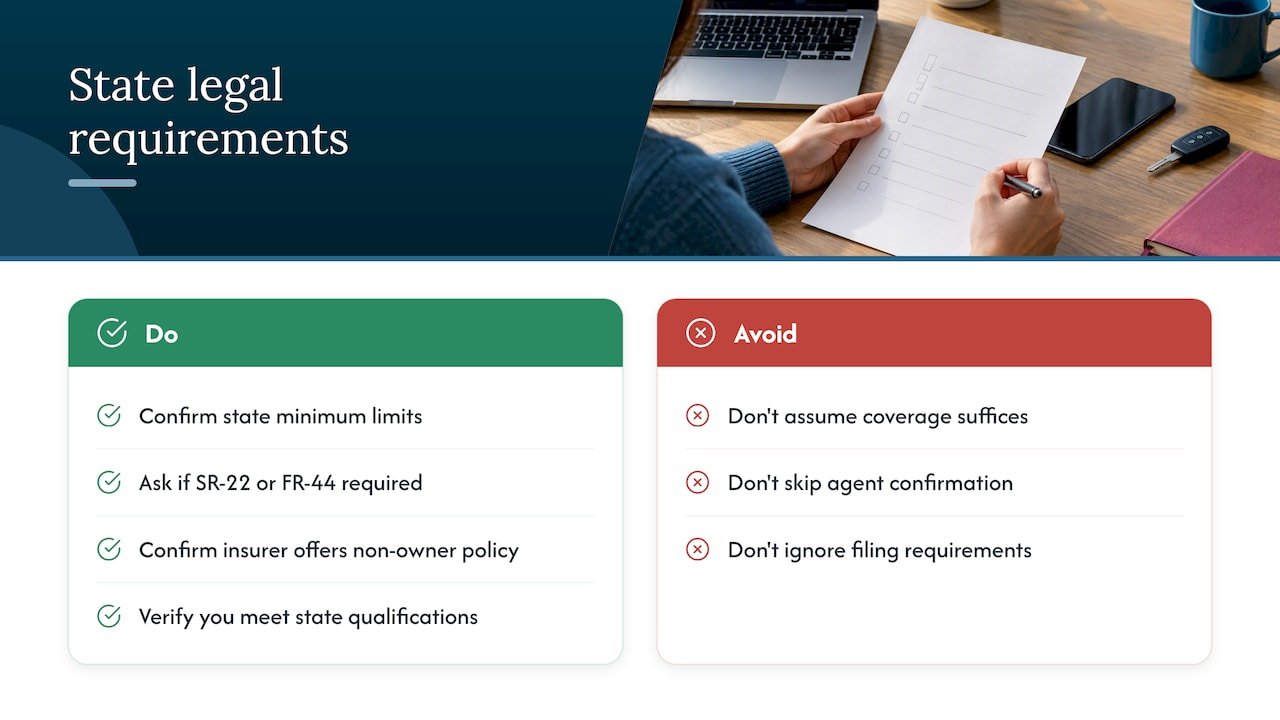
Every state sets its own minimum liability limits, and those minimums apply to any driver operating a vehicle in that state, including someone covered under a non-owner policy. Because a non-owner policy is liability coverage, it generally needs to meet or exceed your state’s minimum bodily injury and property damage requirements to satisfy legal driving obligations.
States also differ on how they handle SR-22 and FR-44 filings. Some require an SR-22 after a DUI, a license suspension, or an at-fault accident without insurance, while others use the similar FR-44 form, which typically carries higher minimum liability limits than a standard SR-22. If you’ve been told you need either filing and don’t own a car, a non-owner policy is usually the most direct route to compliance, since the insurer handles the electronic filing with your state once coverage is active.
One more wrinkle: not every insurer offers non-owner policies in every state, and some states restrict who qualifies, for instance requiring that you not have regular access to a vehicle in your household. Before assuming a policy will work for your situation, it’s worth confirming with a licensed agent in your state that the coverage and filing match what’s legally required for your case.
Impact of driving record and credit score on premiums
Your driving record carries real weight in how a non-owner policy is priced. Insurers look at recent violations, accidents, and especially whether you’re required to carry an SR-22 or FR-44, since those filings typically follow a serious infraction like a DUI or driving without insurance. A clean record for several years can bring your rate down noticeably compared to someone with recent points or a lapse in coverage.
Credit-based insurance scores factor in as well in most states, though a handful prohibit or limit their use. Insurers that use credit history as a rating factor generally view stronger credit as a sign of lower risk, which can translate into a better rate even on a liability-only policy. If your credit has taken a hit, it’s worth asking an agent whether your state allows that factor and how much it’s actually affecting your quote, since the weight it carries varies by company.
Gaps in coverage also matter here. Letting your insurance lapse, even briefly, often signals higher risk to insurers and can push your next quote higher, which is part of why some drivers use a non-owner policy specifically to maintain continuous coverage between vehicles.
How claims are handled and the claims process
Filing a claim under a non-owner policy follows the same basic steps as a standard auto claim: you report the incident to your insurer, provide details about the accident and the vehicle you were driving, and the claims adjuster investigates to determine fault and damages. Because you weren’t driving your own car, the adjuster will also coordinate with the vehicle owner’s insurer, since that policy is typically primary.
If you caused an accident while driving a borrowed or rented car, the owner’s or rental company’s insurance usually pays first, up to their policy limits. Your non-owner policy’s liability coverage then applies as secondary protection, covering costs that exceed what the primary policy pays, within your own policy’s limits. This sequence is why the specific limits you choose on a non-owner policy matter: if you’re relying on it as your main layer of protection, thin limits can leave you exposed to out-of-pocket costs.
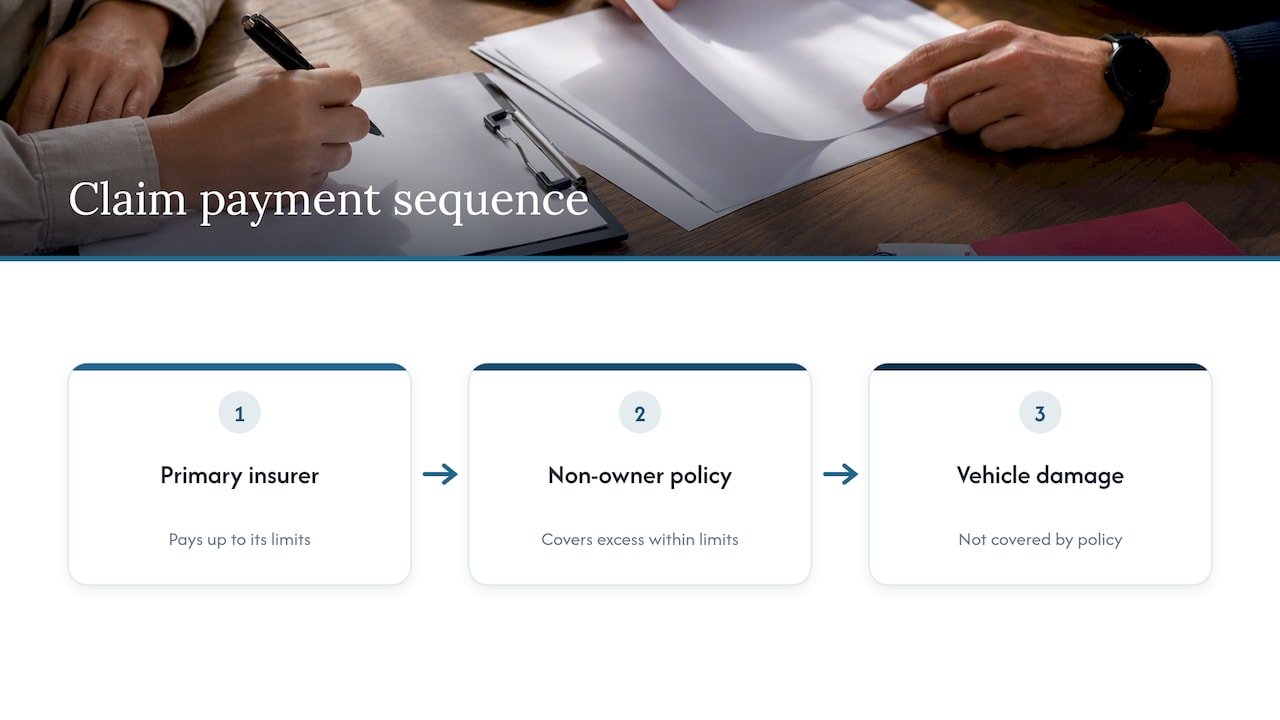
Keep in mind that a non-owner policy generally won’t process a claim for damage to the vehicle you were driving, since that coverage isn’t part of a liability-only policy. If you need help understanding what your policy would and wouldn’t pay for in a specific scenario, that’s a conversation worth having with an agent before you need to file a claim, not after.
Duration and renewal process of non-owner policies
Non-owner policies typically run on standard six-month or twelve-month terms, similar to a conventional auto policy, and most insurers will send a renewal notice before the term ends. If your circumstances haven’t changed, renewal is usually automatic as long as premiums stay current.
If you’re carrying the policy to satisfy an SR-22 or FR-44 filing, pay close attention to your renewal dates. States typically require the filing to stay active for a set period, often a few years, and a lapse in your non-owner policy during that window can trigger a notification to the state and jeopardize your driving privileges. Setting a reminder ahead of each renewal, or asking your agent to flag it, helps avoid an accidental gap.
If your situation changes, say you buy a car or move in with someone whose policy now covers you, it’s worth reviewing whether you still need the non-owner policy at renewal time rather than letting it continue by default.
Daly & Alexander perspective: agent guidance for choosing limits and filing SR-22
Deciding between a non-owner policy and simply being added to someone else’s policy isn’t always obvious from the outside, which is where having an actual person look at your situation helps. We’ve worked through many cases to know that the right answer depends on how often you drive, whose car you’re in, and whether a filing requirement is part of the picture.
We compare your options directly: a non-owner policy, an addition to an existing household policy, or occasional rental coverage, and recommend liability limits based on your actual exposure rather than a generic default. When an SR-22 is involved, filing is handled directly with the state, and if you ever need to file a claim, support is provided through that process rather than leaving you to sort it out with an adjuster alone.
— Nathan
Get a quote or SR-22 filing from Daly & Alexander
If you’ve read this far, you probably already have a sense of whether a non-owner policy fits your situation, whether that’s frequent renting, borrowing a car regularly, or needing an SR-22 filed quickly. We make that next step simple: tell us your situation, and we’ll walk you through the coverage that actually matches it, not a one-size-fits-all package.
Our auto insurance services in Savannah cover non-owner policies and SR-22 filings alike, and if you’re also weighing whether repair deductibles after an accident might strain your budget, Deductible Assist offers a separate program worth knowing about. When you’re ready, reach out and we’ll get you a quote based on your actual driving situation, not guesswork.
FAQ
What is the cheapest non-owner car insurance?
The cheapest option depends on your driving record, state, and whether you need an SR-22, since those factors drive the quote more than any single insurer’s base rate. Getting quotes from a few providers and comparing them directly is the most reliable way to find the lowest price for your specific situation.
Can someone insure a vehicle that is not in their name?
You generally can’t buy a standard owner’s policy on a car that isn’t yours, but a non-owner policy lets you carry your own liability coverage for cars you drive without owning one. This is common for people who frequently rent, borrow, or need to maintain coverage for an SR-22 filing.
What is the purpose of non-owner car insurance?
A non-owner policy provides liability coverage so you’re protected if you cause an accident while driving a car that isn’t registered to you. It’s also a common way to satisfy SR-22 or FR-44 filing requirements for drivers who don’t own a vehicle.
Who offers non-owners insurance?
Many standard auto insurers offer non-owner policies, though availability and rules can vary by state and provider. If you’re trying to sort out which option fits your situation and whether an SR-22 is involved, our SR-22 insurance guide breaks down what to expect, or you can reach out to us directly for a quote.
Sources
- A Driver’s Guide to Non-Owner Car Insurance – NerdWallet
- NAIC consumer guidance: auto insurance and rental vehicles
- WalletHub: non-owner car insurance for rental cars