
Tenant improvements and betterments (often shortened to TIB) are the upgrades you pay for inside a space you rent or don’t fully own, such as new walls, flooring, built-in cabinetry or lighting. Once installed, they usually belong to the building. Your property insurance can still cover your use interest in them, but only if the lease and the policy are set up to do it. This guide explains what counts, how a claim is paid, and what to check before you sign a lease or finish a build-out.
TL;DR
- Improvements and betterments are permanent alterations a tenant pays for that become part of the building and can’t legally be removed at move-out.
- Even though the landlord owns them, you have an insurable interest in using them for the rest of your lease.
- After a loss, payment depends on whether the work is repaired promptly. If it isn’t, the payout is often based on the unamortized value, meaning the time left on your lease.
- Your lease should say in plain words who insures and who rebuilds the improvements.
- Condo owners face the same question with upgrades inside a unit, which are usually covered by an HO-6 policy rather than the master policy.
Table of Contents
- What tenant improvements and betterments actually are
- Improvements versus trade fixtures
- Why you insure something you don’t own
- How a claim is valued
- Who is responsible for insuring them: your lease decides
- The condo version: upgrades inside your unit
- What about residential renters?
- A quick word on taxes
- A checklist before you build out
- Our perspective: where we see tenants get caught
- Coverage for your Savannah business or rental
- FAQ
- Sources
What tenant improvements and betterments actually are
FEMA’s glossary defines improvements and betterments as fixtures, alterations, installations or additions made or acquired solely at a tenant’s expense that form part of an insured building. Insurance trade writers describe them in nearly the same way: permanent changes made by and at the expense of the tenant that may not legally be removed.
Three things have to be true:
- You paid for it. If the landlord funded the work through a construction allowance, the cost picture changes, and so can who insures it.
- It’s attached to the building. It becomes part of the structure, not just something sitting in the space.
- You can’t take it with you. If it stays when you leave, it is a betterment.
If you’re a Savannah restaurant owner who builds a hood and ventilation system into a leased storefront on Broughton Street, or a dental practice that adds plumbing and partition walls to an office suite, you’re looking at classic TIB.
Improvements versus trade fixtures
This distinction trips up a lot of business owners. Trade fixtures are items a business installs for its operations that can be legally removed when the lease ends. Improvements and betterments can’t. The two are often valued differently in a policy, so putting an item in the wrong bucket can lead to coverage gaps or coinsurance penalties.
| Item | Usually treated as | Why |
|---|---|---|
| Partition walls built to your layout | Improvement/betterment | Becomes part of the building |
| New HVAC ductwork you install | Improvement/betterment | Permanent and not removable |
| Built-in reception counter | Often improvement/betterment | Depends on how it is attached and what the lease says |
| Freestanding display shelving | Business personal property | Can be moved out |
| Removable salon chairs or restaurant equipment | Trade fixture or business personal property | Removable at lease end |
The lease has the final word on gray areas, so read its alterations clause before you build anything.
Why you insure something you don’t own
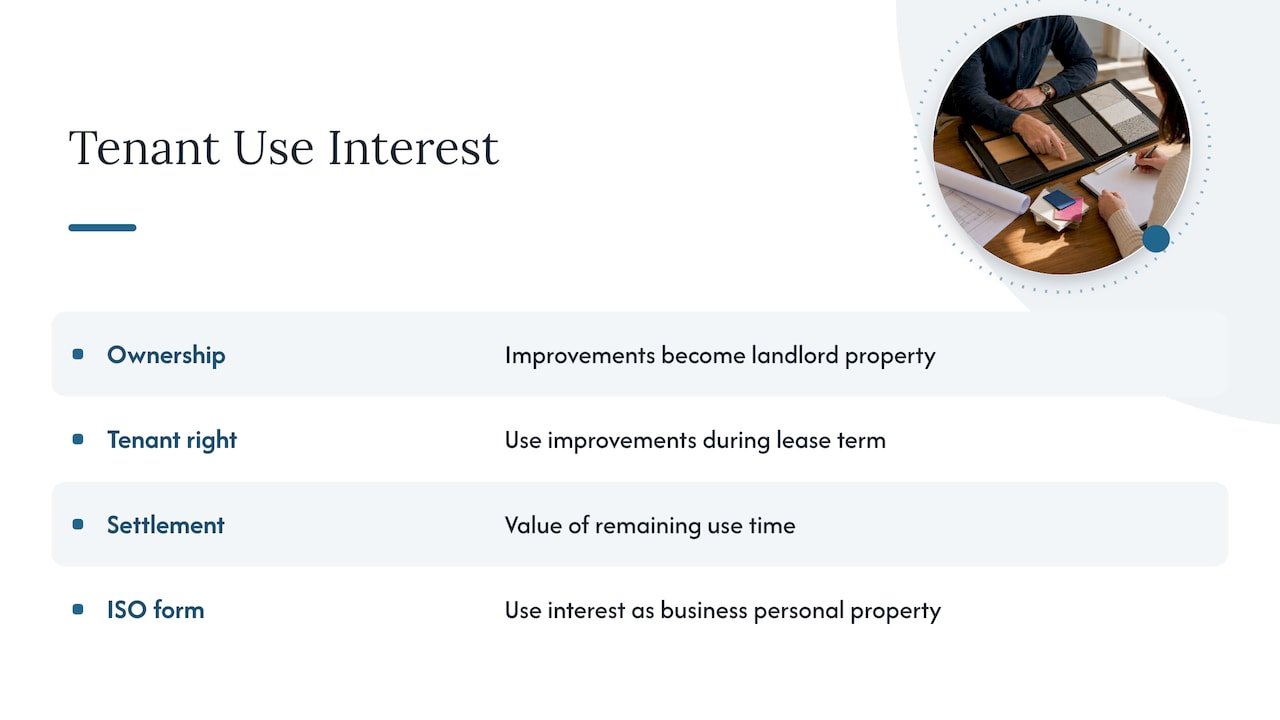
Many tenants assume that paying for the work means owning it. Under standard commercial lease terms, the improvements become the landlord’s property, and the tenant holds a right to use them for the remaining lease term.
Insurance professionals call this a use interest. As Adjusters International explains, the tenant isn’t insuring the physical property itself but the right to use those improvements during the lease. That is why a settlement often focuses on the value of the remaining use time.
Standard commercial property forms reflect this. The ISO Building and Personal Property Coverage Form includes your use interest as tenant in improvements and betterments within the description of business personal property. A coverage description for tenants says this protection is available only to named insureds that are tenants of the building. The Insurance Information Institute notes that if a service business rents its premises, its property policy provides coverage for tenants’ improvements and betterments. Confirm that it is on your policy rather than assuming it.
How a claim is valued
This is where the surprises happen. According to IRMI’s analysis, the valuation depends on whether the improvements are promptly repaired or replaced:
- Repaired promptly: the policy typically pays actual cash value.
- Not repaired: you receive only a proportion of the original cost, based on the unamortized value, calculated from the time remaining on the lease.
Here is a simple illustration. These numbers are hypothetical, not a quote or a policy term. Say you spent $100,000 on a build-out with a 10-year lease. A fire hits at year 8, and you and the landlord decide not to rebuild. A proportional, unamortized approach would pay on roughly the two years of use left, not the full $100,000. If you do rebuild right away, the picture is different, and the claim is generally paid to fund the repair.
Practical takeaways:
- Rebuild decisions after a loss have money consequences. Talk to your agent before you sign off on anything.
- Coverage that pays based on the lease term gets thinner as the lease runs down. A longer lease or a renewal can change what your coverage is worth.
- Ask how your policy values improvements, and whether the limit you’ve chosen reflects the actual build-out cost.
As one insurance coverage column puts it, after a fire the improvements are the landlord’s property, and the tenant’s own loss is the use interest. That is the logic behind the formulas.
Who is responsible for insuring them: your lease decides
Insurance trouble often starts with silence in a lease. According to Wolf Commercial Real Estate, both landlords and tenants should state in the lease who is responsible for insuring improvements. If the lease doesn’t say who repairs or replaces them, both sides can end up with complications such as underinsurance penalties or coverage gaps in a claim.
Before you sign, ask these questions:
- Who must insure the improvements, and for what amount?
- If the building is damaged, who rebuilds them, and by when?
- Does the landlord’s policy cover the building shell only, or tenant build-outs too?
- Who owns the improvements at the end of the lease, and does the lease require you to remove any of them?
- If you receive a construction allowance from the landlord, how does that change ownership and insurance?
Get answers in writing, and share the lease with your insurance agent early. It is much easier to fix a gap before you build than after a loss.
If an insurer unreasonably delays or underpays a valid claim, that can raise questions of insurance bad faith law. A licensed attorney in your state can tell you where you stand. The better move is to avoid the dispute with documentation: keep contracts, invoices, permits and photos of the build-out.
The condo version: upgrades inside your unit
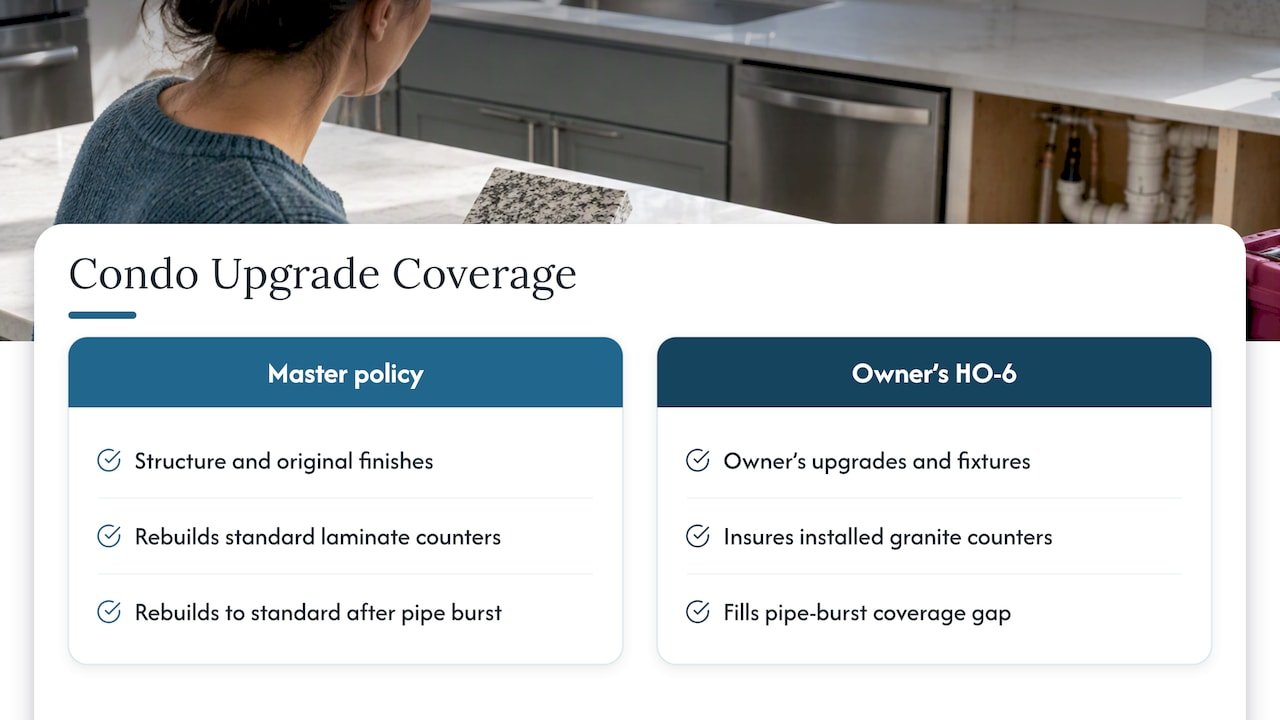
The search term “improvements and betterments” also shows up for condo owners, and the idea is similar. According to the Washington Office of the Insurance Commissioner, an association’s master policy typically covers the building structure and original finishes, while unit owners insure their own upgrades, such as improved flooring or fixtures, with an individual HO-6 policy. The details depend on the association’s governing documents, which define a “standard unit.” Anything beyond that standard is generally yours to insure.
Example: your building’s standard unit has laminate counters, and you installed granite. If a pipe bursts and the association rebuilds to standard, the granite upgrade is a gap your HO-6 needs to fill.
If you own a condo in or around Savannah, start with our guide to HO-6 coverage and master policy gaps, then read about condo insurance in Savannah.
What about residential renters?
Residential tenants have a similar, if smaller, interest. A PropertyCasualty360 analysis notes that, just as commercial lessees have a use interest in additions and improvements made at their expense, a residential tenant has a similar interest. Most renters never face this, because most leases bar major alterations. But if your landlord has approved a built-in, new fixtures or other upgrades you’ve paid for, tell your agent. Our renters insurance guide covers what a typical policy does and doesn’t include.
Landlords have the mirror-image question. If you rent out property, our long-term rental insurance guide explains how your coverage fits with what your tenants carry. And if you are gutting a property between tenants, see our vacant renovation insurance guide.
A quick word on taxes
Tenant improvements also have tax angles, and your interests and your landlord’s can pull in different directions. Tax specialist Mark Hennigh points out two basic principles: income is taxable in the year it is received, and the owner of a leasehold improvement must depreciate it. Another write-up of the same topic notes that tenants should be careful with cash allowances that could be treated as taxable income, and that landlords often want to avoid the 39-year depreciation period for nonresidential real property. Your CPA, not your insurance agent, should guide this part.
A checklist before you build out
- Read the lease alterations clause and mark which items you must remove at move-out.
- Separate trade fixtures from improvements in your budget, so each one is insured under the right category.
- Document the total cost of the build-out, with contracts and receipts.
- Ask your agent how your policy values TIB, and whether your limit matches the build-out cost.
- Clarify who rebuilds after a loss and how fast.
- Revisit coverage at renewal or when you extend the lease, since remaining lease time affects value.
- Check related coverage, such as business income after a loss that shuts you down.
Our perspective: where we see tenants get caught
We work with Savannah business owners, landlords and condo owners, and the same pattern repeats. People insure their inventory and equipment carefully, then forget the walls, floors and fixtures they paid for. Nobody thinks about it until a pipe bursts or a storm comes through, and then the lease turns out to be vague about who rebuilds.
Our advice is simple. Bring your lease to your agent before the contractor starts, not after. A good agent reads the alterations and insurance clauses, tells you what the landlord’s policy probably leaves to you, and builds your coverage around that. We act as your advocate, not just a policy seller, so we’d rather catch a gap in a conversation than during a claim.
If you do have a loss, document everything, call us early, and hold off on major repair decisions until we’ve talked through how your policy values the work.
— Nathan
Coverage for your Savannah business or rental
If you lease commercial space, a Business Owners Policy can bundle property and liability protection, with published pricing of $500 to $3,500 per year depending on your business. For a broader look at how contents and building coverage work together, see our commercial property insurance guide. When you’re ready to talk through your lease and your build-out, reach out to Daly & Alexander and we’ll go through the details with you.
FAQ
What are improvements and betterments in insurance?
They are fixtures, alterations, installations or additions a tenant pays for that become part of the building. The tenant can’t legally remove them. Insurance covers the tenant’s use interest in them for the lease term rather than outright ownership.
Is tenant improvement coverage the same as a tenant improvement allowance?
No. An allowance is money a landlord provides toward a build-out, and it carries lease and tax consequences. Improvements and betterments coverage is the insurance that protects what you’ve built if it’s damaged. Ask your agent and your CPA about each separately.
Does the landlord’s policy cover what I build?
Not necessarily. It depends on what the lease says and what the landlord’s policy insures. If the lease is silent, both sides risk gaps, so spell out responsibility in writing and check with your agent.
Do condo owners need improvements and betterments coverage?
Usually through an HO-6 policy. A master policy typically covers the building and original finishes, so upgrades beyond the association’s standard unit are generally the owner’s to insure. Check your association’s governing documents for the exact definition.
Sources
- FEMA: Improvements and Betterments
- IRMI: Tenants’ Improvements and Betterments, Important Considerations
- Adjusters International: Understanding Improvements and Betterments
- Improvements And Betterments coverage description
- PropertyCasualty360: Tenant Interest in Improvements and Betterments After Loss
- PropertyCasualty360: Improvements, Additions and Alterations
- Wolf Commercial Real Estate: Tenant Improvements and Betterments
- Washington Office of the Insurance Commissioner: How Condo Insurance Works
- Mark S. Hennigh: Tax Considerations Affecting Construction Allowances
- Shenkman Education: Tenant Improvements and Costs, Tax Benefits
Recommended
- Landlord Liability Coverage: 4 Protections, One Costly Catch
- Vacant Renovation Insurance Guide: Coverage, Vacancy Definitions & Everything Property Owners Need to Know During Renovation
- Vacant Renovation Insurance Savannah GA
- Long-Term Rental Insurance Guide: Landlord Insurance Coverage, Property Types & Everything Rental Owners Need to Know