
A waiver of subrogation is an insurance endorsement or contract clause that stops your insurer from suing a third party to recover what it paid you on a covered claim. You’ll see these clauses in construction contracts, commercial leases, and vendor agreements, and adding one usually means an endorsement and sometimes an added premium. Verifying one takes more than a certificate of insurance: you need the actual endorsement form.
TL;DR:
- A waiver of subrogation prevents an insurer from pursuing third parties for claims paid, requiring the endorsement to be in place before the loss occurs.
- Different forms apply depending on policy lines, with scheduled waivers protecting only listed parties and blanket waivers applying broadly where mandated by contract.
- Obtaining the endorsement involves requesting the actual form, verifying form number and schedule, and confirming it accompanies the policy at least before work begins.
- Waivers typically cost extra, especially on workers’ compensation policies, and charges vary depending on carrier and policy type.
- Courts usually uphold valid, pre-loss waivers, but international and jurisdictional differences can affect enforceability and should be reviewed with legal counsel.
Table of Contents
- What a waiver of subrogation is and how it works
- Why parties ask for waivers and what they risk
- Common waiver endorsement forms and how to read them
- How to request, document, and verify a waiver
- Typical costs and insurer requirements for adding a waiver
- Legal enforceability and representative court outcomes
- When to accept, negotiate, or decline a waiver
- How Daly & Alexander helps with policy review and endorsements
- Procedures to revoke a waiver of subrogation if permitted
- International considerations or variations in waiver of subrogation practices
- Balancing litigation avoidance against insurability
- How Daly & Alexander can help you get it right
- Primary sources and forms to consult
- Sources
- FAQ
What a waiver of subrogation is and how it works
Subrogation is the process that lets your insurer step into your shoes after paying a claim and go after whoever actually caused the loss. Say a delivery truck backs into your storefront: your insurer pays for the damage, then pursues the trucking company to recoup that payout. A waiver of subrogation cuts that recovery path off before it starts.
Because the insurer’s right to pursue a third party is derivative, meaning it only has the rights you had, a contract clause where you agree not to sue someone effectively ties your insurer’s hands too. That agreement then gets formalized through a policy endorsement, which is what actually binds the insurance company to give up its recovery rights.
Timing matters more than almost anything else here. The waiver has to exist before the loss happens. An insurer that already paid a claim, or a contract signed after an incident, generally can’t undo subrogation rights retroactively, according to IRMI.
Why parties ask for waivers and what they risk
Contractors, landlords, and vendors ask for these waivers for practical reasons. A general contractor doesn’t want a subcontractor’s insurer coming after them for a jobsite fire; a landlord doesn’t want a tenant’s carrier chasing the building owner after a burst pipe.
- Waivers reduce litigation between parties who need to keep working together.
- They speed up claims handling because nobody is waiting on a third-party recovery fight.
- They preserve business relationships that a subrogation lawsuit would otherwise strain.
The tradeoff cuts the other way for insurers. A carrier that waives subrogation loses its shot at recouping the payout, which is part of why Investopedia notes insurers frequently charge extra for the endorsement. There’s also exposure risk if policy limits or exclusions apply, since the waiver doesn’t create coverage where none existed.
Pro Tip: When you only need to protect one specific party, ask for a scheduled waiver naming that party rather than a blanket waiver that gives up rights broadly.
Common waiver endorsement forms and how to read them
Waivers aren’t one generic document. They come as specific ISO endorsement forms tied to specific policy lines, and knowing the form number tells you exactly what you’re getting.
- CG 24 04 covers general liability with a schedule naming specific parties.
- CG 24 53 is the automatic version for general liability, applying broadly where a written contract requires it.
- CA 04 44 and CA 04 43 handle business auto policies.
- WC 00 03 13 applies to workers’ compensation.
The form numbers and their coverage lines are documented by COI Software, which also flags that relying on additional-insured status alone won’t protect you the way a subrogation waiver does, especially when a loss falls outside the additional-insured language or exceeds policy limits.
A scheduled waiver only protects the parties listed by name. A blanket waiver applies automatically to anyone you have a written contract with requiring it, which is why most large projects with many subcontractors default to blanket wording rather than chasing individual endorsements.
One warning worth repeating: a certificate of insurance or an ACORD form is not the endorsement. It’s a summary, and summaries can be wrong. Always request the actual endorsement page.
How to request, document, and verify a waiver
Getting a waiver in place correctly takes a few deliberate steps, and skipping any one of them is how gaps happen.
- Put it in the contract first. The written agreement should require the waiver be in effect before the occurrence, not after.
- Request the endorsement from your insurer, not just a certificate. Ask your agent for the actual form and its schedule.
- Check three things on the document itself: the correct form number, the correct policy line (general liability, auto, workers’ comp), and whether the schedule text says blanket or names specific parties. If you carry umbrella or excess coverage, confirm it follows form to the underlying waiver.
- File the endorsement somewhere retrievable and revisit it at renewal, since waivers don’t always carry forward automatically.
If your carrier won’t add the waiver, you’re not out of options. Negotiating indemnity language or increasing liability limits can sometimes cover the same risk transfer without the endorsement.
Pro Tip: Set a calendar reminder tied to your policy renewal date to reconfirm the waiver is still attached, since endorsements sometimes drop off during a renewal rewrite.
Typical costs and insurer requirements for adding a waiver
Waivers aren’t usually free. Workers’ compensation waivers commonly carry a percentage-based charge on developed premium, sometimes with a stated minimum, according to COI Software’s blanket waiver explainer.
- General liability and auto waivers may or may not carry a separate charge, depending on the carrier.
- Assigned-risk or residual-market workers’ comp policies often won’t issue a blanket waiver at any price.
- A certificate of insurance never shows whether a charge applies, so ask your agent directly about the premium impact before assuming the waiver is included.
Small contractors placed in assigned-risk plans face the tightest restrictions here, since those markets exist for higher-risk businesses that standard carriers won’t write.
Legal enforceability and representative court outcomes
Courts generally uphold waivers of subrogation when the language is clear and the waiver was in place before the loss. Because an insurer’s subrogation right is derivative of the insured’s own right to sue, a valid pre-loss waiver by the insured blocks the insurer from stepping into a claim it never had standing to pursue.
- Appellate courts examining AIA-style construction contract waivers have treated them as enforceable, barring insurer recovery when the contract language was clear and executed before the loss, per the Third Circuit’s opinion on AIA waiver language.
- State statutes and specific policy wording can still narrow or expand how far a waiver reaches, so the same clause won’t necessarily behave the same way in every jurisdiction.
Waiver clauses can bar insurer suits when the contract language is clear and executed before loss.
A waiver doesn’t erase liability. It just decides who absorbs the cost when a covered loss happens: the liable party walks away from that particular insurer’s recovery claim, but the underlying fault and any uncovered exposure remain exactly where they were.
When to accept, negotiate, or decline a waiver
Whether a waiver makes sense depends on your leverage, your exposure, and what it costs relative to the risk you’re actually transferring.
- Weigh your bargaining position: a small subcontractor on a large project has less room to push back than a general contractor setting the terms.
- Ask for scheduled naming when you want protection limited to specific parties rather than handing over blanket rights.
- Get the endorsement copy in hand before work starts, never after.
- Decline or renegotiate when the premium cost is disproportionate to the risk transferred, when you can’t secure matching umbrella or excess coverage, or when your policy line simply won’t allow it.
How Daly & Alexander helps with policy review and endorsements
Daly & Alexander Insurance reviews commercial policies, requests endorsements from carriers, and helps clients confirm the schedule text matches what a contract actually requires. Backed by over 45 years of experience across business owner policies, commercial liability, and workers’ compensation lines, the agency also provides claims support if a dispute ever reaches that point.
Procedures to revoke a waiver of subrogation if permitted
Revoking a waiver isn’t automatic, and it isn’t something you do unilaterally in most cases. If the waiver lives in a policy endorsement, the standard path is a formal request to the carrier to remove or amend the endorsement, typically timed to a policy renewal or a scheduled midterm change. Carriers generally require written notice, and removing the endorsement usually means notifying every party who was relying on it under the underlying contract.
If the waiver was written into the contract itself rather than only the policy, revocation gets more complicated. Both parties typically need to agree to modify or terminate that provision, since a unilateral attempt to walk away from a signed contractual waiver can expose you to a breach claim regardless of what your insurer does with the endorsement.
A few practical points matter here:
- Check whether the underlying contract sets its own notice period or renewal window for changing insurance requirements.
- Confirm with your carrier whether removing the endorsement affects your premium, since some waiver charges are baked into rating for the full term.
- Notify any additional insureds or scheduled parties promptly, since they may be relying on the waiver for their own risk planning.
- If work is already underway, consider whether removing a subrogation waiver mid-project creates a gap that needs a temporary alternative, like an indemnity agreement, until the contract can be formally amended.
Because revocation touches both the policy and the contract, it’s worth looping in whoever handles your commercial coverage before sending any formal notice, so the insurance side and the contract side change at the same time rather than drifting apart.
International considerations or variations in waiver of subrogation practices
Subrogation itself is a concept recognized well beyond domestic insurance markets, but how waivers are treated shifts from one legal system to another. Civil law jurisdictions, common law jurisdictions, and countries with codified insurance statutes don’t all handle a pre-loss waiver the same way a court in the reader’s own market would.
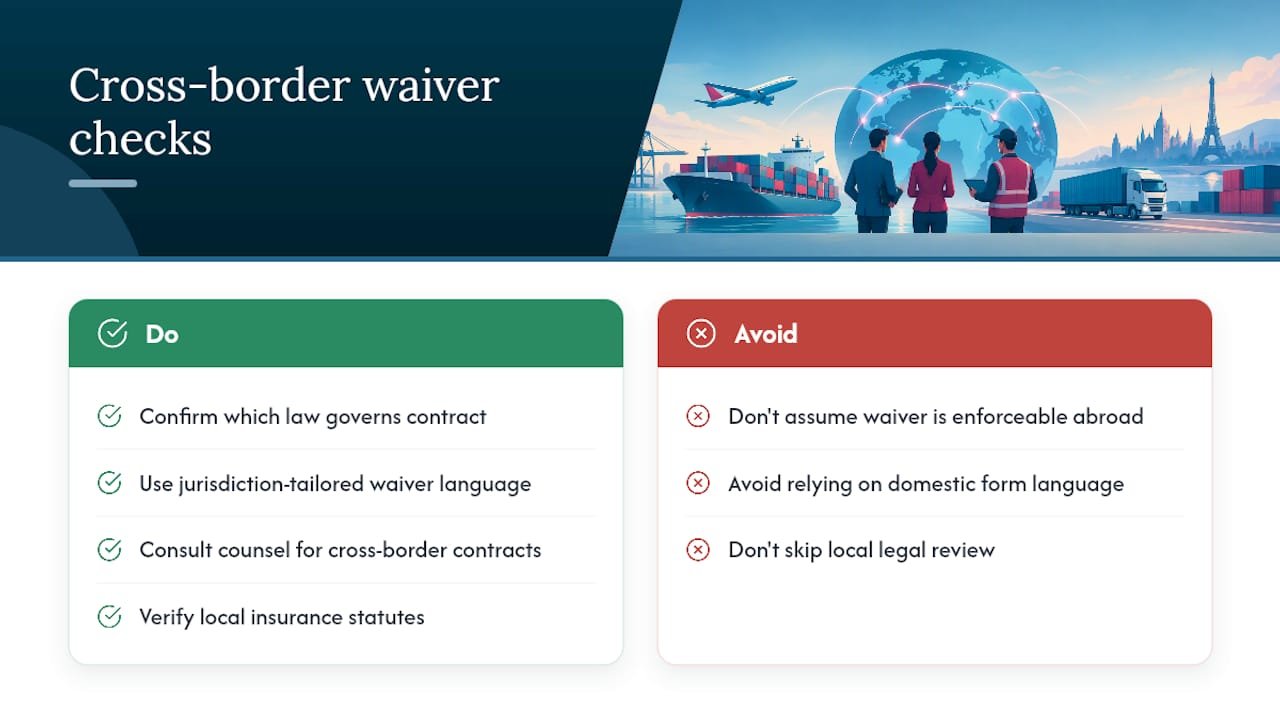
Construction and shipping contracts that cross borders often specify which country’s law governs the agreement precisely because subrogation and waiver enforceability can differ so much. A waiver clause drafted with domestic form language in mind may not carry the same weight if a dispute ends up in a foreign court or under a different country’s insurance code.
For anyone dealing with a multinational vendor, an overseas lease, or an international construction project, the practical move is the same one that applies domestically, just with an added layer: confirm which jurisdiction’s law governs the contract, and don’t assume a waiver that works under one country’s rules for insurance endorsements will function identically somewhere else. Where a contract touches multiple countries, involving legal counsel familiar with each relevant jurisdiction is worth the cost relative to the risk of an unenforceable clause.
Balancing litigation avoidance against insurability
A waiver of subrogation is one tool, not a substitute for adequate limits or clear indemnity language. Verify the endorsement, loop in your broker early, and bring in counsel when the exposure is significant.
— Nathan
How Daly & Alexander can help you get it right
Sorting out whether a contract needs a scheduled or blanket waiver, and getting the actual endorsement in hand, is a detail an insurance agent should walk through with clients rather than leave them to guess. Agents typically review contract language, request the right endorsement from carriers, and check the schedule text before documents are signed.

| What you get | What it covers |
|---|---|
| Contract and policy review | Confirming waiver language matches your coverage |
| Endorsement procurement | Requesting the correct form from your carrier |
| Claims support | Assistance if a dispute or loss arises later |
If you’re negotiating a contract that requires a waiver of subrogation, start with a Business Owners Policy review or reach out about commercial liability coverage to get the endorsement conversation moving before you sign.
Primary sources and forms to consult
For readers who want the original material behind this guide:
- ISO endorsement forms CG 24 04, CG 24 53, CA 04 44, CA 04 43, and WC 00 03 13, detailed by COI Software.
- Court treatment of construction waiver clauses in the Third Circuit’s AIA-related opinion.
- Background definitions from Investopedia and IRMI.
- Always request the actual endorsement copy, form number and schedule included, directly from the insurer rather than relying on a certificate.
Sources
- Investopedia — Waiver of subrogation
- COI Software — Waiver of Subrogation Endorsement: CG 24 04 and Blanket
- Third Circuit opinion (AIA waiver context) — court opinion PDF
- IRMI — Waiver of subrogation
FAQ
Why would I want a waiver of subrogation?
A waiver of subrogation keeps your insurer from suing a business partner, landlord, or vendor after paying your claim, which helps preserve that working relationship. It’s commonly requested in construction contracts and leases where ongoing cooperation matters more than recovering a payout from a party you’ll keep working with.
What is an example of subrogation?
If a contractor’s equipment damages your property and your insurer pays for the repair, the insurer can then pursue the contractor to recover what it paid. That recovery step is subrogation, and a waiver in the contract beforehand would have blocked it.
What is another term for waiver of subrogation?
It’s sometimes called a “subrogation waiver” or referred to by its specific endorsement form, such as CG 24 04 for general liability, as documented by COI Software. The underlying concept stays the same regardless of the label used.
How much does a waiver of subrogation cost?
Costs vary by policy line and carrier, and there’s no single published rate. Workers’ compensation waivers commonly carry a percentage-based charge on premium, sometimes with a minimum, according to COI Software’s explainer, while general liability and auto charges depend on the individual carrier’s underwriting.