
A workers comp ghost policy is a minimum-premium workers’ compensation policy that gives an owner-only business a valid certificate of insurance without covering the owner if they get hurt on the job. It exists so solo contractors can satisfy a general contractor’s paperwork or a licensing board’s requirement. The tradeoff is real: you get the certificate, but you don’t get the wage or medical benefits a normal policy provides, and hiring even one helper off the books can undo the whole arrangement.
TL;DR:
- Ghost policies typically cost between $750 and $2,500 annually, with higher rates for trades like roofing and framing, and include optional endorsements costing up to $150.
- These policies offer a valid certificate but exclude the owner from coverage, leaving them without wage or medical protection if injured on the job.
- Hiring even a casual helper or apprentice can reclassify the business as having payroll, risking audit penalties and liability exposure if not properly documented.
- Many states restrict or prohibit ghost policies, especially for licensing or public work projects, requiring full policies with declared payroll instead.
- Proper recordkeeping, including itemized invoices and signed affidavits, is critical to avoid costly audits and ensure the policy remains appropriate for solo operators.
Table of Contents
- What Is a Workers Comp Ghost Policy, Exactly?
- Who Actually Needs One?
- What Coverage Gaps Should You Expect?
- How Much Does a Ghost Policy Cost?
- Do All States Allow Ghost Policies?
- What Happens if You Hire a Helper?
- How Do You Get a Ghost Policy?
- How Do You Spot a Ghost Policy on a COI?
- What Agents See Go Wrong Most Often
- The Real Problem With Ghost Policy Advice Online
- Get Local Help With a Workers’ Comp Ghost Policy
- Sources
- FAQ
What Is a Workers Comp Ghost Policy, Exactly?
Carriers write a ghost policy with zero declared payroll and an owner-exclusion endorsement attached to the standard policy form. That endorsement tells the insurance company, in writing, that the business owner is not a covered employee. The industry uses a few interchangeable names for the same product: “ghost policy,” “if-any policy,” and “minimum-premium policy” all describe the same setup.
Once the endorsement is in place, your agent issues an ACORD 25 certificate of insurance, the standard form GCs and licensing boards use to verify coverage. Insurers still charge a minimum earned premium even though there’s no payroll to insure, because the policy has to exist somewhere on paper. It’s the cost of having an active policy number a computer system or compliance officer can verify.
Who Actually Needs One?
Sole proprietors, single-member LLCs, and some officer-excluded corporations with no employees are the typical candidates. If you’re the only person doing the work, and your state allows an exemption for owner-only entities, a signed exemption certificate may satisfy a licensing board on its own.
Contracts are a different animal. Many general contractors won’t accept an exemption form at all. They want an active policy number, and often a waiver of subrogation, because their own insurer requires it before subcontractors set foot on a job site. That’s when a ghost policy earns its keep.
If you expect to hire help within the policy year, or you want actual wage and medical protection for yourself, skip the ghost policy and buy a full workers’ comp policy instead. It costs more, but it removes the guesswork.
What Coverage Gaps Should You Expect?
The owner-exclusion endorsement means exactly what it says: if you’re hurt on the job, this policy pays nothing toward your medical bills or lost wages. That’s the single biggest misunderstanding contractors have about ghost policies, and it’s worth repeating before you sign anything.

What the policy does provide is a live policy number, valid dates, and the ability to attach endorsements a GC might demand, such as additional insured or waiver of subrogation language. That’s often enough to get through a bid process.
The gap that catches people off guard is statutory-employer exposure. If you pay a subcontractor or helper who isn’t properly insured, some states can treat you, or the GC above you, as the statutory employer responsible for that person’s injury claim. A final-premium audit can reclassify those payments as payroll after the fact, which is where the real financial risk shows up.
How Much Does a Ghost Policy Cost?
Ghost policies typically run $750 to $2,500 per year, depending on your class code, your state, and broker fees. Roofers and framers land toward the higher end; lower-risk trades like handyman services or consulting-adjacent work tend to sit closer to the floor.
Endorsements add modest costs on top. A waiver of subrogation commonly adds $25 to $150, and turnaround is usually a day or two once the underlying policy is bound. Additional insured requests are similarly quick in most cases.
Keep in mind the price you pay at binding isn’t necessarily the final bill. If an audit finds payments that look like payroll, your carrier can rebill you for the difference after the policy period ends.
Do All States Allow Ghost Policies?
No. Some states restrict or outright disallow minimum-premium policies, and licensing boards in those states may require a full policy with declared payroll before issuing or renewing a contractor’s license. California’s contractor licensing rules, for example, have specific nuances around how carriers file coverage electronically with the regulator, which is how the state confirms a policy is active.
Rules also shift on public-works and federally funded jobs. A Davis-Bacon project or a municipal contract can demand proof of coverage that goes beyond a standard certificate, sometimes requiring specific wage and classification documentation a ghost policy wasn’t built to provide.
Before you assume a ghost policy will work, check your state workers’ compensation board and your trade’s licensing agency directly. Rules change by state and sometimes by county-level permitting office, and an agent familiar with your market can flag a mismatch before you’ve already bid the job.
What Happens if You Hire a Helper?
Final-premium audits exist because insurers price a policy on estimated exposure, then true it up against what actually happened. Auditors look for cash payments, unitemized invoices, and any sign that someone besides the owner did billable work.
That last item is the one that trips up solo contractors. Bring on a casual helper or an apprentice for even a few weeks, and you may have created a statutory employer relationship, one that can pull liability up the chain to the GC and trigger claims that affect experience modification rates for everyone involved. An uninsured helper’s injury doesn’t disappear just because your policy excludes you.
A few habits reduce that exposure significantly:
- Keep invoices itemized by labor and materials, not lump-sum totals.
- Sign a solo-operator affidavit each policy period confirming you have no employees.
- Add a clause to your subcontract agreements prohibiting unauthorized helpers on the job site.
Pro Tip: If you ever plan to bring on even one helper for a rush job, call your agent first. A same-day policy adjustment costs far less than an audit reclassification six months later.
How Do You Get a Ghost Policy?
Getting quoted is faster than most contractors expect, provided you have the right information ready.
- Confirm your entity type (sole proprietor, single-member LLC, or officer-excluded corporation) and your class code.
- Tell your agent your expected payroll is $0 and explain the contract language driving the request.
- Specify any endorsements the GC or license board requires, especially waiver of subrogation.
- Review the ACORD 25 fields before you accept the certificate, particularly the policy number and effective dates.
- Keep itemized invoices and a signed solo-operator affidavit on file in case of an audit.
That last step matters more than most contractors realize. A well-documented file can be the difference between a clean audit and a surprise bill.
How Do You Spot a Ghost Policy on a COI?
If you’re a GC reviewing a sub’s paperwork, or a contractor checking your own certificate, look for these markers on the ACORD 25:
- The “Any proprietor/partner/executive officer excluded?” box marked “Y.”
- Endorsement language referencing owner exclusion or “If-Any” payroll.
- A valid policy number with current effective and expiration dates.
- A waiver of subrogation endorsement, if your contract requires one.
If any of these are missing, or the dates have lapsed, call the agent listed on the certificate before you sign a contract based on it.
What Agents See Go Wrong Most Often
A common mistake contractors make isn’t choosing the wrong policy type, it’s failing to update it. A contractor buys a ghost policy, then quietly starts using a helper for busy season without telling anyone.
We typically recommend a ghost policy for genuinely solo operators who need a certificate for bidding, and a full policy the moment hiring becomes likely. Documenting that intent upfront, in writing, protects you if a question ever comes up during an audit or a claim.
The Real Problem With Ghost Policy Advice Online
Most guides treat ghost policies like a paperwork hack, something you buy once and forget. That framing undersells the risk. The policy itself is simple. The exposure comes from what happens after you buy it, specifically whether your business stays exactly as solo as it was on the day you signed.
Conventional advice focuses almost entirely on cost and eligibility, and barely touches the audit mechanics that actually cause financial pain. A $1,200 annual premium looks cheap right up until an auditor reclassifies six months of “material and labor” invoices as payroll for an unlisted helper. That’s not a hypothetical edge case. It’s the single most predictable way a ghost policy backfires.
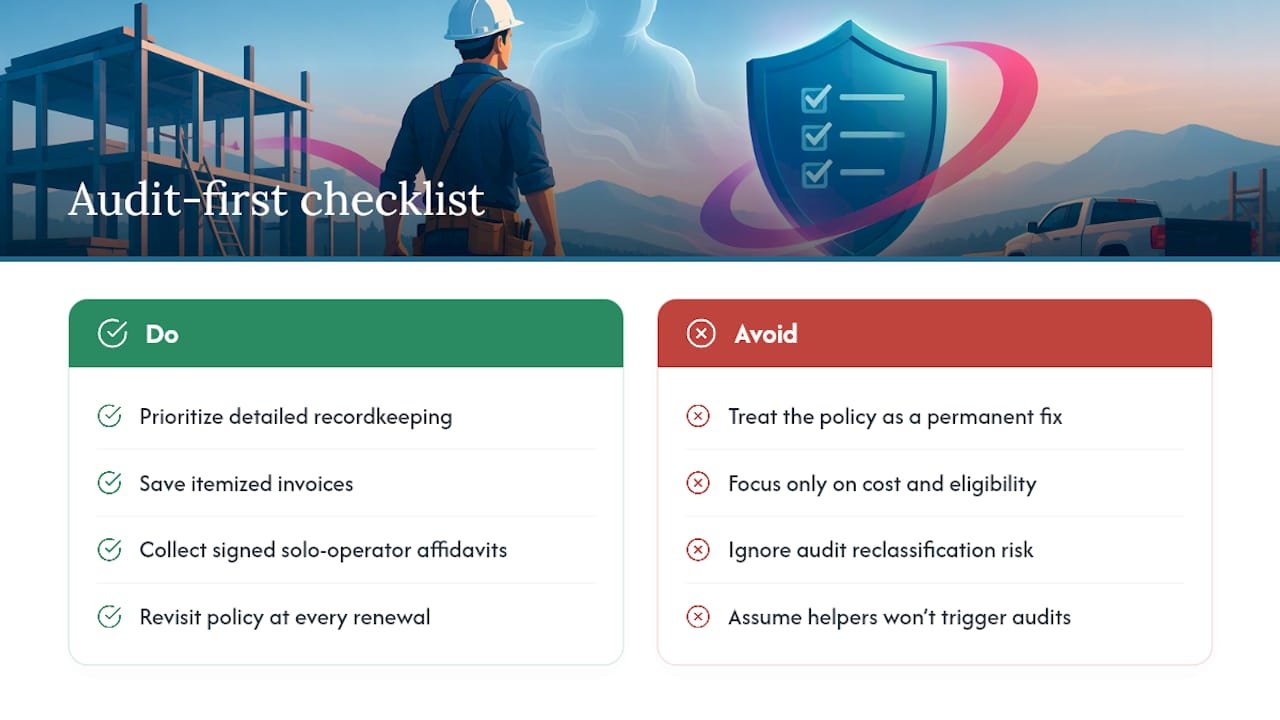
If there’s one priority worth putting ahead of everything else in this guide, it’s recordkeeping. Not the endorsement schedule, not the class code, the paper trail proving you worked alone. Contractors who keep itemized invoices and signed solo-operator affidavits walk into audits with confidence. Contractors who don’t are gambling with a policy that was never designed to protect them if the facts on the ground change.
The instinct to treat a ghost policy as a permanent fix is where most solo contractors get it wrong. Revisit it every renewal, and every time your workload changes.
— Nathan
Get Local Help With a Workers’ Comp Ghost Policy
Local agents can provide Savannah-area contractors with more personalized assistance than generic online quote tools, including checking ACORD 25 fields, endorsement schedules, and contract wording before gaps cause issues with a GC. That local review is what keeps a cheap ghost policy from becoming an expensive audit surprise.

We help owner-only businesses figure out whether a workers’ compensation ghost policy or a full policy fits their situation, and we handle the waiver of subrogation and additional insured requests GCs ask for. To get quoted quickly, have your entity type, class code, and the specific contract or license requirement ready when you call.
Many solo contractors also carry a Business Owners Policy, which runs $500 to $2,500 per year, alongside their workers’ comp coverage for broader liability and property protection. If you’re not sure which combination your contracts actually require, reach out and we’ll walk through it with you before you bid the next job.
Sources
Check your state workers’ compensation board for filing rules, review standard policy language on audits, and consult BLS self-employment data for context on how many U.S. workers operate solo.
This article is general information, not a substitute for advice from a qualified financial advisor. Consult a qualified financial professional about your own circumstances before acting on anything here.
- Workers’ Compensation and Employers Liability Insurance Policy (standard policy excerpts)
- Berkeley labor/regulatory analysis (helper and statutory employer risks)
- North Carolina Department of Insurance — Workers’ Compensation
- Ghost policy pricing guide (state examples)
FAQ
How Much Does a Workers Comp Ghost Policy Cost?
Most ghost policies run $750 to $2,500 per year, depending on class code, state, and broker fees. Endorsements like waiver of subrogation typically add $25 to $150 on top of the base premium.
Does Workers Comp Insurance Monitor Employees?
No. Workers’ compensation carriers don’t surveil workers; they audit payroll records, invoices, and contracts after the policy period to confirm the exposure they insured matches what actually happened. That final-premium audit is where discrepancies, not surveillance, get flagged.
What Is a California Ghost Workers Comp Policy?
It’s the same product used nationwide, a minimum-premium policy with an owner-exclusion endorsement, but California’s contractor licensing system has specific rules about how carriers file coverage electronically with the state. Contractors there should confirm with the CSLB that their carrier’s filing matches licensing requirements before assuming a ghost policy will pass review.
What Is a Workers Comp Ghost Policy in South Carolina?
South Carolina treats ghost policies similarly to most other states: a minimum-premium policy that satisfies a GC’s contract requirement without covering the owner. Availability and specific filing rules should always be confirmed with your state’s workers’ compensation board, since requirements can shift by trade and permitting authority.
Can I Get a Workers’ Comp Policy Through Daly & Alexander?
Yes. Daly & Alexander works with owner-only contractors across the Savannah area to determine whether a ghost policy or a full workers’ compensation policy fits their contract and licensing needs, and handles the endorsement paperwork GCs typically require.