
If someone requests a certificate of insurance, tell them you can provide it and immediately ask for the exact certificate holder name, required coverages, and any additional insured language, then contact your broker or insurer portal to issue it. Having those details ready before you make the call usually means a same-day turnaround instead of a week of back-and-forth.
TL;DR:
- Before contacting your agent, confirm the holder’s exact legal name and address, required coverages and limits, endorsement wording, project dates, deadline, and delivery method.
- A certificate summarizes coverage but does not amend the policy; verify required additional insured or waiver endorsements are active, and request endorsement pages if required.
- An insurer portal may issue certificates instantly, while broker requests can take hours to several business days, especially when an endorsement must be added.
Table of Contents
- What a certificate of insurance actually proves
- When you actually need a COI
- What’s on a COI and how to read it
- How to request a certificate of insurance, step by step
- Copy-ready templates for requesting a COI
- How insurers and brokers deliver certificates, and typical timelines
- How we handle COI requests day to day
- Keeping your COI current without the last-minute scramble
- Why a COI request gets denied or kicked back
- Verifying that a COI is real and accurate
- How a COI protects everyone in the transaction
- What the COI process gets wrong, and what actually matters
- How we help with certificate of insurance requests
- FAQ
- Sources
What a certificate of insurance actually proves
A certificate of insurance, often shortened to COI, is a snapshot document that lists your active policies, your limits, and your insurer’s name. Brokers, agents, or insurers prepare it using standardized ACORD forms, which is why a COI from a Georgia contractor and one from a vendor in another state look nearly identical.
Here is the part that trips people up: a COI does not change your policy. It is informational only, a summary for the certificate holder to review, not a contract amendment. If a lease or job contract requires you to name someone as an “additional insured,” that status has to exist as an actual endorsement on your policy. The certificate can reference it, but the certificate alone does not create it. When a request specifically calls for additional insured status or a waiver of subrogation, ask your agent to confirm the endorsement is in place before the COI goes out, rather than assuming the paperwork will catch up later.
When you actually need a COI
Requests for proof of insurance show up in a handful of predictable situations:
- Signing a commercial lease, where landlords want to confirm you carry liability coverage before handing you keys.
- Landing a contract with a general contractor or property manager who requires proof before subcontractors step on site.
- Renting equipment, where the rental company wants assurance that damage or injury claims will not land on them.
- Running an event, where venues often require event liability coverage and a specific certificate holder listed.
- Working as a vendor or subcontractor, where the hiring business wants confirmation of your coverages and limits.
Requestors ask for a COI because they want to confirm your coverage actually exists at the limits they expect, and because many want to be added as an additional insured or protected by a waiver of subrogation. Some contracts go further and require formal endorsement pages, not just the certificate, so read the fine print before you promise delivery.
What’s on a COI and how to read it
A standard certificate is dense, but it breaks down into a handful of sections worth knowing by name:
- Producer: the broker or agency issuing the certificate.
- Insured: your business name, exactly as it appears on the policy.
- Insurer(s) affording coverage: the carrier or carriers backing each policy.
- Policy numbers and periods: effective and expiration dates for each line of coverage.
- Coverage types and limits: general liability, auto, workers comp, umbrella, and the dollar limits for each.
- Certificate holder: the person or business requesting the proof.
- Description of operations: a short note on what the policy covers in context.
- Cancellation language and authorized signature: standard language on notice and a signature validating the document.
The ACORD 25 Certificate of Liability Insurance form was updated for the December 2025 edition, clarifying disclaimer language and adjusting the coverages grid layout. If you’re comparing an older certificate to a newly issued one, slight differences in wording or grid formatting are expected and do not signal an error.
One distinction matters more than any single field: a line item on the COI grid is not the same as a policy endorsement. The grid shows what coverage exists; it does not, by itself, prove that a third party has been added as an additional insured. That proof lives in the endorsement itself.
How to request a certificate of insurance, step by step
Most delays come from missing details, not from insurer slowness. Work through these steps in order and you will usually avoid a second round of emails.
- Get the exact requirements from whoever is asking. Confirm the certificate holder’s legal name and mailing address, the specific coverages and limits they require, any additional insured or waiver of subrogation language, the project or lease dates, and the deadline and preferred delivery method.
- Check your own policy before you call your agent. Confirm your current limits match what’s being requested and note whether an additional insured endorsement is already on file.
- Contact your agent or broker, or log into your insurer’s portal, with the certificate holder’s details ready to paste in. If an endorsement is needed and isn’t already active, flag it now rather than after the certificate is issued.
- Confirm the delivery method. Some requestors want a PDF by e-mail, others want it uploaded to a compliance portal or sent directly from the insurer to a third party.
- Review the delivered COI against the original request. Check the certificate holder name, limits, and any additional insured language line by line, and follow up immediately if an endorsement is missing.
Pro Tip: Save your certificate holder’s exact legal name and address from their W-9 or contract header. A one-letter mismatch is one of the most common reasons a COI gets kicked back for revision.
Copy-ready templates for requesting a COI
Keep these on hand so you are not drafting a request from scratch every time one comes up.
- Quick e-mail for routine jobs: “Hi [agent name], I need a certificate of insurance for [job or lease name]. Certificate holder: [exact legal name and address]. Required coverage: [general liability limit, auto, workers comp]. Needed by: [date]. Please send directly to [requestor e-mail] or back to me, whichever works best.”
- Formal request for leases or contracts with endorsements: “We have been asked to name [certificate holder name] as an additional insured under our general liability policy, effective [date range], per the attached contract clause. Please confirm the endorsement is active and issue a COI reflecting additional insured status and a waiver of subrogation in favor of [certificate holder].”
- Vendor or subcontractor checklist: a short form listing certificate holder name and address, required coverage types and limits, additional insured status (yes or no), waiver of subrogation (yes or no), project dates, and where the completed COI should be returned.
How insurers and brokers deliver certificates, and typical timelines
Delivery speed depends entirely on how your policy is set up. If your insurer offers an online account, you can often generate and download a certificate instantly, a growing option that cuts turnaround time significantly compared with routing a request through a broker. Broker-issued certificates typically take anywhere from a few hours to several business days, especially when an endorsement has to be added first.
The most common causes of delay are an incorrect certificate holder name or address, a requested endorsement that was never actually bound to the policy, or a policy that lapsed and needs renewal before anything can be issued. Double-checking those three items before you submit a request eliminates most of the wait.
How we handle COI requests day to day
Nathan here. Most of the COI requests we process break down into the same handful of sticking points: a missing endorsement, a misspelled certificate holder name, or a requestor who hasn’t specified limits. Catching those before the request reaches underwriting is what separates a same-day certificate from a three-day one.
With over 45 years handling property and casualty coverage, our agents are used to the construction and event paperwork that comes with Builders Risk and contractor jobs. A short checklist helps every time: confirm the certificate holder’s exact name, confirm whether additional insured status is already endorsed, and confirm the delivery deadline before calling it in.
Keeping your COI current without the last-minute scramble
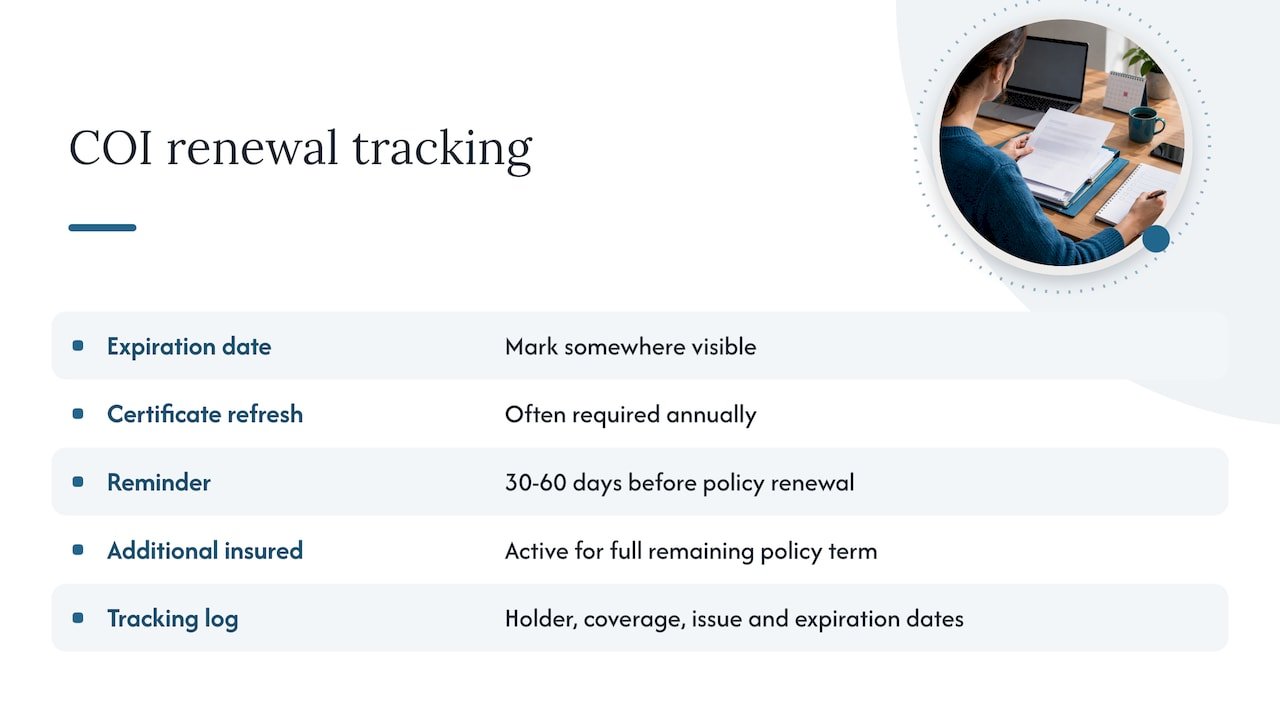
A certificate of insurance is only as good as the policy behind it, which means tracking your renewal date matters as much as the request itself. Mark your policy’s expiration date somewhere you will actually see it, not just in an insurer’s e-mail that gets buried.
If you work with multiple vendors, landlords, or event venues that each hold a copy of your COI, build a simple log: who has a copy, what coverage they require, and when their copy needs to be refreshed. Many contracts require annual renewal of the certificate even if the underlying policy term runs longer, so a certificate issued in January can be stale by the time a lease renews in November.
Set a reminder thirty to sixty days before your policy renews. That gives your agent time to process the renewal and reissue certificates to everyone on your list before the old ones expire, which avoids the common scramble where a property manager or general contractor suddenly flags an expired certificate on file. If you’re adding a new additional insured partway through the year, confirm the endorsement is active for the full remaining policy term, not just until your current certificate’s listed date.
For businesses juggling several active jobs or leases at once, a simple spreadsheet with certificate holder name, coverage required, issue date, and expiration date prevents the kind of gap that shows up only when someone asks for an updated copy and you realize the last one is six months old.
Why a COI request gets denied or kicked back
A handful of issues account for most rejected certificates. The certificate holder’s name is misspelled or doesn’t match their legal entity name exactly. The requested coverage limits exceed what your current policy provides. The additional insured endorsement was requested but never actually bound to the policy before the certificate was issued. Or the policy itself has lapsed, which means there is nothing valid to certify.
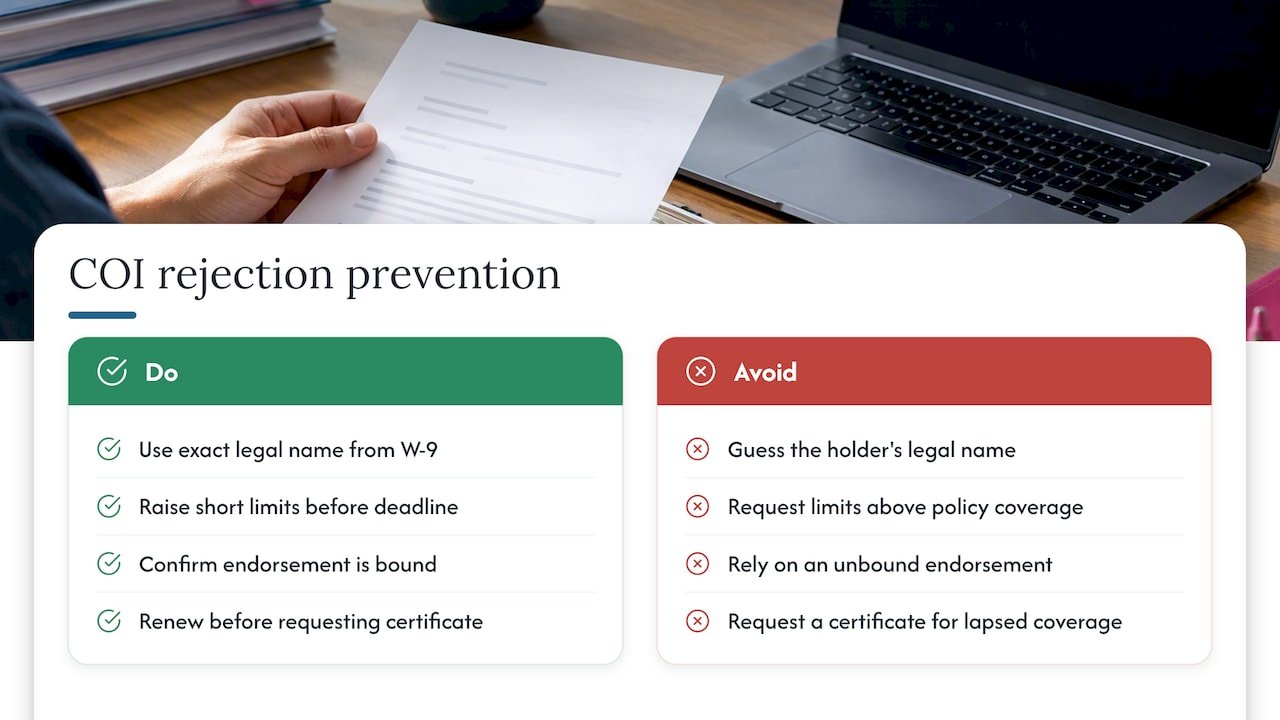
The fix for each is straightforward. Pull the certificate holder’s exact legal name from their W-9, contract header, or lease agreement rather than guessing. If your limits fall short of what’s required, talk to your agent about raising them before the deadline rather than after a rejection. If additional insured status is required, confirm with your agent that the endorsement has been processed and is reflected on the policy, not just requested. And if your policy is close to lapsing, renew before you request the certificate, since a COI cannot certify coverage that does not exist.
One subtler denial reason: the requestor wanted a specific form edition or exact wording for the additional insured endorsement, and the certificate issued used generic language instead. Contracts with lenders or large general contractors sometimes specify exact endorsement forms. Ask for that detail up front rather than discovering it after a rejected submission.
Verifying that a COI is real and accurate
Because a certificate is just a summary document, it is possible to receive one that is outdated, altered, or simply wrong. If you are the one receiving a COI rather than requesting one, a few checks protect you.
Confirm the producer and insurer names are legitimate, searchable businesses rather than unfamiliar entities with no public presence. Check that the policy period listed is still active, not expired or not yet in effect. If additional insured status matters to you, ask for the actual endorsement page rather than relying on the COI grid alone, since the certificate itself does not amend or alter the policy it describes.
When the stakes are high, such as a large lease or a multi-party construction contract, calling the issuing agency directly to confirm the certificate’s details is a reasonable extra step. Legitimate agencies expect this and will confirm policy status without hesitation. For real estate or multifamily transactions specifically, due diligence checklists often flag certificate verification as a standard step before closing, alongside confirming coverage limits match lease or loan requirements.
How a COI protects everyone in the transaction
For the business requesting the certificate, a COI is a quick way to confirm that the vendor, contractor, or tenant they are working with actually carries coverage, at the limits they expect, before anything goes wrong. It’s a screening tool more than a guarantee, but it’s the fastest way to avoid working with an uninsured party.
For the insured business providing the certificate, it’s proof of good faith and compliance. Handing over a COI promptly, with accurate limits and the correct certificate holder listed, often moves a lease signing or contract award forward without delay. It also creates a paper trail: if a dispute arises later about whether coverage existed at a given time, the certificate (backed by the actual policy) is part of the record.
Neither party should treat the certificate as the full picture. Commercial general liability coverage is what typically shows up on the COI for service providers and contractors, but the certificate holder’s real protection comes from confirming that endorsement language, like additional insured status, is bound to the policy, not just mentioned on a summary form.
What the COI process gets wrong, and what actually matters
Most advice on this topic treats the certificate itself as the finish line. It isn’t. The certificate is a summary; the policy and its endorsements are the substance. We’ve seen plenty of businesses chase a fast COI turnaround while skipping the one question that actually protects them: is the additional insured endorsement bound, or just requested?
The conventional advice to “just ask your agent for a COI” undersells how much friction comes from vague requests. A requestor who says “send proof of insurance” without naming exact limits or additional insured language is setting up a second round of corrections. The fix isn’t a faster certificate. It’s a sharper request.
If you take one thing from this, prioritize getting the certificate holder’s exact legal name and the specific endorsement requirements before you contact your broker, not after. That single habit eliminates the majority of rework we see, regardless of how fast your insurer’s portal is.
— Nathan
How we help with certificate of insurance requests
We prepare certificates of insurance for our clients as part of standard policy service, which means a request to add an additional insured or confirm limits doesn’t require starting from scratch. Our agents handle the endorsement conversation directly with underwriting so the certificate that goes out matches what the requestor actually asked for.

If your business doesn’t yet carry the coverage a lease, contract, or vendor agreement requires, that’s worth fixing before a request catches you unprepared:
- A Business Owners Policy (BOP) bundles general liability and property coverage for many small businesses, priced from $500 to $3,500 per year.
- Commercial Liability coverage addresses the liability limits most certificate holders ask for.
Reach out to request a quote and we’ll walk through what coverage your current contracts or leases actually require.
FAQ
How do you complete a certificate of insurance request?
Confirm the certificate holder’s exact legal name and address, the coverages and limits required, and any additional insured language, then send those details to your agent, broker, or insurer portal. Most certificates are issued using standard ACORD forms once that information is confirmed.
How do I download my insurance certificate?
If your insurer offers an online account or app, you can often generate and download a certificate instantly through that portal. If your insurer requires you to go through a broker instead, request it by phone or e-mail with the certificate holder’s details ready.
How do I get proof of insurance from my auto insurer?
Most personal and commercial auto insurers let you access proof of insurance through their online account or mobile app, with a downloadable or e-mailed copy available immediately. If your policy is through a broker rather than directly with a carrier, contact the broker with the exact recipient and purpose for the request.
What does COI mean?
COI stands for certificate of insurance, a document summarizing your active policies, limits, and insurer. It’s informational only and does not change or create coverage on its own.
Is getting a certificate of insurance free?
Issuing a COI is typically free for policyholders, whether it comes through an online portal or a broker request. Delays usually come from missing information or endorsement processing, not from any fee.
Sources
- ACORD — Certificates of Insurance FAQ
- How to get a certificate of insurance for a business — CNBC Select
- Certificate of insurance for business — NerdWallet