
A drive other car (DOC) endorsement is an add-on to a commercial auto policy. It gives named people, usually owners or executives, auto coverage when they drive a car they don’t own, such as a rental, a borrowed car or a test-drive vehicle. It works much like the non-owned coverage on a personal auto policy. The standard form is ISO CA 99 10, and carriers’ versions vary by state and wording.
It isn’t for everyone. If you don’t have a commercial auto policy, you can’t attach it. If you do, the real question is whether the people who drive for your business already have personal coverage that does this job. Here is how to work that out, and what to ask your agent before you pay for it.
TL;DR
- A DOC endorsement (CA 99 10) attaches to a commercial auto policy and covers named individuals in non-owned vehicles.
- It extends coverages your business policy already carries. It can’t create a coverage the policy lacks, such as collision.
- It usually excludes cars owned by the named person or a household member. Cars furnished for regular use need a close read.
- There is no standard price. It is quoted against your commercial policy, so ask an agent.
- Hired and non-owned auto is a different endorsement. Many businesses need that one first.
Table of Contents
- What a drive other car endorsement does
- The key limit: it extends, it doesn’t create
- Who actually needs it
- Drive other car vs. hired and non-owned auto
- What a DOC endorsement usually does not cover
- Can I drive someone else’s car if I’m not on their policy?
- What to give your agent to request DOC
- How much does it cost?
- Our perspective
- Getting a DOC endorsement in Savannah
- A quick checklist before you buy
- FAQ
- Sources
What a drive other car endorsement does
Think of a business owner, Maria, who has a commercial auto policy on her company’s vans. She flies to a trade show and rents a sedan for three days. Her personal auto policy may respond, but it might not. Many personal policies limit or exclude commercial use, and the NAIC notes that personal auto isn’t meant to cover people using their vehicles for commercial purposes.
The DOC endorsement is the commercial-policy answer. Per the IRMI definition, it provides non-owned auto coverage under a commercial auto policy, similar to what a personal auto policy would give. It applies to the person listed on the schedule, and in many forms to that person’s resident spouse.
Depending on the policy and the endorsement schedule, it can extend:
- Liability, for injuries and damage you cause to others
- Physical damage, meaning collision and comprehensive on the car you’re driving
- Medical payments
- Uninsured and underinsured motorist coverage
Not every item is automatically included. The limits and deductibles are the ones shown on the endorsement or derived from the commercial policy. Read the schedule, not just the label.
The key limit: it extends, it doesn’t create
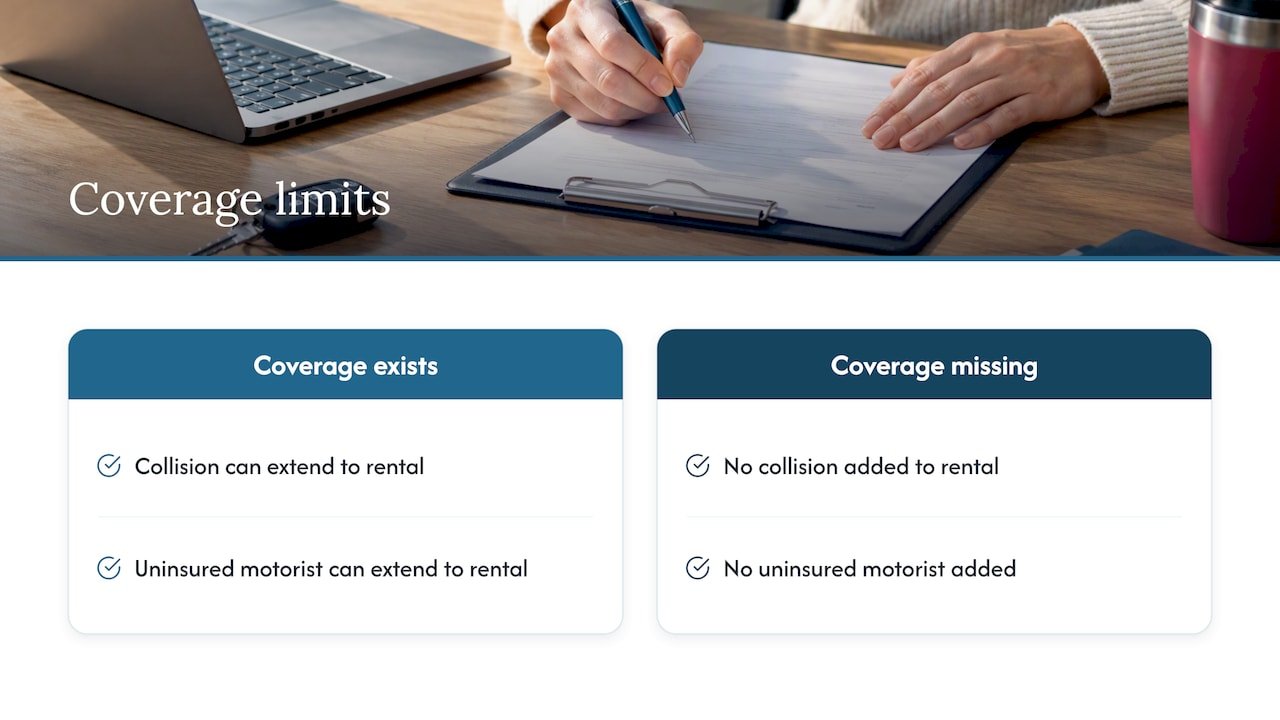
This is the point most people miss. Karen Sorrell, CPCU, explains in Property Casualty 360 that CA 99 10 is an extension endorsement. It stretches coverage already in the business policy to a non-owned car. It can’t supply one that is missing.
So if your commercial policy has no collision coverage, the endorsement generally can’t give you collision on a rental. If it has no uninsured motorist coverage, same story. Before you add DOC, look at your declarations page and confirm the underlying coverages are there at the limits you want.
Who actually needs it
DOC fits a narrow group. It is most useful for:
- Owners and executives of a corporation or partnership who drive rentals, loaners or borrowed cars for business and don’t have a personal policy that clearly covers that use.
- Employees furnished a company car who also have personal driving needs, where the company vehicle is available for their regular use. These are the situations the broad form version was built for.
- Business owners without a personal auto policy, for example someone who sold their personal car and relies on company vehicles.
- Families where a spouse shares the exposure, since the resident spouse can be covered on many forms.
It is rarely needed for an employee who occasionally drives a personal car on an errand. That is a hired and non-owned issue, covered below.
Drive other car vs. hired and non-owned auto
These two get mixed up constantly. They solve different problems.
| Drive other car (CA 99 10) | Hired and non-owned auto | |
|---|---|---|
| Who is protected | Specific named individuals (and often a resident spouse) | The business itself, for liability |
| Typical situation | An executive drives a rental or borrowed car | An employee drives their own car on a work errand, or the business rents a vehicle |
| Main coverage | Can extend liability, med pay, UM/UIM, physical damage | Primarily liability to others |
| Setup | Named on a schedule | Applies to the business as a whole |
As the Big “I” article on the topic isn’t the source here, we’ll just say it plainly: they are separate endorsements, and having one doesn’t mean you have the other. If your team runs errands in their own cars, start with our piece on asking for the CA 99 33 on hired and non-owned auto.
What a DOC endorsement usually does not cover
Exclusions vary by carrier, but these come up again and again:
- Vehicles owned by the named person or a household member. Those belong on a policy of their own. The IRMI entry describes this exclusion as typical.
- Work in the auto business. Use while selling, servicing, repairing or parking cars is commonly excluded.
- Vehicles furnished for regular use. This is often the most important underwriting question. A one-week rental is different from a car you can use any day. Wording and carrier rules differ, so check yours.
- Household members who aren’t scheduled. A live-in partner or other relative isn’t automatically covered for every part of the endorsement. They may need to be named, and the treatment can differ between liability, med pay, UM/UIM and physical damage.
A practical rule: if the answer to “who is covered, in which car, for which coverage” isn’t written on the schedule, assume it isn’t covered until your agent confirms in writing.
Can I drive someone else’s car if I’m not on their policy?
This is a personal-auto question, and it comes up alongside DOC searches. The Insurance Information Institute explains that your own auto policy generally covers you and family members on it when driving someone else’s car with permission. The owner’s policy typically also protects when someone who isn’t listed drives with permission.
That is the general picture. Details depend on your state, your policy and whether the trip is for business. A boyfriend’s or girlfriend’s car, a friend’s truck or a rental all fall under the same questions: whose policy is primary, and what are the limits?
If you own no car and drive other people’s regularly, a different product may fit better. We explain the trade-offs in our guide to non-owner car insurance and daily rental fees.
What to give your agent to request DOC
The more complete your request, the faster the quote. According to the research behind this article, be ready with:
- Your commercial auto policy details, including carrier and policy number
- The names and roles of each person who would be covered
- Whether each person has a resident spouse, and whether other household members drive
- The vehicles furnished to those people, and whether they are used for personal driving
- Driving history for each named person
- The liability and physical-damage limits you want
The NAIC advises small businesses to make sure the business is properly listed as the principal insured and to review business-use exclusions. Once the agent quotes, ask for the eligibility, exclusions, deductibles and effective date confirmed in writing.
How much does it cost?
There is no universal DOC price. The premium depends on the carrier, the state, the drivers, the coverages and the limits, and an additional premium applies when it is attached. Anyone who quotes you a flat national number is guessing. The only reliable approach is a quote against your actual commercial auto policy.
Compare that cost with the alternative. If the named person already has a personal auto policy that covers business rentals, the endorsement may be redundant. If they don’t, the cost of the endorsement can be small next to one uncovered accident in a rental.
Our perspective
We’ve been helping Savannah-area families and business owners for more than 45 years, and DOC questions usually start the same way. Someone rents a car for a work trip, then wonders whether anything would respond if it went wrong.
Our advice is to work backward from the real driving. Who drives what, how often, and for whose benefit? Those answers tell you whether you need DOC, hired and non-owned auto, a stronger personal policy, or just a higher limit on the commercial one. The endorsement name matters less than the schedule behind it.
We also push back on adding coverage that can’t work. If the underlying commercial policy lacks physical damage or uninsured motorist coverage, a DOC endorsement won’t fill that hole, and we’d rather tell you that than sell you a form. Because we place policies with multiple carriers, we can compare how different carriers word the endorsement for your situation.
— Nathan
Getting a DOC endorsement in Savannah
If you run a business in Savannah or the surrounding area and want to know whether a drive other car endorsement belongs on your policy, we can review your current declarations and tell you honestly. Start with our commercial auto insurance in Savannah page, or see all the coverages we offer. For the wider picture, our commercial auto guide covers fleets, business use and more.
A quick checklist before you buy
- Do you have a commercial auto policy? If not, DOC isn’t available.
- Does that policy carry the coverages you want extended, at the limits you want?
- Is the person named on the schedule, and is a resident spouse covered where you need it?
- Is any vehicle furnished for the person’s regular use?
- Is the driving personal, business or both?
- Does your personal auto policy already respond to rentals? You can compare against the personal auto coverage breakdown.
- Do you have the answers in writing, with the effective date?
FAQ
What is a drive other car coverage endorsement?
It is an optional add-on to a commercial auto policy, commonly the CA 99 10 form. It extends selected coverages to named individuals when they drive vehicles they don’t own, like rentals or borrowed cars. The schedule on the endorsement controls who and what is covered.
Can I drive my boyfriend’s car if I’m not on his insurance?
Often yes, if you have his permission, because coverage generally follows the car for permissive drivers, according to the III. Limits, exclusions for regular use and state rules vary, so ask his agent. If you drive it often, being listed is the safer move.
Does DOC replace a personal auto policy?
No. It is built around a specific commercial policy, named people and the coverages already on it. If you own a personal vehicle, it needs its own policy, since DOC normally doesn’t cover cars owned by the named person or a household member.
Is a spouse covered under drive other car?
Many forms extend to the resident spouse of the named person, but other household members aren’t automatically covered for every section. Ask your agent to confirm in writing who is covered for liability, med pay, UM/UIM and physical damage.
How much does a DOC endorsement cost?
It varies by carrier, state, drivers and limits, and it is charged as additional premium on the commercial policy. An agent has to quote it against your policy.
Sources
- IRMI: drive other car endorsement
- IRMI: broad form drive other car coverage
- Property Casualty 360: Drive Other Car Coverage Endorsements
- NAIC: small business insurance
- NAIC: personal auto and commercial use