
Replacement cost pays what it takes to repair or replace damaged property at today’s prices. Actual cash value (ACV) pays that same figure minus depreciation for age and wear. After a covered loss, the gap between those two numbers can be thousands of dollars, and it comes out of your pocket.
This guide covers how each method works, a worked example with real numbers, where deductibles fit in, and how to decide which one belongs on your policy. We write it from Savannah, where hurricane season, older homes and rising rebuilding costs make the choice matter more than most people expect.
TL;DR
- Replacement cost value (RCV) pays the current cost to repair or replace with like kind and quality. ACV pays that cost minus depreciation.
- ACV usually means a lower premium and a bigger gap after a claim, especially for older roofs and for belongings.
- Many replacement-cost policies first pay ACV, then release the held-back depreciation once you finish repairs and send receipts.
- The deductible comes off the payment either way. On the coast, a percentage hurricane deductible can matter as much as the RCV or ACV choice.
- Coverage can be mixed inside one policy, so check the dwelling, belongings and roof separately.
Table of Contents
- What actual cash value means
- What replacement cost means
- Replacement cost vs. ACV side by side
- A worked example: the roof
- A worked example: belongings
- How the money actually arrives
- Where the deductible fits
- What does replacement cost cost?
- Which one should you choose?
- Check each part of your policy separately
- Our perspective
- Get your coverage basis checked
- FAQ
- Sources
What actual cash value means
Actual cash value is the replacement cost of an item minus depreciation, the loss of value from age and wear. The NAIC explains that ACV pays the property’s value after age, wear and depreciation, so it can leave you short of what new replacements cost. The North Carolina Department of Insurance describes it as the amount needed to fix your home minus the decrease in value from age or use.
Two things people often assume are wrong:
- ACV is not market value. The Consumer Financial Protection Bureau notes that ACV considers age and condition and may match neither market value nor rebuilding cost.
- ACV is not a lowball by definition. It is a formula written into your policy. The problem is only that you may not have realized the formula applied to you.
What replacement cost means
Replacement cost value is the amount needed to repair or rebuild with materials of similar kind and quality, without subtracting depreciation. The CFPB says RCV is based on today’s repair or rebuilding cost, which is why it generally produces the larger payment.
It is also not the same as what your house would sell for. Market value includes land and local real estate conditions. Replacement cost is about lumber, labor, shingles and drywall. That is why your dwelling limit should follow rebuilding costs, not the price on your closing paperwork. For a look at how your limits are laid out, see our walkthrough of Coverages A through F on your declarations page.
Replacement cost vs. ACV side by side
| Replacement cost (RCV) | Actual cash value (ACV) | |
|---|---|---|
| What it pays | Current cost to repair or replace with like kind and quality | Replacement cost minus depreciation |
| Age of the item | Does not reduce the settlement | Reduces the settlement |
| Premium | Higher | Generally lower |
| Out-of-pocket risk after a loss | Mainly the deductible | Deductible plus the depreciation gap |
| Paperwork | Often requires proof of repair or replacement to collect the full amount | Usually paid on the estimate |
| Best fit | You want to rebuild or buy comparable new items | You can absorb a shortfall or will replace with used items |
A worked example: the roof
The Texas Department of Insurance gives a useful example. A $10,000 roof replacement with a $4,000 deductible produces a $6,000 payment under replacement cost, regardless of the roof’s age. Under ACV, the roof’s value before the deductible is shown as $8,500 at 5 years, $7,000 at 10 years and $4,000 at 20 years. TDI’s example assumes a home insured for $200,000 and a 2% deductible, and real policy terms differ.
Do the subtraction yourself and the lesson is plain:
| Roof age | ACV value | After $4,000 deductible | RCV payment |
|---|---|---|---|
| 5 years | $8,500 | $4,500 | $6,000 |
| 10 years | $7,000 | $3,000 | $6,000 |
| 20 years | $4,000 | $0 | $6,000 |
On a 20-year-old roof, ACV pays nothing in this example because the deductible eats the whole depreciated value. The roof still needs replacing. In Savannah, where summer storms, humidity and Spanish moss debris wear on roofs, that scenario is not far-fetched.
A worked example: belongings
NerdWallet’s illustration uses a two-year-old laptop with a $2,000 replacement cost and a $500 deductible. Assuming a five-year useful life and $400 of depreciation a year, ACV pays $700. Replacement cost pays $1,500. The publication notes this is an example and not a universal insurer formula, and that the RCV difference is typically paid after you document the replacement.
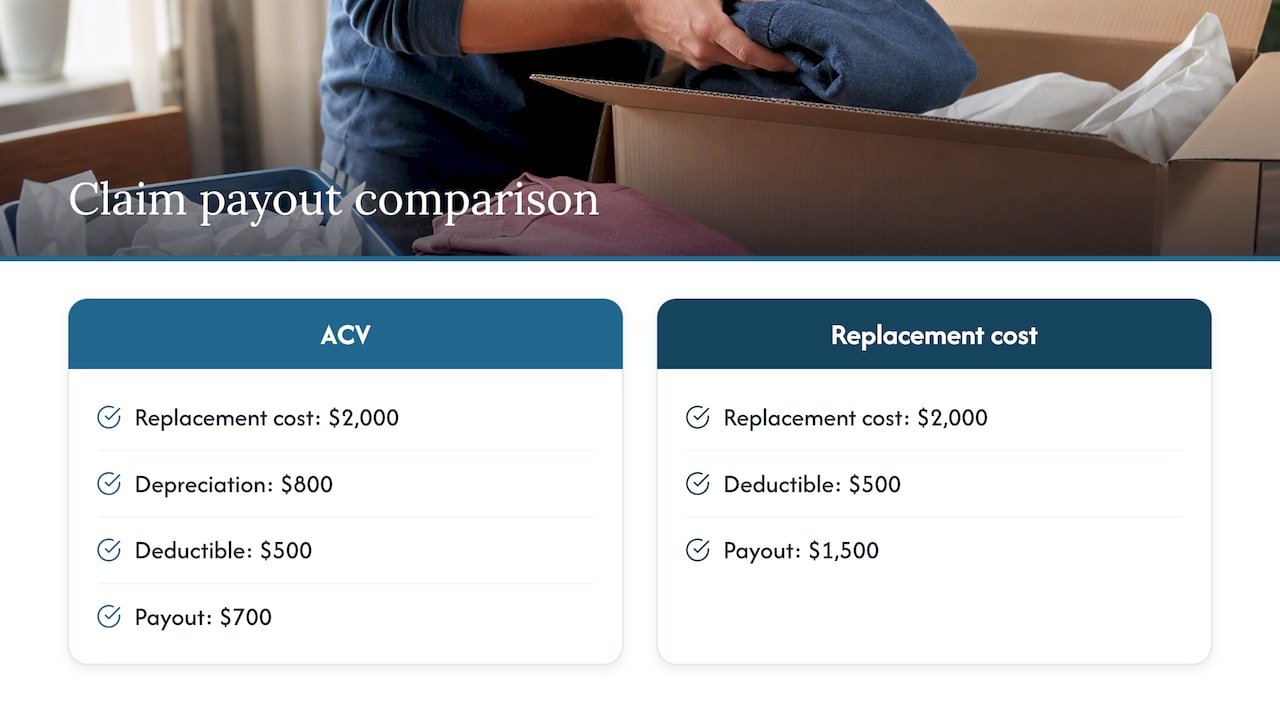
Now multiply that across a living room, a closet and a kitchen. Depreciation on belongings adds up quickly, which is why many people choose replacement cost for contents even if they would be fine with ACV elsewhere.
How the money actually arrives
Choosing replacement cost does not mean a check for the full amount on day one. The NC Department of Insurance explains that many claims are first paid at ACV, and the recoverable depreciation is reimbursed after you repair or replace the property and submit receipts. The CFPB describes the usual sequence: you report the loss, an adjuster evaluates the damage, the insurer sets a settlement under your policy, and you document repairs when the policy requires it.
In practice, that means:
- Report the loss as soon as it is safe to do so.
- Preserve evidence with photos and video before cleanup, and keep damaged items if the adjuster needs to see them.
- Meet the adjuster and walk through every damaged area, not only the obvious one.
- Review the estimate line by line. Ask which items were depreciated and by how much.
- Repair or replace, then send invoices and receipts to collect the held-back depreciation.
- Watch the deadline. Policies set time limits for claiming the recoverable amount, so read yours.
A home inventory makes steps 2 and 4 much easier. The Insurance Information Institute points to the habit of keeping photos, purchase records, model numbers and receipts as a way to show what was lost and check that the settlement is calculated correctly.
Where the deductible fits
A deductible is your share of a covered property loss. It can be a flat dollar amount or a percentage of the insured value. The Triple-I gives this example: a home insured for $100,000 with a 2% deductible has a $2,000 deductible, so a $10,000 loss would pay $8,000 before any other policy limitations.
The order of operations matters for ACV. In the NAIC’s $10,000 example, RCV pays the covered repair cost minus the deductible, while ACV applies depreciation before the deductible. Same loss, same deductible, smaller check.
Deductible vs. premium
These two numbers pull in opposite directions. The premium is what you pay to keep the policy in force. The deductible is what you pay when you file a claim. A higher deductible generally lowers your premium but raises the cash you need after a loss.
A simple way to think about it: pick the deductible you could write a check for tomorrow without borrowing. Then choose RCV or ACV based on how much of the remaining gap you can live with. Georgia’s insurance regulator offers the same advice in plain terms: it recommends you compare deductibles and be comfortable paying the amount if you file a claim.
The hurricane deductible
If you live near the coast, check for a separate wind or hurricane deductible. The Triple-I notes that percentage deductibles generally apply to homeowners policies and are calculated on the insured value of the home. On a Savannah policy, that percentage is often much larger than the flat deductible for other claims. We break it down in our guide to hurricane deductibles, and explain what wind coverage does and does not include in this article on hurricane and tropical storm wind damage.
Here is why this belongs in a replacement cost conversation. A policy with full replacement cost on the roof but a large percentage wind deductible can still leave you with a big bill after a storm. Always read the two together.
What does replacement cost cost?
Replacement cost coverage generally costs more, because the insurer is promising a larger payout. NerdWallet’s 2023 quote comparison found replacement-cost coverage for personal belongings cost between $260 and $2,200 more per year across houses in three ZIP codes. That range applies to its comparison and not to every household, and certainly not to a specific Savannah policy. Your price depends on your home, your location and your coverage choices.
The better question is what the extra premium buys. Compare it with the shortfall you would face on your most expensive likely claim. If a 15-year-old roof or a full set of furniture would leave you $10,000 short under ACV, a few hundred dollars a year for protection is often a reasonable trade. If your belongings are modest and old, ACV on contents may be perfectly sensible.
Which one should you choose?
There is no single right answer, but a few questions usually settle it.
- Could you cover a depreciation gap? If a $10,000 surprise would hurt, lean toward replacement cost.
- How old is your roof? Older roofs create the largest ACV gaps, as the TDI example shows.
- Would you replace with new or used? If used is fine, ACV on belongings may do the job. If you want the same quality new, you need RCV.
- Do you have a mortgage? Lenders often care about how the dwelling is insured, so confirm requirements before you change anything.
- Are you a landlord, condo owner or small business? Coverage basis, valuation method, limits and documentation rules can differ by property and policy form. The NC Department of Insurance recommends discussing replacement cost with an agent before you buy.
Georgia’s own regulator confirms you can choose to insure your home and belongings for either replacement cost or actual cash value, as its home insurance page explains. So this is your decision to make, ideally before a loss.
Check each part of your policy separately
One policy can contain more than one valuation method. The TDI notes that a dwelling may carry replacement cost while belongings, roofs or certain categories have ACV limits or endorsements. Do not assume the label on your declarations page applies to everything.
Ask your agent these questions:
- Is the dwelling settled at replacement cost or ACV?
- Are my belongings settled the same way?
- Is there a roof schedule or age-based payment on the roof?
- How is wind or hurricane damage handled, and what is the deductible in dollars?
- How long do I have to claim the recoverable depreciation?
- Are valuables like jewelry or art covered on this policy, or should they be scheduled separately?
That last point matters because standard contents limits often fall short for high-value items. Our guide to personal articles insurance explains how scheduling works. If you want to understand every section of the policy first, start with understanding your homeowners insurance policy.
Our perspective
Most of the claim conversations we have with Savannah clients that go badly share one feature: the person did not know which valuation method they had until the check arrived. Nobody chose ACV on purpose. It was a default, a line item, or a lower quote they said yes to.
So here is how we approach it. We start with what you would actually do after a loss: rebuild the same house, replace the same belongings, keep the same roof. Then we match the coverage to that plan and show you the price difference in plain numbers. For a lot of families, replacement cost on the dwelling is the clear call. For contents, the answer depends on what you own. For older roofs, we look closely at how the policy treats them before you are in the middle of a claim.
We are an independent agency with over 45 years of experience, and we would rather spend twenty minutes walking through your declarations page now than help you sort out a shortfall later. The same logic applies to auto: if you are comparing how a total loss is valued, see how new car replacement works against ACV undervaluation.
— Nathan
Get your coverage basis checked
If you are not sure whether your home, rental property or business is insured at replacement cost or ACV, we will read through it with you. We write homeowners insurance in Savannah, plus flood, auto, condo, renters, rental property and business coverage, and we help with claims when you need them. See everything we offer on our services page, or call a local agent for a policy review.
FAQ
Is replacement cost better than ACV?
For most homeowners, yes, because it does not subtract depreciation from your payout. It costs more in premium, though, so the better choice depends on your budget and how large a shortfall you could absorb. ACV can make sense for older, low-value belongings you would replace with used items.
How do you calculate ACV from replacement cost?
Subtract depreciation from the replacement cost, then subtract your deductible. In NerdWallet’s example, a $2,000 laptop that has lost $1,300 in value is worth $700 after the deductible comes off. Insurers use their own depreciation schedules, so your policy and adjuster’s estimate control the actual number.
What is the difference between cash value and replacement cost?
Cash value reflects what the item is worth today after age and wear. Replacement cost reflects what it costs to buy or build a similar item now. The difference is depreciation.
Does replacement cost pay the full amount right away?
Not always. Many insurers first pay the ACV portion and release the rest after you complete repairs or replacement and submit receipts. Check your policy for the deadline and documentation rules.
Is my deductible taken out before or after depreciation?
Under ACV, depreciation is applied first and then the deductible comes off, as in the NAIC example. Under replacement cost, the deductible comes off the covered repair cost. Either way, you pay it on a covered loss.
Sources
- NAIC: What’s the difference between actual cash value coverage and replacement cost coverage
- North Carolina Department of Insurance: Actual cash value vs. replacement cost value
- Texas Department of Insurance: Home policies, replacement cost or actual cash value
- NerdWallet: Actual cash value vs. replacement cost
- Consumer Financial Protection Bureau: How do home insurance companies pay out claims?
- Triple-I: Understanding your insurance deductibles
- Georgia Office of Commissioner of Insurance: Home insurance