
Equipment breakdown coverage pays to repair or replace business equipment that fails suddenly from an internal cause, such as a burned-out motor, a short circuit or a failed pressure valve. It also can pay for the money you lose while the equipment is down. Standard commercial property insurance often does not respond to those failures, so it usually has to be added on purpose. If you run a restaurant, shop, salon, office or rental property in Savannah, this is the coverage that answers the question, “What happens when the walk-in cooler dies on a Friday in July?”
Below, we explain what the coverage includes, what it leaves out, how it relates to business personal property and a business owners policy (BOP), and what to check before you buy.
TL;DR
- Equipment breakdown coverage (once called boiler and machinery insurance) pays for sudden mechanical, electrical or pressure-system failures that ordinary property coverage may exclude.
- It can include spoilage, extra expense and lost income while you wait on repairs, depending on how the policy is written.
- A BOP usually bundles liability, property and business interruption. Equipment breakdown is commonly an add-on, so ask for it by name.
- Business personal property is the stuff you own inside the space. Equipment breakdown covers how it fails, not just what it is.
- Limits and deductibles differ by equipment type and loss type, so read the schedule of coverage, not just the summary page.
Table of Contents
- What equipment breakdown coverage actually covers
- The losses that come with a breakdown
- What equipment breakdown coverage usually does not cover
- Equipment breakdown versus boiler and machinery insurance
- How it fits with a BOP
- Business personal property, business contents and where breakdown fits
- Power surges and lightning
- What about equipment breakdown on a homeowners policy?
- Who needs it most
- Our perspective
- Getting equipment breakdown coverage with Daly & Alexander
- FAQ
- Sources
What equipment breakdown coverage actually covers
Think of it as coverage for the machine failing on its own, rather than something hitting it from the outside. Investopedia describes the trigger as a sudden and accidental breakdown of mechanical, electrical or pressurized equipment from an internal cause, such as a cracked bolt or a broken valve.
Compare that with the perils most people think of when they hear “property insurance”:
| What happened | Typical home for the claim |
|---|---|
| Fire destroys your kitchen equipment | Commercial property or BOP property coverage |
| A burst pipe ruins your inventory | Commercial property or BOP property coverage |
| The compressor in your freezer burns out | Equipment breakdown |
| A power surge fries your point-of-sale system and server | Equipment breakdown, if the surge is covered under your form |
| A customer slips on a wet floor | General liability |
The examples differ, but the logic is the same: the policy matches the cause of the loss. Equipment breakdown fills the gap for failures that come from wear, defects, electrical arcing or operator error inside the machine itself.
What kinds of equipment qualify
Covered equipment is typically anything that runs on power, pressure or moving parts. That includes:
- Heating, ventilation and air conditioning (HVAC) systems and boilers
- Refrigeration and walk-in coolers
- Electrical panels, transformers and switchgear
- Production and kitchen machinery
- Computers, servers, phone systems and other communications equipment
- Diagnostic or specialized equipment, such as dental or salon devices
The exact list lives in your policy, so do not assume your most important machine is on it. If a single piece of equipment is the heart of your business, such as a commercial oven, a CNC machine or a server room, ask the agent to point to it on the schedule.
The losses that come with a breakdown
The broken part is rarely the biggest bill. Investopedia notes that a single internal failure can create direct equipment damage plus secondary losses such as downtime, spoilage and extra operating expense.
Depending on the form, equipment breakdown coverage can include:
- Repair or replacement of the covered equipment.
- Business interruption, which replaces income you lose while operations are stopped.
- Extra expense, such as renting a temporary unit or paying for rush shipping on parts.
- Spoilage, for food, medicine or other perishable stock that goes bad.
- Utility interruption, when a failure at a utility supplier stops your operations.
- Building ordinance costs, when code requires you to upgrade equipment as part of the repair.
Investopedia lists these add-ons as things coverage may include. May is the important word. Each one is a line you confirm on your own policy, not something you assume.
A worked example
Picture a small seafood restaurant near River Street. The compressor on the walk-in cooler fails overnight. By morning, a few thousand dollars of shellfish and produce is spoiled, a refrigeration technician has to order a part, and you rent a refrigerated trailer for three days to keep serving.
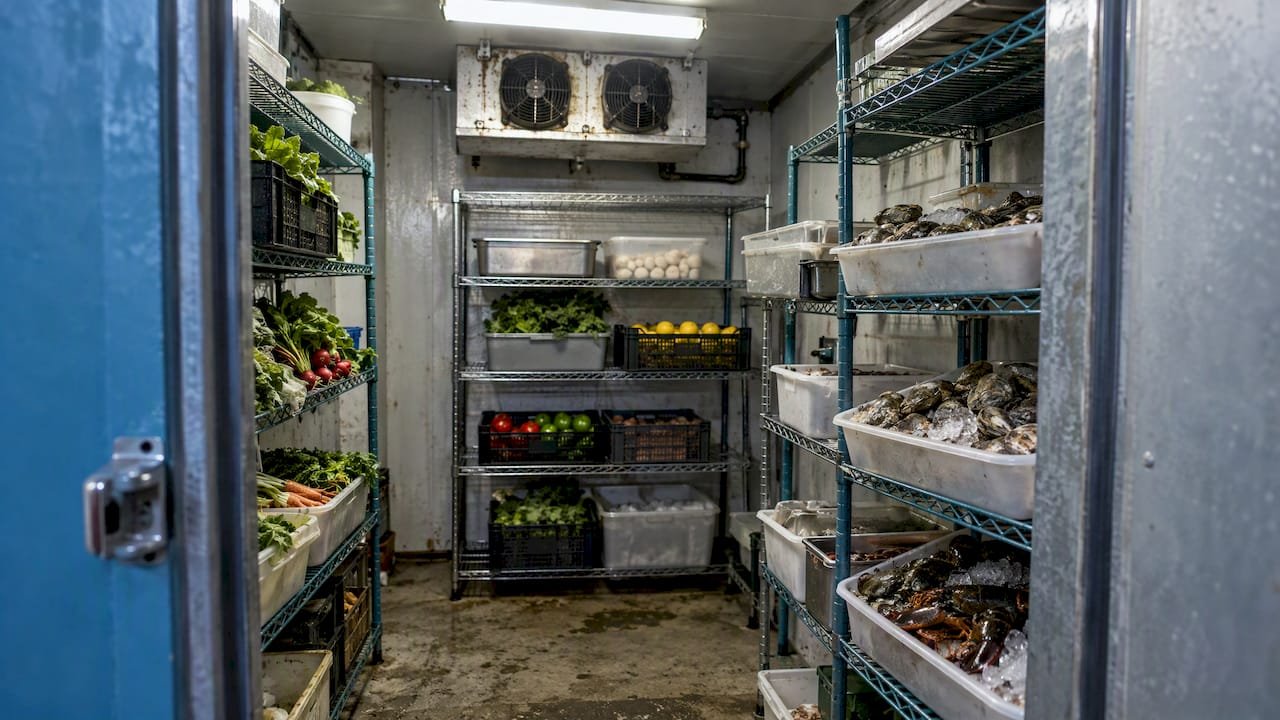
With equipment breakdown coverage that includes spoilage and extra expense, the policy can respond to the compressor, the lost food and the trailer rental, subject to your limits and deductible. Without it, you may be paying all three out of pocket, because the failure came from inside the machine rather than from a fire or storm. This example is illustrative, not a promise of how any specific policy would pay.
What equipment breakdown coverage usually does not cover
Exclusions are where claims get argued, so know them before you need them.
- Routine maintenance and wear. A filter change, a worn belt you knew was failing, or a machine that simply reached the end of its useful life is a maintenance cost, not a sudden breakdown.
- Outside causes. Fire, windstorm, theft and water damage belong to your property policy. Flood in particular is its own line. In coastal Georgia it is a real exposure, so see our flood insurance guide.
- Unlisted equipment. If the policy limits coverage to certain equipment types or locations, anything outside that list is out.
- Software or data loss in many forms, unless a cyber or data endorsement says otherwise.
- Liability to others. If a failure injures a customer, that is a general liability question. Our guide to BOP versus general liability explains the split.
How your underlying property form treats breakdown matters too. A commercial property policy may exclude or limit mechanical, electrical and pressure-system breakdown, and the endorsement is how you restore it, according to a commercial equipment breakdown FAQ from a U.S. insurance agency and general insurance education sources.
Limits and deductibles
Do not look for one deductible. Central Washington University’s equipment breakdown FAQ says deductibles and limits can vary by equipment type, location and loss type, which is why it tells policyholders to review the schedule of coverage. That holds for small businesses too. Typical questions to check:
- Is the limit per breakdown, per location or per policy period?
- Is there a separate, often time-based, deductible for business interruption?
- Are spoilage and extra expense sublimits lower than the main limit?
- Does the policy pay replacement cost or actual cash value on the equipment?
Equipment breakdown versus boiler and machinery insurance
The two names describe the same family of coverage. The Insurance Information Institute identifies equipment breakdown, also called boiler and machinery insurance, as a coverage you can add to a commercial package policy for malfunctioning heating, electrical, air-conditioning, telephone and other equipment.
The older name came from steam boilers and pressure vessels, which were the dangerous machines of the last century. Today the coverage reaches well past boilers, to refrigeration, computers and everyday electrical equipment. If an agent or a vendor uses “boiler and machinery,” they are almost certainly talking about equipment breakdown.
How it fits with a BOP
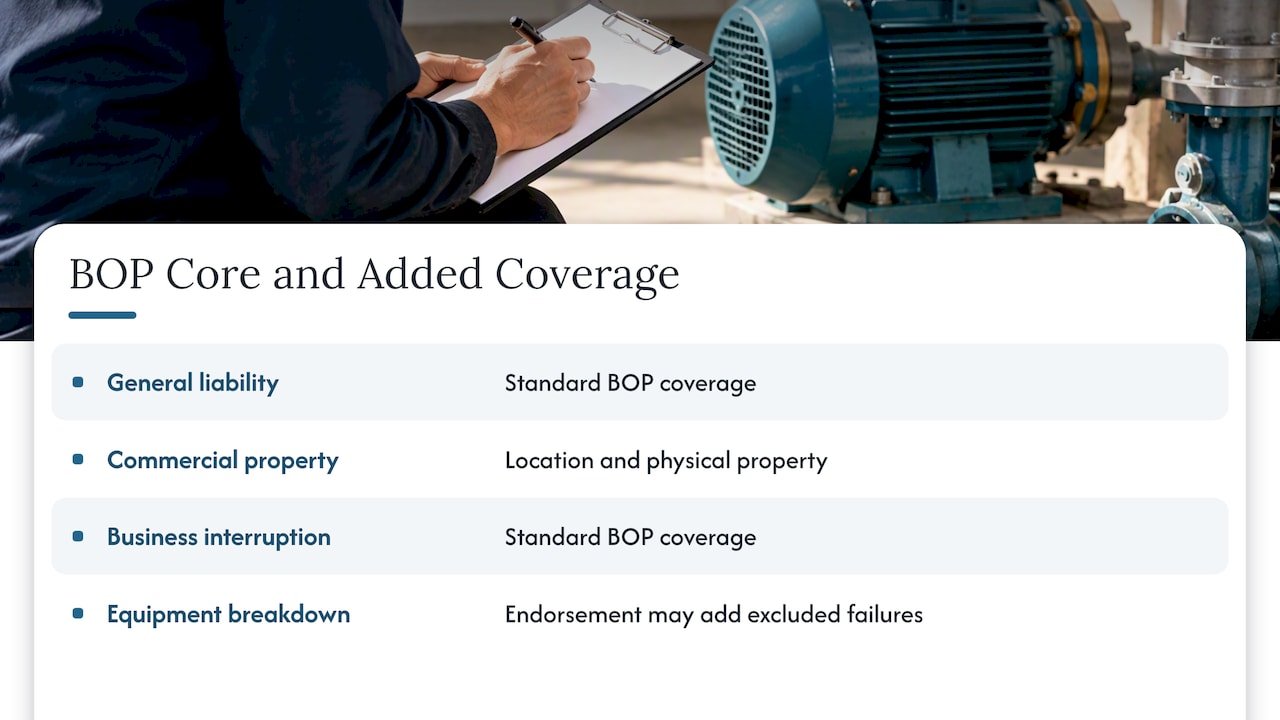
A business owners policy is the package most small businesses buy first. The NAIC says a BOP commonly includes general liability, commercial property or business property coverage, and business interruption insurance. The property piece protects the location and physical property such as equipment, inventory and furniture.
That sounds like it should cover a broken freezer, and sometimes it does in part, but a BOP is a bundle of standard coverages, not a promise that every failure is included. Equipment breakdown is commonly added as an endorsement. The NAIC explains that an endorsement changes the existing contract, can add coverage that was otherwise excluded, and can change the premium, and its terms control the amended coverage.
For BOP policies the price range we publish is $500 to $3,500 per year, depending on the business. What you pay depends on your industry, size, location and the endorsements you select, so we quote it case by case. You can see how we structure the package on our Business Owners Policy page for Savannah, or read the broader BOP guide.
What to ask when you review a BOP
- Does the policy include equipment breakdown, or is it an endorsement?
- If it is an endorsement, what does it add: just repair costs, or spoilage and income loss too?
- Is my most expensive or most critical equipment named or clearly included?
- How does the waiting period for business interruption work after a breakdown? See our overview of business interruption coverage for the questions to ask.
Business personal property, business contents and where breakdown fits
Many people searching this topic are really asking about three related terms. They overlap, but they are not the same thing.
Business personal property (BPP) is the property your business owns and uses in operations, apart from the building. That generally means furniture, office equipment, computers, machinery, tools, inventory and supplies. “Business contents insurance” is the plain-language name for the same idea: coverage for what is inside the space.
Equipment breakdown is not a list of items. It is a cause of loss. Your BPP coverage describes what is protected from named perils such as fire or theft. Equipment breakdown describes an extra trigger, internal mechanical or electrical failure, and applies it to certain machinery, whether the building owner or you own it.
Here is the practical difference:
| Business personal property | Equipment breakdown | |
|---|---|---|
| What it is | The things you own inside the space | A cause of loss for failing equipment |
| Typical triggers | Fire, theft, wind, covered water damage | Mechanical, electrical or pressure failure |
| Where you usually find it | Commercial property section or BOP | Endorsement or separate coverage part |
| Can pay for lost income | Through business interruption, if included | Often through its own income and extra expense lines |
A tenant should note one more wrinkle. If you lease your space, the landlord’s policy usually covers the building and the HVAC that came with it. Your policy covers your own contents and improvements. Who owns a given machine decides which policy responds, so check your lease before you assume.
If you want the full property picture, our commercial property insurance guide covers building, contents and business income, and our plain-English guide to commercial property in Savannah is a shorter start.
Power surges and lightning
Power problems are the most common reason business owners think of this coverage. The Insurance Information Institute explains that optional equipment breakdown coverage can extend business protection to utility-supplied surges and to mechanical or electrical failures not caused by lightning, while standard business insurance generally covers lightning damage.
That split matters on the coast. Summer thunderstorms are a given around Savannah, and a lightning strike and a grid surge can look the same when your register will not turn on. Which policy pays depends on the cause, and the claim adjuster will work that out. Knowing in advance that both are covered, one by your base property policy and one by the endorsement, takes a lot of the stress out of that conversation.
What about equipment breakdown on a homeowners policy?
Some readers want home equipment breakdown coverage. It works on the same logic, applied to your house: an optional endorsement that can pay for mechanical or electrical failure of home systems and appliances, such as central air or a refrigerator, which a standard homeowners form may not cover when the cause is wear or internal failure. Whether you can add it, and what it includes, depends on the carrier and your policy. Start with our guide to understanding your homeowners policy, or look at homeowners insurance in Savannah.
If you run a business from home, do not count on the homeowners policy to cover it. The NAIC notes that homeowners policies typically exclude business-related property or liability, so a business endorsement or a more comprehensive business policy may be needed.
Who needs it most
Every business that depends on a machine to make money should at least price it. The need is strongest for:
- Restaurants, cafés and bars with refrigeration, hoods and ovens
- Medical, dental and salon offices with specialized, expensive equipment
- Offices and retailers that rely on servers, phones and point-of-sale systems
- Small manufacturers and workshops running production machinery
- Landlords and short-term rental owners with HVAC, water heaters and appliances that tenants and guests expect to work
If you could limp along for a week without the equipment, the coverage is less urgent. If a week of downtime would force you to close or lay people off, it is probably the best value-per-dollar endorsement you can add.
Our perspective
In our experience with Savannah businesses, equipment breakdown is the coverage owners most often assume they already have. A business owner shows us a policy, we point to the property section, and they are surprised to learn that a failed compressor or a fried circuit board might not sit under it.
Our advice is simple. Make a list of the five machines you cannot operate without. Ask for each to be confirmed in writing as covered, or confirm what the endorsement would add. Then ask what happens to income and spoilage while the repair is underway. We work with multiple carriers, so we can compare how each one words these terms rather than hand you the only option we sell. After more than 45 years helping local families and businesses, we have learned that the best time to find a gap is before the compressor goes.
And if a loss does happen, call us early. Our job includes helping you document the claim and keep it moving, because a breakdown is stressful enough.
— Nathan
Getting equipment breakdown coverage with Daly & Alexander
We are a local agency in Savannah, Georgia, and we write business insurance including business owners policies, commercial property and commercial liability. If you already have a policy, send it over and we will show you where equipment breakdown stands. If you are starting from scratch, we will build a package around the equipment your business actually depends on. Talk to a local agent about adding equipment breakdown to your coverage, or see everything we write on our services page.
FAQ
Is equipment breakdown coverage the same as a warranty or service contract?
No. A warranty or service contract is a promise from a manufacturer or vendor to fix specific equipment under set terms. Equipment breakdown is insurance: it can pay for covered equipment from any manufacturer, and it can also reach losses like spoilage and lost income that a warranty does not touch. The two can work side by side.
Does a BOP include equipment breakdown?
Not automatically. A BOP commonly bundles general liability, property and business interruption, and equipment breakdown is generally something you add. Policies differ by carrier, so ask for it by name and confirm it on the declarations or endorsement list.
What is the difference between equipment breakdown and boiler and machinery insurance?
They are essentially the same coverage. Boiler and machinery is the older name, and equipment breakdown is the modern one that reflects its reach into HVAC, refrigeration, electrical and computer equipment. Ask your agent to explain exactly which equipment your form names.
Is business personal property the same as equipment breakdown?
No. Business personal property describes what you own inside the space, such as furniture, tools, inventory and equipment. Equipment breakdown describes one cause of loss, an internal mechanical or electrical failure, for covered machinery. You often want both.
Can I get it as a home-based or rental property owner?
Often yes, though the structure varies by carrier. Homeowners can sometimes add equipment breakdown for household systems, and landlords can ask about it on rental property policies. A business run from your house usually needs its own business coverage, so ask us to review your setup.
Sources
- What Is Equipment Breakdown Coverage? (Investopedia)
- Understanding commercial package policies (Triple-I)
- Business interruption and business owner’s policy (NAIC)
- Do you know how to use an insurance rider or endorsement? (NAIC)
- Lightning coverage and safety (Triple-I)
- Boiler and Machinery FAQ (Central Washington University)
- Working from home and your insurance coverage (NAIC)
- Commercial Equipment Breakdown Coverage FAQ