
A certificate holder receives proof that someone has insurance. An additional insured is actually covered under that someone’s liability policy. That one distinction decides who can make a claim when something goes wrong on a job site, at a rental property or at an event, and it is the reason a contract that asks for “additional insured” is not satisfied by a certificate alone.
If a landlord, general contractor, venue or client has just sent you a contract with insurance requirements, this guide walks through what each term means, how a named insured fits in, what the wording should say, and how to get it done without delays.
TL;DR
- A certificate holder is the person or business that receives a certificate of insurance. It is evidence of coverage and gives the holder no rights under the policy.
- An additional insured is added to your liability policy by endorsement and receives coverage, usually limited to claims tied to your work or operations.
- The named insured is the policy owner. Only the named insured can change or cancel the policy and pays the premium.
- Read your contract before you request anything: it tells you which status is required, and whether primary and non-contributory wording is needed.
- Ask your agent for the endorsement and the certificate together, and check that the certificate matches the endorsement actually attached to your policy.
Table of Contents
- The short version: proof versus protection
- What a certificate holder actually is
- What an additional insured actually is
- Where the named insured fits in
- Specific versus blanket endorsements
- What additional insured wording should say
- Which status do you need?
- What are the risks of adding an additional insured?
- How to add an additional insured or certificate holder
- A note from our desk
- Getting the right coverage in place
- FAQ
- Sources
The short version: proof versus protection
Think of it this way. A certificate holder gets a piece of paper. An additional insured gets a seat at the table.
A certificate of insurance (often called a COI) is a summary of your policies: the insurer, the policy number, the limits, the dates. New York’s insurance regulator describes the certificate holder as the intended recipient of a certificate, which provides evidence that coverage is in place but confers no rights. Georgia’s insurance code takes the same practical approach: it defines a certificate holder as any person other than a policyholder who requests, obtains or possesses a certificate.
An additional insured is different. Per the same regulator, it is a person or entity added to another’s policy as an insured at the policyholder’s request. That addition is made by an endorsement, a signed change to the policy itself. The certificate only reports on it.
| Certificate holder | Additional insured | |
|---|---|---|
| What they get | A copy of the certificate of insurance | Coverage under your liability policy |
| Rights under the policy | None | Coverage for the situations the endorsement describes |
| How it is created | You ask your agent to issue a certificate | An endorsement is added to your policy |
| Typical examples | A city permit office, a lender, a client who just wants to see you are insured | A landlord, general contractor, property owner, venue |
| Can it cost extra? | Usually no charge | Sometimes a modest premium, depending on the insurer and form |
| Can they change the policy? | No | No |
What a certificate holder actually is
When someone asks you for “a certificate,” they want to see that you carry insurance. Your agent produces the document and lists the requesting party in the certificate holder box.
A few things are worth knowing:
- It is not a contract. A risk management training resource explains that the certificate holder receives the certificate, and it is not a contract between the holder and the issuer.
- It does not change your policy. The same source notes a certificate does not alter policy terms or stand in for an endorsement.
- Being listed does not mean being covered. Your name in the holder box means you get the document, nothing more.
Certificate holders are common and usually harmless to add. A bank, a licensing board, a customer who wants proof before hiring you: all of them are comfortable with a certificate. They are not asking to share your coverage.
What an additional insured actually is
An additional insured is a party added to a liability policy through an endorsement that changes the “who is an insured” section. According to Sonoma County’s contract insurance guidance, coverage is limited to the relationship or circumstances stated in the endorsement.
In plain terms: if someone sues the landlord because a customer slipped in your leased shop, the landlord can look to your liability policy for a defense and payment, within what the endorsement allows. It does not mean the landlord is covered for everything. It means the landlord is covered for claims connected to you.
Who typically asks for additional insured status
Investopedia notes that general contractors and property owners may be additional insureds on subcontractors’ policies, and that landlords may ask to be added to a tenant’s policy so they can benefit from its coverage if an accident or loss occurs on the premises. In Savannah, that looks like:
- A restaurant on River Street whose lease requires the landlord to be an additional insured on the tenant’s general liability.
- A painting or HVAC subcontractor working for a general contractor on a Southside remodel.
- A vendor at a festival or private event where the venue wants protection from vendor claims.
- A property manager requiring vendors to carry coverage naming the owner and the management company.
Why landlords and owners want it
It is about who gets sued. When an injury happens, the injured person often sues everyone near the scene, including the property owner. Additional insured status gives that owner a source of defense and payment through your policy before they dip into their own. That makes it a reasonable ask, and it is why contracts so often require it.
Where the named insured fits in
People searching this topic often ask about the named insured too, so here is the full ladder.
- Named insured: the person or business on the policy’s declarations page. They own the policy, pay the premium, and can change or cancel it. They receive the full coverage described in the policy.
- Additional insured: a third party added by endorsement. They get coverage tied to the named insured’s work, property or operations, and they cannot change or cancel the policy.
- Certificate holder: a recipient of the certificate. No coverage, no control.
The key difference between additional insured and named insured is control and breadth. A named insured has the whole policy. An additional insured has a defined slice of it, only for the situations the endorsement names.
You will also see “additional named insured.” That usually describes a related entity, such as a second business you own or a DBA, that is listed on the policy more fully than a typical additional insured. The exact rights depend on the policy wording, so ask your agent which category a particular party falls into.
Specific versus blanket endorsements
There are two main ways to add an additional insured, and the Sonoma County guide spells out the difference: specific endorsements identify the additional insured by name, while blanket endorsements provide automatic status when a contract requires it.
Specific (scheduled) endorsement. Your agent adds one named party. It is clear and easy to verify, but you need a new request every time a new client or landlord appears.
Blanket endorsement. Anyone you are required to cover by written contract is automatically an additional insured. It saves time if you sign contracts often. Courts have held that blanket endorsements extend additional insured status automatically when a contract requires the named insured to buy the insurance. The catch, according to an American Bar Association article, is that coverage under a blanket endorsement depends on careful review of the underlying contract’s terms. If the contract is vague or was never signed, status can be disputed.

What additional insured wording should say
The endorsement is where the protection lives, so the wording matters more than the certificate. When you review a draft contract or an endorsement, check these points:
- Who is covered. The exact legal name of the landlord, owner or contractor, not a nickname.
- What the coverage is for. Typically liability arising from your operations, your work, or the premises you lease. Narrower or broader wording changes what the additional insured can actually claim.
- Which policy it attaches to. Most requests apply to commercial general liability. Others may call for umbrella, auto or workers’ compensation language.
- Primary and non-contributory. The Sonoma County guide explains that primary coverage means your policy pays before the additional insured’s own policy or self-insurance, and non-contributory wording keeps the policies from sharing the cost. If your contract demands this, tell your agent up front.
- Ongoing versus completed work. Contractors often need coverage that continues after the job ends. Contracts sometimes ask for it specifically.
- Matching the contract. If the contract says “additional insured,” a certificate listing the party as holder alone will not meet it.
The bigger point: the certificate can say “additional insured” in a description box, but a certificate is not proof of that status. The endorsement is. If a counterparty is relying on you, make sure the endorsement actually exists on your policy.
Which status do you need?
Use this quick guide.
| Situation | Usually asked for |
|---|---|
| A client wants to confirm you are insured before hiring you | Certificate holder |
| A lender or licensing office wants proof on file | Certificate holder |
| A commercial lease says the landlord must be protected | Additional insured, plus certificate |
| A general contractor hires you as a subcontractor | Additional insured (often primary and non-contributory), plus certificate |
| A venue hosts your event or booth | Additional insured, plus certificate |
| A mortgage company on a home or building | Usually a mortgagee or lienholder clause, which is its own thing |
On that last row: a lienholder or mortgagee is not the same as an additional insured. A lender is typically listed on a property or auto policy to protect its financial interest in the asset. An additional insured on a liability policy is protected against claims arising from your operations. Different clause, different purpose. If you own a home or vehicle with a loan, your lender will be named on that policy through the mortgagee or loss payee provision, which your agent handles separately.
What are the risks of adding an additional insured?
Adding one is routine, and it is usually the right call. Still, you should go in with eyes open.
- Shared limits. The additional insured draws on the same limit as you. A claim involving them can use up limits you need for your own claims. That is one reason some businesses add an umbrella or excess liability layer. Our excess liability guide explains how layers work.
- Claims history. Claims involving the additional insured can show on your loss record.
- Possible cost. Some insurers charge for specific endorsements, others include blanket wording. Your agent can tell you what your carrier does.
- Contract promises. If you agree in a contract to broader coverage than your policy provides, you may be in breach even though you thought you were insured. Our piece on contractual liability insurance covers that exposure.
Keep the list short. Add the parties your contracts require and not every business that asks.
How to add an additional insured or certificate holder
The process is simple when you give your agent what they need.
- Send the contract language. The insurance section, not just the party’s name. It shows the limits, wording and endorsement forms required.
- Give the exact legal name and mailing address of the party being added.
- Say which policies are involved: general liability, commercial auto, umbrella, workers’ comp.
- Mention special terms: primary and non-contributory, waiver of subrogation, notice of cancellation.
- Ask for the endorsement and the certificate together. Then read both. The certificate should match what is on the policy.
- Calendar your renewal. Certificates show policy dates. When you renew, the other side will want a fresh one.
Most requests can be handled by phone or email in a short time, though timing depends on the carrier. Request early when a start date is coming. Waiting until the morning of a job is how people lose work.
A note from our desk
We see the same mix-up regularly: a small business owner hands a landlord or contractor a certificate and assumes the requirement is met. Then the contract review turns up a line asking for additional insured status, and the job waits while we add an endorsement. Nothing was wrong with the policy. The paperwork just did not match the ask.
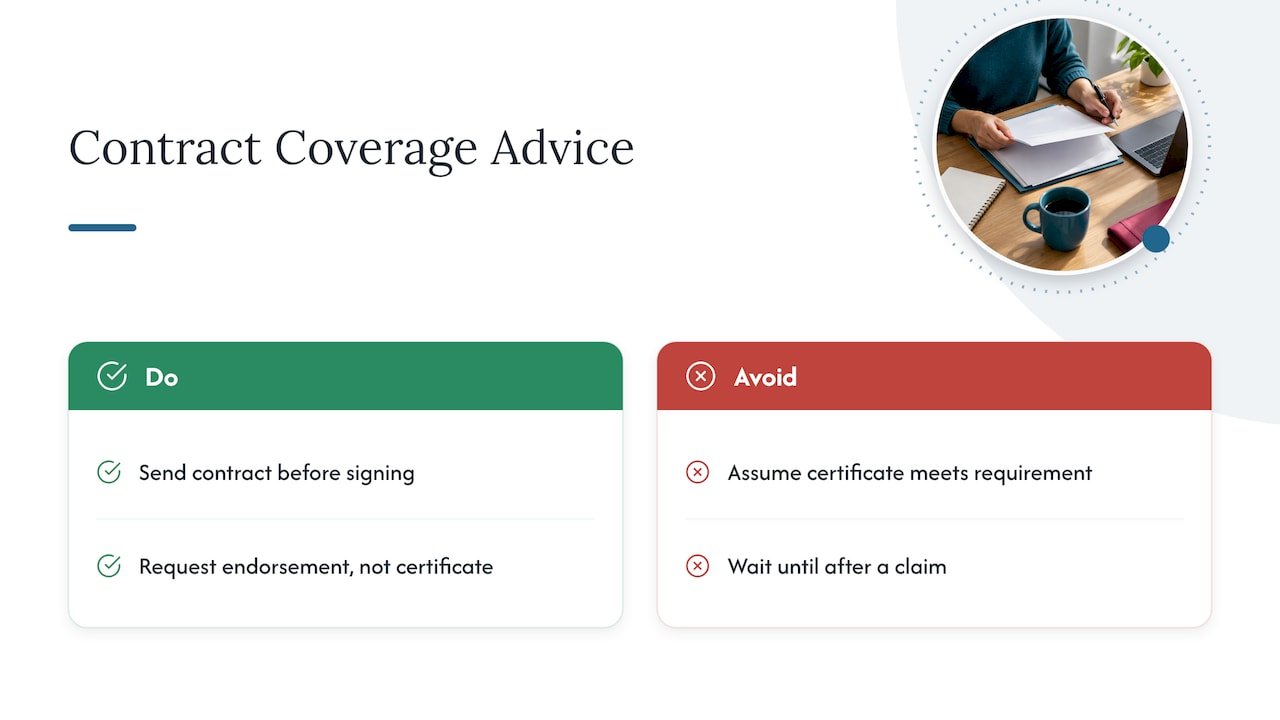
Our advice is to send us the contract before you sign it. Our agents work with clients across Savannah and the surrounding region, and we place coverage with multiple carriers, so we can often find a policy whose forms fit the language you have been given. If the contract asks for more than your current policy offers, better to hear that now than after a claim.
And if you are the one requesting coverage, as a landlord or property manager, ask for the endorsement, not only the certificate. It is the one document that proves you are covered.
— Nathan
Getting the right coverage in place
Additional insured endorsements usually sit on commercial general liability, so that is where to begin. If you run a small business, our commercial liability coverage in Savannah is built around personalized guidance, and a Business Owners Policy, which bundles liability and property coverage, is published at 500 to 3,500 USD per year depending on the business. Tell us who your contracts require you to cover and we will help you set it up. You can also see all our services or reach us from our home page.
If you are comparing policy types first, our guide on BOP versus general liability is a good next step.
FAQ
Is a certificate holder covered by my insurance?
No. A certificate holder only receives proof that your policy exists, with its limits and dates. The certificate does not give them rights under the policy or change its terms. To give someone coverage, you need an additional insured endorsement.
Can a certificate holder also be an additional insured?
Yes. Many landlords and contractors are both: they receive the certificate and are added by endorsement. The certificate is the record, and the endorsement is what provides the protection. Always confirm the endorsement is actually on the policy.
What is the difference between additional insured and named insured?
The named insured owns the policy, pays for it, and can change or cancel it. An additional insured is a third party added by endorsement who gets coverage only for the situations that endorsement describes. They cannot make changes to the policy.
Does adding an additional insured cost extra?
Sometimes. Some carriers charge for a specific endorsement, and others include blanket wording in the policy at no separate charge. Ask your agent what your current carrier does before you commit to a contract.
Is a lienholder the same as an additional insured?
No. A lienholder or mortgagee is listed to protect a loan on a home, building or vehicle. An additional insured is added to a liability policy for claims connected to your operations. They serve different purposes and use different policy wording.
Sources
- OGC Opinion No. 10-09-12: Certificate of Insurance, New York Department of Financial Services
- Georgia Code § 33-24-19.1, Certificate of insurance forms
- Certificates of Insurance and Additional Insureds
- Additional Insured Endorsements, Sonoma County Liability & Insurance
- What Is an Additional Insured? Investopedia
- Who Is an “Additional Insured”? American Bar Association
- Chapter 1, American Bar Association