
Homeowners insurance can pay for a new roof, but only when a covered event, such as wind, hail, or fire, damages it. It generally does not pay because the roof is old or worn out. How much you actually receive then depends on your roof’s age, your deductible, and whether your policy pays replacement cost or actual cash value.
If you live on the Georgia coast, where summer thunderstorms, tropical systems, and salt air all work on a roof, those details matter. Here is how roof coverage works, where claims go wrong, and what to check on your own policy before the next storm.
TL;DR
- Sudden, accidental damage from perils like wind, hail, and fire is typically covered. Age, wear, and deterioration are not.
- A covered loss may mean repairing only the damaged part of the roof, not replacing all of it.
- As roofs age, some insurers switch from replacement cost to actual cash value, which can cut a payout by thousands.
- Your deductible, possibly a separate percentage-based wind or hail deductible, comes off every roof claim.
- Read your declarations page now, not after the storm, and call your agent with questions.
Table of Contents
- Does homeowners insurance cover roof replacement?
- Which kinds of roof damage are covered
- Repair or replace: why partial claims happen
- How roof age changes what you get paid
- How roof deductibles work
- Why roof claims get denied
- How to file a roof damage claim, step by step
- Our perspective on roofs and coverage
- Get your roof coverage reviewed
- Ways to protect your roof claim before a storm
- Roof questions that come up most
- Sources
Does homeowners insurance cover roof replacement?
Sometimes. The Maryland Insurance Administration explains that payment depends on the policy and on why the roof needs replacing. If the damage is covered, the amount is shaped by your policy terms, limits, deductible, and how losses are settled.
The cause is what counts. The Texas Department of Insurance says an insurer will not pay for a new roof just because the roof is old or worn out. Insurance responds to sudden events, not to the slow passage of time.
A simple way to sort it:
| Situation | Usually covered? |
|---|---|
| Hail dents and bruises shingles in a storm | Often yes, subject to your policy |
| Wind tears off shingles or a tree limb punctures the roof | Often yes, subject to your policy |
| Fire damages the roof | Often yes |
| Shingles curl, crack, and lose granules after 20 years | Usually no (wear and tear) |
| Slow leak from a neglected flashing problem | Usually no (maintenance) |
| Storm surge or rising water | Not under a homeowners policy (flood is separate) |
That table is a general pattern. Your policy language controls the result.
Which kinds of roof damage are covered
The Maryland Insurance Administration notes that homeowners policies generally cover sudden, accidental roof losses from listed perils such as fire, wind, hail, or the weight of ice or snow. On the Georgia coast, wind and hail are the two you will think about most. Ice and snow are rarer here, but a falling tree during a thunderstorm or hurricane is not.

The same page lists common exclusions: maintenance issues, wear and tear, deterioration, flood, and earthquake. The National Association of Insurance Commissioners (NAIC) adds a warning that matters near the water: windstorm or hail coverage may be excluded, particularly in some coastal areas. If your home sits near the marsh, a river, or the beach at Tybee, confirm exactly how wind is handled on your policy.
Why water from the ground is a different policy
Rain that comes through a storm-damaged roof is usually part of the roof claim. Water rising into your home from the ground is not. That is a flood loss, and it needs its own coverage. If you are not sure where that line falls, our piece on why flood insurance matters walks through it.
Repair or replace: why partial claims happen
This is where many homeowners are surprised. A covered peril may result in repair of only the damaged portion rather than full roof replacement. If a windstorm lifts shingles on one slope, the insurer may pay for that slope, or even a section of it.
A few things influence which way a claim goes:
- How much of the roof is damaged. Scattered damage across every slope points toward replacement. One damaged corner points toward repair.
- Your policy’s wording. Some policies address matching and some do not, so ask your agent how yours treats it.
- The roof’s condition before the storm. Pre-existing wear can reduce what the insurer is willing to pay.
If the damage is severe and the repair bill looks heavy, some owners weigh a different path entirely. Reading about options for a storm-damaged house can help you see the alternatives when a home needs more work than you want to take on. Most of our clients, though, simply want the claim handled well and the roof fixed.
How roof age changes what you get paid
Age does not just invite wear. It can change how your policy pays.
The Texas Department of Insurance explains that as roofs age, some companies switch coverage to actual cash value, some policies pay less for older or worn roofs, and a company might decline to cover a roof in poor condition. Insurers set their own cutoffs. Ask your agent at what roof age your carrier changes the terms.
Replacement cost vs. actual cash value
These two terms decide whether a roof claim leaves you whole or leaves you with a large bill.
- Replacement cost (RCV) pays to repair or replace damaged property without deducting depreciation.
- Actual cash value (ACV) pays the replacement cost minus depreciation for age and wear.
The NAIC gives a clear example. On a $15,000 roof loss with a $1,000 deductible, replacement-cost coverage could pay $14,000. Under actual-cash-value coverage, a $10,000 depreciation deduction would leave a payment of only $4,000. Same roof, same storm, a $10,000 difference.
The Iowa Insurance Division adds that roof replacement-cost coverage generally pays for like-kind materials, labor, permits, and inspections, less your deductible, with limits and exclusions still applying. We break down the same idea in our guide to replacement cost vs. ACV.
Policy limits still cap the payout
The Texas Department of Insurance points out that policies pay only up to their dollar limits. If your dwelling limit is too low, you cover the difference. Building costs rise, so an old limit can quietly fall behind. Our homeowners coverage guide explains how the dwelling coverage and valuation options fit together.
How roof deductibles work
Your deductible is the amount you pay before insurance pays. The NAIC’s consumer guide says it may be a fixed dollar amount or, for catastrophes and sometimes wind or hail, a percentage of the dwelling limit. Some policies carry separate wind or hail deductibles.
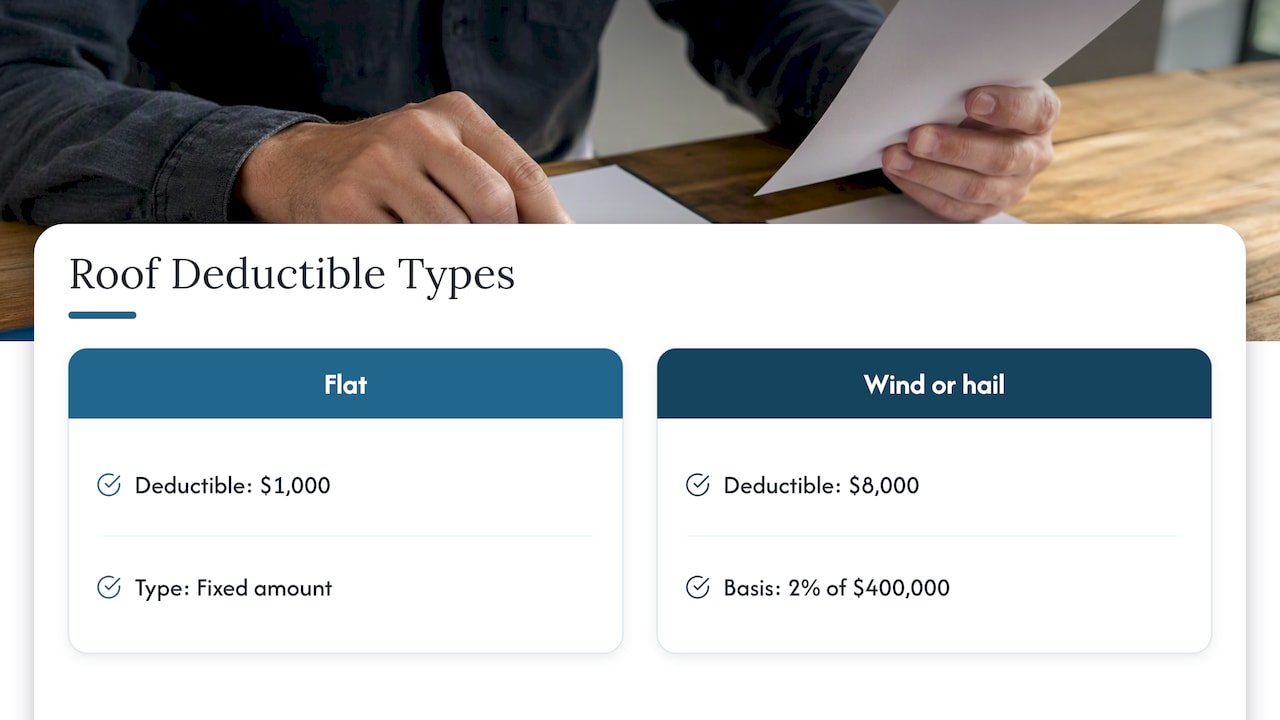
Here is why the percentage version deserves your attention. A flat $1,000 deductible is easy to picture. A 2% wind or hail deductible on a home insured for $400,000 is $8,000. (That is simple arithmetic to show the scale, not a quote.) A moderate roof claim could fall entirely below that number.
The NAIC’s post-disaster guide says homeowners should review the declarations page or policy front page to find coverage limits and deductible types. That one page tells you what you would face before any storm hits.
Checklist for your declarations page
- What is my all-other-perils deductible?
- Is there a separate wind or hail deductible, and is it a dollar amount or a percentage?
- Is the roof settled at replacement cost or actual cash value?
- Is there a roof-age or roof-surface endorsement?
- Is my dwelling limit in line with today’s rebuild cost?
Why roof claims get denied
Most denials come down to a few repeat causes:
- The damage is below your deductible. The repair estimate is smaller than what you pay first.
- The cause is excluded. Wear, deterioration, or lack of maintenance rather than a sudden event.
- Late reporting. Policies carry filing deadlines, so report promptly.
- Further damage that was preventable. If water kept coming in after the storm because nothing was done, the insurer may push back.
- Coverage limited by the roof’s age or condition.
The California Department of Insurance advises that when you disagree about an exclusion or limitation, you should ask the adjuster to identify the specific policy provision, document conversations and repair costs, and try to settle directly with the insurer before hiring a public adjuster or attorney. Asking for the exact provision turns a vague “no” into something you and your agent can evaluate.
How to file a roof damage claim, step by step
These steps follow guidance from state insurance departments. Start soon after the storm.
- Document first. The Texas Department of Insurance recommends photographing or video-recording the damage before repairs. Capture the roof, interior ceilings, and any damaged belongings.
- Stop further damage. Make only temporary repairs, such as tarping the roof, and keep every receipt.
- Report the loss promptly. Call your agent or insurer. The California Department of Insurance suggests asking whether the damage is covered, how long processing may take, whether estimates are needed, and what your deductible is.
- Hold off on permanent repairs. Avoid extensive permanent work until the adjuster has inspected.
- Work with the adjuster. Share what you documented, keep copies of all correspondence, and complete a proof-of-loss form if one is required.
- Understand the first payment. The same California guide notes an initial payment is often an advance, not a final one, and additional damage can in many circumstances be reported to reopen a claim.
If you are a Savannah-area client, you can start with our claim filing page.
Our perspective on roofs and coverage
We have been helping families and businesses in Savannah for over 45 years, and roof questions come up after nearly every active storm. The pattern is consistent: people assume “covered” means “new roof, fully paid,” then find out about depreciation, a percentage deductible, or a roof-age rule only when they are standing in the driveway.
Our view is simple. The best roof claim is won months before the storm, in how the policy is built. We prefer to sit down with a homeowner, look at the roof’s age, the dwelling limit, and the wind and hail terms, and tell them plainly where they are exposed. Because we place coverage with multiple carriers, we can look at how different policies treat older roofs rather than fit you into one product.
When a loss does happen, we act as your advocate, not just the person who sold you the policy. We want you to recover quickly, and we would rather answer your questions on a Tuesday afternoon before a claim than after one.
— Nathan
Get your roof coverage reviewed
If you are not sure how your policy would treat a roof loss, talk to us. We will go through your declarations page with you, explain your deductible, and check whether you are on replacement cost or actual cash value. You can see the full range of what we offer on our services page, or start with homeowners insurance in Savannah.

If your home is near water, ask us about flood protection at the same time, since your roof policy will not pay for rising water. Our flood insurance in Savannah page explains the options.
Ways to protect your roof claim before a storm
Small habits strengthen a claim and, sometimes, prevent one:
- Keep maintenance records. Invoices for repairs show the roof was cared for, which counters a wear-and-tear argument.
- Photograph the roof once a year. Dated photos give the adjuster a baseline.
- Clear gutters and trim overhanging branches. Savannah’s live oaks are beautiful, and they are also the limbs that fall.
- Review coverage at every renewal. Ask whether anything changed about roof terms.
- Update your dwelling limit. The Texas guidance above is clear that limits cap what is paid.
- Learn your policy. Our overview of understanding your homeowners policy is a good place to begin.
Before you buy or renew, the Texas Department of Insurance also recommends asking how the company treats roofs as they age, since that can change both your coverage and your price.
Roof questions that come up most
Will my insurance pay for a whole new roof after a storm?
It can, if the storm damage is extensive and covered. Often the insurer pays to repair only the damaged portion. Your deductible and whether you have replacement cost or actual cash value settle the final number.
What happens if my roof is old?
An old roof is not automatically uninsurable, but terms can change. Some insurers move older roofs to actual cash value, pay less for worn roofs, or decline coverage on a roof in poor condition. Ask your agent at what age your carrier changes its terms.
Is a roof leak from age covered?
Usually not. Wear, deterioration, and maintenance problems are common exclusions. Resulting damage from a covered event may be treated differently, so report any leak promptly and let the insurer decide on the facts.
Should I fix the roof before the adjuster comes?
Only temporary repairs, such as a tarp, to stop more damage. Keep your receipts and photos, and wait for the adjuster before permanent work.
Sources
- Maryland Insurance Administration: roof replacement
- Texas Department of Insurance: insurance and your roof
- Texas Department of Insurance: home insurance guide
- NAIC: replacement cost and actual cash value
- NAIC: a consumer’s guide to home insurance
- NAIC: post-disaster claims guide
- Iowa Insurance Division: roof coverage options
- California Department of Insurance: residential property claims guide
- California Department of Insurance: consumer alert on claims
- Options for a storm-damaged house