
Whether you need insurance for a golf cart depends on where it rolls. On private property, such as a golf course or a gated community, the law generally leaves it up to you. On a public street, most places treat the cart like a vehicle and want proof of liability coverage. In the Savannah area, that line is sharper than many owners expect, because a standard golf cart and a street-legal low-speed vehicle (LSV) are treated differently, and your homeowners policy may not cover either one the way you assume.
This guide walks through what Georgia and a few neighboring states require, what Tybee Island asks of cart owners, which coverages matter, and how to figure out what you should actually carry.
TL;DR
- A standard golf cart in Georgia is a “personal transportation vehicle” (PTV), and it needs a local ordinance before it can use public streets. Your city or county sets many of the insurance details.
- Street-legal LSVs are registered like cars and carry liability insurance. Tybee Island’s cart ordinance lists minimums of 25/50/15.
- Even where no law requires coverage, liability protection matters. A cart accident can injure a passenger or a pedestrian, and you can be held responsible.
- Homeowners policies often exclude carts or cover them only on your own premises. Ask your agent before you assume.
- Typical costs are modest, with one national guide citing an average of $80 to $600 a year. Your actual price depends on the cart, how you use it and your carrier.
Table of Contents
- Do you need insurance for a golf cart?
- What Georgia requires
- Tybee Island: the local example
- How other states compare
- What coverage a golf cart policy includes
- Does your homeowners policy cover the cart?
- What golf cart insurance costs
- Our perspective: what we tell Savannah cart owners
- How to get your cart properly insured
- Getting a quote in Savannah
- Common mistakes to avoid
- FAQ
- Sources
Do you need insurance for a golf cart?
There is no single national rule. Golf cart law is written state by state, and often city by city. Three situations cover most owners:
- Private use only. If the cart never leaves a golf course, your own land or a private community, insurance is typically not legally required. A California-focused guide is one of many that says the same thing in general terms, but check your community’s own rules, since an HOA or club can require proof of coverage.
- Public streets under a local ordinance. Here you are usually looking at a license-holding driver, equipment standards, registration and proof of liability insurance.
- Street-legal LSV. These are registered motor vehicles with plates, and liability insurance comes with that status.
So the honest answer to “do I need it?” is: legally, maybe not. Practically, almost always yes, if anyone besides you ever sits in that cart.
What Georgia requires
Georgia draws a clear distinction between two kinds of vehicles that look similar from the sidewalk.
Standard golf carts (PTVs)
According to a Savannah golf cart law summary, a Georgia PTV is limited to 20 mph, weighs under 1,300 pounds, and needs a local ordinance before it can be used on public roads. Where an ordinance allows it, the cart is generally limited to roads with a speed limit of 25 mph or less and needs lights, reflectors, a horn, a mirror and passenger hand-holds or hip restraints.
That means two neighbors in two different Georgia towns can face two different sets of rules. The insurance requirement lives in the local ordinance, so read yours or ask your city or county before you drive on the street.
Low-speed vehicles (LSVs)
An LSV, such as the street-legal electric vehicles used by many Savannah tour operators, meets federal safety standards and can top out at 25 mph. The same source says LSVs must be registered with the Georgia Department of Revenue, carry liability insurance and display a license plate. They can operate on roads with a speed limit of 35 mph or less, and the driver needs a valid license.
Because an LSV is a registered vehicle, the usual Georgia auto rules apply. The state’s baseline liability limits are explained in our guide to Georgia auto insurance minimums: 25/50/25, meaning $25,000 per injured person, $50,000 per accident and $25,000 for property damage.
If you are weighing which category your vehicle falls into, our golf cart insurance guide for LSVs and NEVs explains the difference in more detail.
Tybee Island: the local example

Life near Savannah often means a short drive, or a short cart ride, to Tybee Island. The island has its own motorized cart ordinance, and it is one of the more specific in the state.
According to a Tybee Island golf cart law summary:
- Carts are allowed on city streets except Highway 80/Butler Avenue, with four designated crossing points.
- The driver must be 16 or older with a valid license.
- Initial registration costs $15 at City Hall, renewals are free, and an annual inspection is mandatory.
- Required equipment includes headlights, taillights, brake lights, turn signals, seat belts for every seat, a horn and a top-mounted amber light.
- Minimum insurance is $25,000 per person and $50,000 per accident for bodily injury, plus $15,000 for property damage.
- Carts may not go on the beach, sidewalks or bike paths.
Ordinances change, so confirm current details with the City of Tybee Island before you register. If you rent a cart on the island, the rental company handles registration and insurance for the cart itself, according to the same summary. Your own cart is another story: you need the policy in place before you go for inspection.
How other states compare
If you travel with your cart, or you are reading this from the Carolinas or Arizona, the numbers differ.
| State | Public road rule | Insurance requirement |
|---|---|---|
| Georgia (Tybee Island example) | Local ordinance, registration and inspection | 25/50 bodily injury, $15,000 property damage |
| South Carolina | Permit decal and registration through the DMV | Proof of liability insurance must be provided |
| Arizona | Applies to every vehicle on roadways, golf carts included | 25/50 bodily injury, $15,000 property damage |
In South Carolina, the state’s public safety department says the cart must be insured, permitted and registered with the SCDMV, and the driver must carry the registration certificate and proof of liability insurance while on a public highway. The driver must also be at least 16 with a valid license. That matters if you cross the river to Hilton Head or Bluffton.
In Arizona, the Department of Transportation says liability insurance is required for every vehicle on its roads, including golf carts, motorcycles and mopeds.
The lesson is not to memorize each state. It is to look up the rule wherever you plan to drive, and to remember that your Georgia policy was written with Georgia use in mind.
What coverage a golf cart policy includes
A golf cart policy is a close cousin of auto insurance, trimmed to fit a smaller vehicle. Here are the pieces you will see, in plain terms.
Liability coverage
This pays for injuries and property damage you cause to others. It is the coverage most ordinances ask for, and the one that protects your savings if a passenger is hurt or you clip a parked car. If you want a refresher on how it works, see how auto liability coverage works in Savannah.
The usual way to read limits is three numbers. A 25/50/15 limit means $25,000 per injured person, $50,000 per accident and $15,000 for property damage. Those are minimums, not recommendations. One serious injury can exceed $25,000 quickly.
Physical damage (comprehensive and collision)
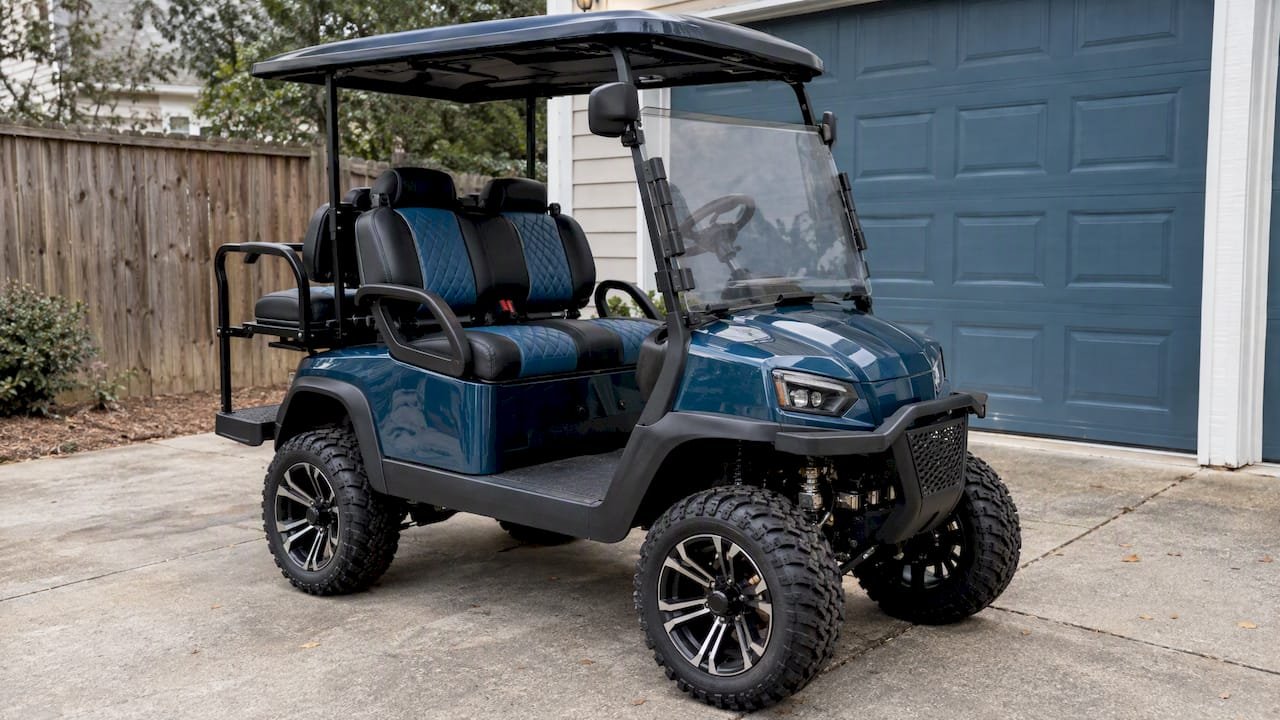
This covers the cart itself: theft, fire, storms, a collision with a fence or a tree. A newer lithium cart with upgraded wheels, a lift kit and a custom seat set can cost as much as a used car, so this coverage is worth a look. Ask whether custom accessories are covered, and whether payment is for actual cash value or a agreed amount.
Medical payments
This helps cover medical bills for you and your passengers regardless of fault. It is useful when the people riding with you are friends or family and nobody wants a dispute.
Uninsured motorist
If a driver without insurance hits you on a road crossing, this coverage steps in. It matters most if you use public streets.
Does your homeowners policy cover the cart?
This is the most common surprise we see. Homeowners policies can sometimes extend limited coverage to a golf cart, but the details vary. Insurance.com notes that you can buy golf cart coverage as a rider on a homeowners policy or as a standalone policy. And as one national comparison points out, a cart generally must be specifically listed on an auto policy to be covered, and not every insurer allows it.
Some policies cover damage to the cart only while it is on your premises, and say nothing about an accident down the street. Before you assume you are covered, ask these questions:
- Is the cart named on my policy, or is it just assumed?
- Does liability apply away from my property?
- Are passengers covered?
- Is the cart covered for theft, flood and wind?
- Does it matter whether I use the cart on public streets?
Our guide to understanding your homeowners insurance policy shows where to look in the policy itself, and homeowners vs. auto insurance explains why a motorized vehicle often falls between the two.
What golf cart insurance costs
Golf cart policies are among the less expensive vehicle policies. Insurance.com puts the average at $80 to $600, though that article dates from 2016, so treat it as a ballpark and not a quote. Prices today may differ.
What moves your price:
- Cart value and age. A custom lithium cart costs more to insure than a basic older one.
- Where you drive. Private community use is cheaper to insure than regular public street use.
- Coverage limits and deductible. Higher liability limits cost more. A higher deductible lowers the premium.
- Bundling. Some carriers price a cart better when it is added to a home or auto policy.
- Driving record and claims history.
- Use. Rentals, short-term rental guests and business use change the policy you need.
We do not publish a flat rate for golf cart policies, because it varies by carrier and by cart. The only reliable number is a real quote based on your cart and your address.
Our perspective: what we tell Savannah cart owners
We have been helping Savannah-area families and business owners for over 45 years, and golf carts raise the same question again and again: “It is just a cart, do I really need a policy?”
Our answer is that the cart is usually the smallest part of the risk. A cart can carry four or six people at once. Add the humid evenings, a neighborhood with kids on bikes, a few guests at a cookout, and you can see how a low-speed accident becomes a real injury claim. The cart costs a few thousand dollars. A lawsuit can cost far more.
Here is how we look at it with clients:
- Start with where the cart goes. Gated neighborhood, marsh-side lot, Tybee streets, or all three? Use decides the policy.
- Match the limits to your assets, not the minimum. The state or city number is the floor. If you own a home, an umbrella policy can add a layer above it.
- Do not leave it to your homeowners policy by default. We read the actual language with you, and we tell you when a separate policy is the better fit.
- Plan for the claim. If something happens, you want someone on your side who knows how to help you through it. That is how we work.
We work with multiple carriers, so we can compare options for your situation instead of handing you the only one we sell.
— Nathan
How to get your cart properly insured
Here is a simple path that works for most owners.
- Identify your vehicle type. Is it a standard golf cart (PTV) or a street-legal LSV? Check the manufacturer label and your registration paperwork.
- Check your local ordinance. Look up your city or county rules, or Tybee Island’s if you ride there. Note the insurance minimums, age rules and equipment standards.
- Gather details. Make, model, year, VIN or serial number, purchase price, any added accessories, and where it is stored.
- Review your existing policies. Ask what your homeowners or auto policy does and does not say about the cart.
- Choose limits and deductibles. Aim above the minimum for liability, and pick a deductible you can pay without stress.
- Keep proof of insurance with the cart. Where the law asks for it, you will need to produce it.
- Review each year. Upgrades, a new driver in the family or a change in use should prompt a call.
Getting a quote in Savannah
If you want a straight answer on the right coverage for your cart, our team at Daly & Alexander can help. We handle golf cart insurance in Savannah, and we can pair it with your homeowners or auto coverage when that makes sense. You can also see everything we write on our services page. Tell us how and where you use the cart, and we will explain your options in plain language.
Common mistakes to avoid
- Assuming the HOA or community has no rules. Many do, and some ask for proof of liability coverage.
- Skipping coverage because the cart stays in the neighborhood. Guests and neighbors can still be hurt.
- Insuring only the minimum. Legal minimums protect the law, not your finances.
- Forgetting upgrades. Lift kits, lights, sound systems and batteries can add real value that a basic policy may not cover.
- Using the cart for rentals or business without telling your insurer. Short-term rental guests or commercial use call for a different policy. If this is you, ask us about vacation rental coverage or commercial liability.
- Not reading the exclusions. A policy that covers the cart only at home will not help on the street.
FAQ
Is golf cart insurance required in Georgia?
It depends on the type of vehicle and the place. Street-legal LSVs are registered vehicles that must carry liability insurance. Standard golf carts need a local ordinance to use public roads, and the ordinance sets the details. Tybee Island, for example, lists minimum limits of 25/50/15.
Does my homeowners policy cover my golf cart?
Sometimes, but often only in a limited way. Some policies cover damage to the cart only on your premises, and may not cover liability for accidents elsewhere. Ask your agent whether the cart is listed and what applies away from home.
Is golf cart liability coverage different from auto liability?
The idea is the same: it pays for injuries and damage you cause to others. The policy is written for a golf cart or LSV, with its own rating and limits. A car policy does not automatically include your cart.
How much does golf cart insurance cost in Savannah?
One national guide puts averages between $80 and $600 a year, though prices vary by cart, use and carrier. The best way to know is a quote based on your cart and where you ride it.
Do I need insurance if I only drive on private property?
Usually the law does not require it, but your community, club or lender might. Liability coverage is still worth considering if guests ride with you.
Sources
- Savannah Golf Cart Laws (2026): LSV Tours & Square Rules
- Tybee Island Golf Cart Laws (2026)
- Golf Cart Law | SCDPS
- South Carolina Code of Laws, Title 56, Chapter 2
- What is “mandatory insurance”? | Arizona DOT
- Vehicle Registration | Arizona DOT
- Golf cart insurance: Coverage, costs and when you need it | Insurance.com