
A named peril policy pays only when the cause of your loss appears on a list in the policy. An open peril policy (also called “all risk”) pays for a loss unless the policy specifically excludes its cause. That is the short answer. The longer answer is that most real policies mix the two, and the exclusions matter more than the label.
If you own a home near Forsyth Park, a condo on Tybee, a rental on the Southside or a small shop downtown, this is worth ten minutes. It changes how you read a quote.
TL;DR
- Named perils: covers only the causes of loss listed in the policy. Usually cheaper, and narrower.
- Open perils: covers any cause of loss that is not excluded. Usually broader, and typically costs more.
- Most homeowners policies are a mix. A standard HO-3 is open peril for the house and named peril for your belongings. An HO-5 extends open peril to contents.
- Neither one covers flood. In Savannah, flood is a separate policy, and it is the gap we see people overlook most.
- Ask which coverage parts are open or named, and what the exclusions are. Do not ask whether the policy is “comprehensive.”
Table of Contents
- What a named peril policy actually covers
- What an open peril policy covers
- Open peril vs named peril side by side
- Where HO-3 and HO-5 fall
- The three categories of perils
- Flood: the gap both types share
- Condos, renters, landlords and small businesses
- What actually decides a claim
- How to choose
- Our perspective
- Get a side-by-side review
- FAQ
- Sources
What a named peril policy actually covers
A peril is simply a cause of loss: fire, wind, hail, theft, vandalism. A named peril policy lists the perils it will pay for. If your loss was caused by something on the list, you are covered. If it was caused by something that is not on the list, you are not, even if the damage looks the same.
The Virginia State Corporation Commission describes named peril protection for specific events such as fire, windstorm, hail, vandalism or sprinkler leakage. Anything outside that list is yours to absorb.
In homeowners insurance, the Triple-I coverage table shows how long these lists run. Basic forms list 10 perils. Broad forms list 16, including:
- fire or lightning
- windstorm or hail
- theft
- vandalism or malicious mischief
- falling objects
- weight of ice, snow or sleet
- accidental discharge of water or steam
- freezing
- sudden accidental electrical damage
You may have heard of “the 12 named perils.” The standard sources we checked do not use that count. The tables show 10 and 16, and your own policy’s list is the one that controls.
What an open peril policy covers
Open peril flips the logic. The policy starts from the idea that a direct physical loss is covered, then subtracts a list of exclusions. Texas Department of Insurance guidance, updated September 29, 2025, explains that open peril coverage generally pays unless the policy specifically excludes the cause. It also notes that named peril coverage is usually less expensive, while open peril is generally broader and typically costs more.
That matters when something odd happens. A tree limb, a kitchen fire, a burst supply line, a thief: all of those are usually covered either way. The difference shows up with the unusual loss nobody listed in advance. Under open peril, the burden is on the policy to exclude it. Under named peril, the burden is on you to find it on the list.

“All risk” does not mean every risk
The name is misleading. Regulators in both Texas and Virginia point out that all-risk policies still carry exclusions. Investopedia lists common ones: earthquakes, war and wear and tear. Flood is the one that matters most here, and we come back to it below.
Open peril vs named peril side by side
| Named peril | Open peril | |
|---|---|---|
| How coverage works | Pays only for causes on the list | Pays unless the cause is excluded |
| Typical cost | Usually lower | Typically higher |
| Best for | Tight budgets, low-value or older contents, simple risks | Your home’s structure, high-value property, anyone who wants fewer surprises |
| Main risk | An unlisted cause leaves you uncovered | Exclusions you did not read |
| Where you see it | HO-1, HO-2, contents on an HO-3 | Dwelling on an HO-3, dwelling and contents on an HO-5 |
A named peril policy is not a bad policy. The regulators’ own guidance suggests it can be a sensible fit when the listed risks match the property’s real exposure and your budget. The problem comes when someone buys it thinking it behaves like open peril.
Where HO-3 and HO-5 fall
This is the part most Georgia homeowners actually need. The 2025 NAIC homeowners form definitions sort the common forms like this:
- HO-1 and HO-2: named peril forms.
- HO-3: open peril for the dwelling, but not generally for personal property.
- HO-5: open peril for both the dwelling and personal property.
So your HO-3 is a hybrid. The house and other structures, like a detached garage or fence, are open peril. Your furniture, clothes and electronics, which sit under Coverage C, are covered for a list of named perils. The sample HO-3 form from Triple-I shows that wording if you want to see it on paper.
Three practical consequences:
- Contents are where a named list can bite. A loss to belongings caused by something unlisted may not be paid, while the same event damaging the walls would be.
- An HO-5 closes that gap. It is broader for contents, though endorsements, sublimits and carrier wording still apply.
- Labels vary by carrier. The form number is a starting point, not a guarantee.
We have a plain-English walkthrough of the questions to ask in HO-3 vs HO-5, and a guide to reading Coverages A through F on your declarations page if your policy is in front of you right now.
The three categories of perils
Readers often ask about “three categories.” For homeowners, a useful way to sort policy forms is:
- Basic named perils: the shortest list, often associated with HO-1.
- Broad named perils: a longer list, found in HO-2 and commonly applied to HO-3 personal property.
- Special (open) perils: everything except exclusions, applied to an HO-3 dwelling and to an HO-5 dwelling and contents.
This is a way of grouping forms, not a promise that every carrier words them identically.
Flood: the gap both types share
In Savannah, this is the section to read twice. Open peril does not cover flood. FEMA states that standard homeowners insurance does not cover flood and that National Flood Insurance Program (NFIP) coverage is separate.
The NFIP fact sheet gives these maximum limits:
| Property | Building | Contents |
|---|---|---|
| One-to-four-family home | $250,000 | $100,000 |
| Residential building, five or more units | $500,000 | $100,000 |
| Business | $500,000 | $500,000 |
The same fact sheet notes a general 30-day waiting period, with exceptions such as coverage tied to a federally backed loan in a high-risk area. Confirm current terms before you buy, because program rules can change.
Local rules are also moving. The City of Savannah adopted a two-foot freeboard above Base Flood Elevation for new and substantially improved structures in the 100-year floodplain on October 24, 2024. The same page explains that FEMA’s updated coastal flood maps drive flood insurance rates and requirements, and that you can check whether you are eligible for a Letter of Map Amendment that could lower your premium.
The edge cases are where claims get confusing. Wind-driven rain, storm surge, sewer backup and rising surface water can each be treated differently. If you have damage after a storm, report it. Do not assume it is covered or denied based on whether someone used the word “flood.” Our guides on water and sewer backup coverage and why flood insurance matters go into the details, and our flood insurance guide covers the programs. If your home is worth more than NFIP limits, excess flood coverage sits on top.
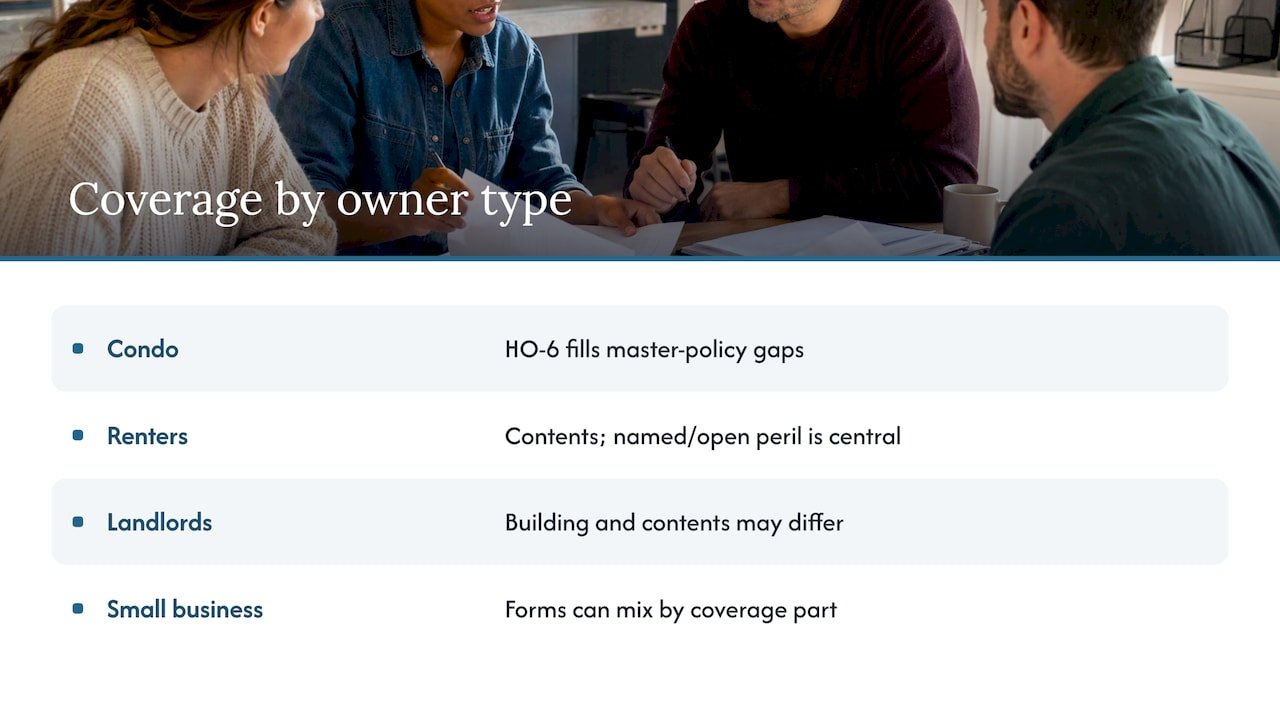
Condos, renters, landlords and small businesses
The same logic applies beyond the single-family home, but the parts change.
Condo owners. An HO-6 covers what the association’s master policy does not, and the master policy’s wording decides where your responsibility starts. Our condo insurance guide explains the master-policy gaps.
Renters. Your belongings are the whole policy, so whether contents are named or open peril is the central question. See our renters insurance guide.
Landlords and vacation rental hosts. A building policy and a contents policy can use different approaches, and guest-related exposures add more questions. A guide on short-term rental insurance gaps (in German) walks through typical holes in rental coverage. For long-term rentals, start with our landlord insurance guide.
Small businesses. Commercial property forms can be mixed. Insurance Journal’s 2024 article illustrates ISO causes-of-loss forms: CP 10 10 (basic named perils), CP 10 20 (broader named perils) and CP 10 30 (open perils). Building coverage might be written on an open peril form while business personal property sits on a named one. Review each coverage part, not the policy as a whole. Our commercial property guide and business interruption questions are good next reads.
What actually decides a claim
The label on the declarations page is only the opening move. The article author at Insurance Journal makes the point that open-versus-named examples are generalizations, and the actual form controls. When you compare two quotes, line up:
- Exclusions: what is carved out of the open peril coverage?
- Conditions: neglect, vacancy and maintenance clauses can limit payment.
- Deductibles: many Gulf and Atlantic coast policies carry separate wind or hurricane deductibles. Ask whether yours does.
- Endorsements: water backup, scheduled items and ordinance or law coverage are often add-ons.
- Sublimits: jewelry, cash, firearms and electronics often have caps.
Two quotes that look alike can protect very different things. After a Savannah storm, the wording about wind-driven rain, roof openings, neglect and the deductible can matter more than the word “open.”
How to choose
A simple way to decide:
- Start with the house. If it is your largest asset, you want open peril on the structure. A standard HO-3 does that.
- Look at your belongings. If you own jewelry, art, a good camera or a lot of electronics, ask about an HO-5 or scheduled items. See what personal articles insurance covers.
- Check your flood zone. Do this before you compare anything else. Our flood team can walk you through flood insurance in Savannah.
- Match the budget honestly. A named peril form can be a fair choice on an older, low-value property or for contents, as long as you know what is not on the list.
- Ask for the exclusions in writing. A good agent will show you.
Our perspective
We have been helping Savannah-area families and business owners for over 45 years, and the same thing happens in our office again and again. Someone brings in a quote and asks, “Is this the good kind?” What they mean is whether it covers everything. No policy does.
We do not think open peril is automatically right and named peril is automatically wrong. We think the right question is which coverage parts are open and which are named, what is excluded, and what the deductible will be on a bad day. We would rather you hear that from a local agent before a claim than discover it during one.
We also work with multiple carriers, so we can compare how different forms treat the same house. And when you do have a loss, we stay in your corner through the claim. That is the difference between an advocate and someone who just sells you a policy.
— Nathan
Get a side-by-side review
If you would like someone to read your declarations page with you, we can do that. We write homeowners insurance in Savannah, along with flood, condo, renters, rental property and business coverage. You can see everything we offer on our services page. For small businesses, our Business Owners Policy is published at $500 to $3,500 per year, depending on the business.
FAQ
Is an HO-3 an open peril policy?
Partly. A standard HO-3 covers the dwelling and other structures on an open peril basis. Personal property under Coverage C is generally covered only for a list of named perils. An HO-5 generally extends open peril to contents too.
Is open peril always better than named peril?
Not always. Open peril is broader and typically costs more, which is why it suits your home’s structure and valuable belongings. A named peril policy can still make sense when the listed risks match your actual exposure and budget. What matters is knowing the exclusions either way.
Does open peril cover flood?
No. Standard homeowners policies, open peril or not, do not cover flood. FEMA says NFIP flood coverage is separate. In a coastal area like Savannah, ask about a flood policy and whether you need excess flood coverage above NFIP limits.
What are the 12 named perils?
There is no single universal list of 12. The sources we reviewed show 10 perils on basic forms and 16 on broad forms. Your policy’s own wording controls, so ask for the list that applies to your coverage.
Sources
- Texas Department of Insurance: All risk or named peril home insurance policies
- Virginia SCC: Virginia Commercial Insurance Guide
- Triple-I: Which disasters are covered by homeowners insurance?
- Triple-I: Sample HO-3 policy form
- NAIC: 2025 homeowners definitions
- FEMA: Think you don’t need flood insurance? Think again
- City of Savannah: Flood Protection Information
- Insurance Journal: Named vs. Open Perils
- Investopedia: All Risk Insurance