
Commercial umbrella insurance is extra liability coverage that sits on top of your primary business policies, such as general liability and commercial auto. It pays only after those policies reach their limits, which makes it one of the more affordable ways to protect your business from a single, very large claim. Below, we explain how it works, what it costs, who needs it and what to ask before you buy.
TL;DR
- A commercial umbrella policy adds liability limits above your general liability, commercial auto and employer’s liability, typically in $1 million increments.
- Limits commonly run from $1 million to $5 million for small businesses, depending on assets and exposure.
- Cost depends on your industry, claims history and the premium of the policies underneath it, so there is no flat rate.
- “Umbrella” and “excess” are not always the same product. Ask which one you are being quoted.
- Premiums for business liability coverage are generally tax deductible as ordinary business expenses. Confirm with your CPA.
Table of Contents
- What commercial umbrella insurance actually does
- Umbrella vs. excess liability: a difference worth asking about
- How much does commercial umbrella insurance cost?
- Who should consider a commercial umbrella
- What an umbrella policy usually does not cover
- Is the premium tax deductible?
- Our perspective: where Savannah businesses get caught
- How to buy commercial umbrella coverage
- Talk to a local agent about your limits
- FAQ
- Sources
What commercial umbrella insurance actually does
Every primary liability policy has a ceiling. If your general liability policy has a $1 million per occurrence limit and a customer wins a $2.5 million judgment, the policy pays $1 million. The remaining $1.5 million is yours, and that can mean business assets, bank accounts and sometimes personal property.
An umbrella policy is built for that gap. Per the Georgia Office of Insurance and Safety Fire Commissioner’s business insurance guide, umbrella liability provides protection over and above the limits of basic liability policies such as commercial general liability and commercial auto.
The policy works in layers:
- A covered accident happens and a claim is filed.
- Your primary policy pays up to its per occurrence limit.
- The umbrella steps in for the amount above that limit, up to its own limit.
The umbrella does not replace your primary coverage. It only triggers once the underlying limit is used up. Because it is designed for rare, catastrophic losses, it is often surprisingly affordable compared with raising the limits on every individual policy.
What it typically sits on top of
- Commercial general liability: customer injuries on your premises, property damage you cause, advertising injury. See our commercial liability insurance guide for the basics.
- Commercial auto: accidents involving company vehicles, from one work van to a fleet. Our commercial auto insurance guide covers how those primary policies work.
- Employer’s liability: certain claims by employees that fall outside workers’ compensation benefits.
The umbrella generally requires you to carry minimum primary limits, and carriers set those. A carrier’s umbrella rule manual, such as this commercial umbrella program manual, shows how eligibility and underlying requirements are spelled out. The exact numbers vary by carrier and class of business, so your agent should confirm them before quoting.
Umbrella vs. excess liability: a difference worth asking about
The two terms get used as if they were synonyms. Practitioners note that a true umbrella policy can be broader and fill gaps in your primary policies, while an excess liability policy generally just raises the limit of one specific underlying policy.
Here is what that looks like in practice:
| Umbrella | Excess liability | |
|---|---|---|
| Sits above | Several primary policies | Usually one specific policy |
| Coverage terms | May be broader than the primary policy in some areas | Generally follows the primary policy’s terms |
| Best for | Businesses with several liability exposures (premises, vehicles, employees) | Businesses that mainly need a higher limit on one policy |
| Key question | What does it cover that the primary policy does not? | Does it follow the form of the policy underneath? |
The NAIC’s Uniform Property and Casualty Product Coding Matrix groups commercial umbrella and excess under one product line, which is part of why the names blur in the marketplace. Do not rely on the label. Ask your agent to show you in writing what the quoted policy follows and what it adds.
If you want a quick parallel from another corner of insurance, this explainer on buying extra cover before a long-distance move shows the same idea: a base level of protection, plus an added layer for the larger loss.
For property owners, we also cover excess property liability and layered programs in a separate guide.
How much does commercial umbrella insurance cost?
There is no single price, and anyone who quotes you one before looking at your business is guessing. Pricing is generally based on a percentage of the underlying liability premium rather than a flat market rate.
As a rough range, business.com reports that $1 million in commercial umbrella coverage averages about $240 to $2,500 per year, with low-risk professional service firms at the lower end and construction or transportation operations paying more. Treat those as national benchmarks, not a quote. Your premium will move with:
- Industry: an office-based consultant and a roofing contractor are priced very differently.
- Claims history: prior losses push rates up and can limit which carriers will quote.
- Vehicles and drivers: fleets and drivers with violations raise the risk.
- Employee count and payroll: more people means more exposure.
- Limit you choose: $2 million costs more than $1 million, but usually not double.
- Your primary policies: cleaner, better-structured underlying coverage helps.
For context on the base layer, the policy many small businesses start with is a Business Owners Policy, which bundles property and liability. Ours runs from $500 to $3,500 per year depending on the business. Read more in our Business Owners Policy guide or see how a BOP compares with general liability alone.
A worked example
Say you run a Savannah restaurant with a $1 million general liability limit. A guest is seriously hurt in a fall on a rainy night and a jury awards $2.8 million. Without an umbrella, you owe $1.8 million after the primary policy pays. With a $2 million umbrella, the umbrella covers that $1.8 million and the primary limit does its job underneath. The exact result depends on policy terms, exclusions and defense cost treatment, which is why you want the wording reviewed, but the structure is the point.
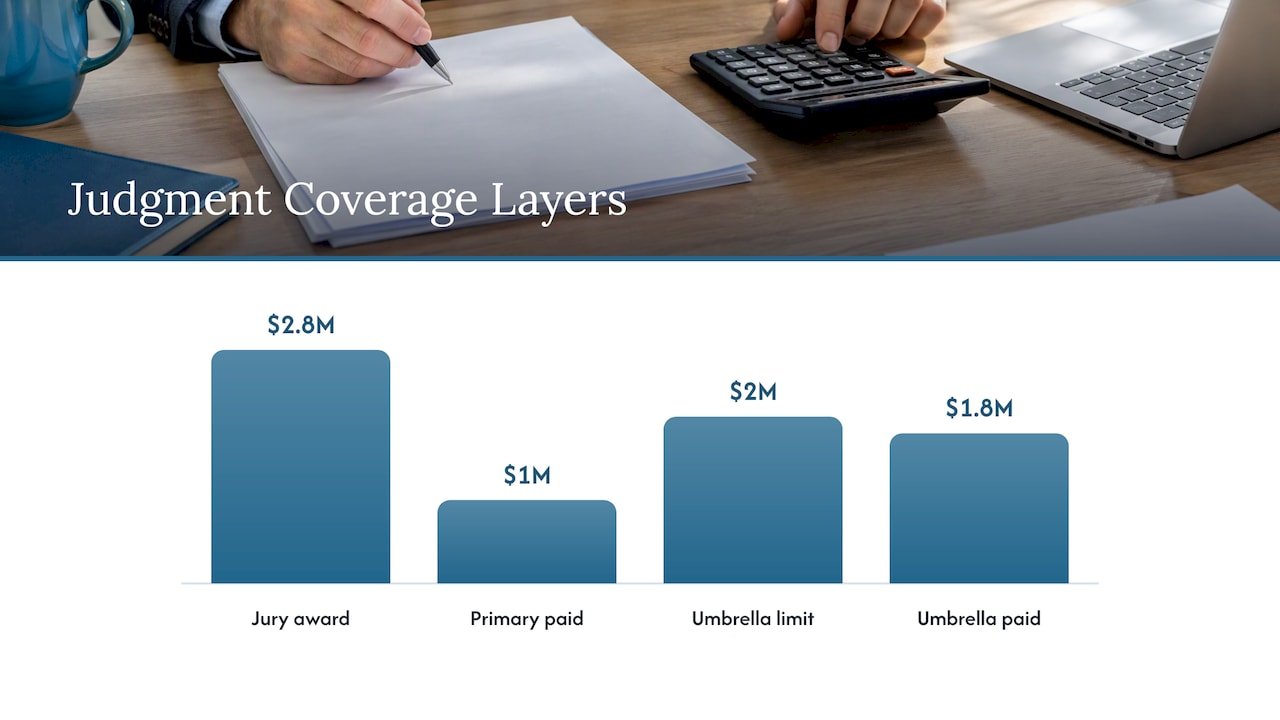
This is an illustration, not a past case or a quote.
Who should consider a commercial umbrella
Not every business needs one. Many do, though, once you look at the worst day rather than the average day. The Georgia insurance commissioner’s guide suggests picturing the most extreme accident your business could be involved in, such as an injury to several people or a serious multi-vehicle collision, and asking whether your standard limits would hold.
In Savannah and the surrounding Coastal Georgia area, these businesses often have a reason to ask:
- Hospitality and food service: restaurants, bars and event venues with heavy foot traffic, especially during festival and tourist season. If you serve alcohol, we also write liquor liability.
- Contractors and builders: job sites carry injury and property damage exposure, and many general contractors require subs to prove higher limits.
- Businesses with vehicles: delivery, service trucks, landscapers and anyone with employees driving on company time.
- Property owners and managers: commercial buildings, vacation rentals and multi-unit properties where a guest or tenant injury can become a large claim.
- Event organizers: large gatherings raise the odds of a severe, multi-person incident.
- Businesses with contract requirements: leases, vendor agreements and client contracts often specify liability limits above a standard $1 million.
That last point is the most practical trigger. If a contract asks for $2 million in liability coverage and your general liability policy has $1 million, an umbrella is usually the cheapest way to close the difference. Check the language of the contract itself and share it with your agent.
What an umbrella policy usually does not cover
An umbrella is not a catch-all. Read the exclusions before you rely on it.
- Your own property. Damage to your building, equipment and inventory belongs to commercial property insurance, not a liability umbrella.
- Flood and storm damage to your premises. On the coast, that means separate commercial flood coverage.
- Workers’ compensation benefits. These are handled by a separate policy.
- Professional errors. Advice or design mistakes typically need professional liability.
- Intentional acts and criminal conduct.
- Anything excluded by the underlying policy, in many excess-style forms.
Umbrella policies also come with conditions: required underlying limits, notice rules and sometimes a self-insured retention if a loss is not covered by the primary policy. Those details are where two similar-looking quotes diverge.
Is the premium tax deductible?
Usually, yes. The IRS has long treated business insurance as an ordinary and necessary expense under Section 162 of the Internal Revenue Code, and Revenue Ruling 2008-8 discusses the deductibility of premiums paid for current-year coverage. The same ruling shows that payments to a captive insurer owned by the taxpayer can draw closer scrutiny as to whether they qualify as true insurance. For a standard policy with a licensed carrier, your CPA can confirm how the premium fits your return.
Our perspective: where Savannah businesses get caught
We have spent more than 45 years helping individuals, families and business owners protect what they have built, and the same pattern comes up with umbrella coverage again and again. Owners buy general liability, sign off on the limit the lease requires and move on. Nobody asks what happens when a claim is bigger than that number.
A few things we tell clients:
- Start with the limits, not the price. Ask what a serious claim could look like for your type of operation, then decide how much of that risk you want to carry yourself.
- Look at the whole stack. An umbrella is only as strong as the policies under it. If your commercial auto or general liability is thin, fix that first.
- Get the umbrella-versus-excess answer in writing. We would rather you know exactly what you are buying than discover a gap during a claim.
- Review every year. New vehicles, new locations, a bigger payroll or a new contract can all change the limit you need.
- Plan for claim day. Insurance is a promise made before the worst day of your year. We stay involved when you file, and we treat claims support as part of the job, not a footnote.
We sell through multiple carriers, so we can compare structures for your business instead of fitting you into one product.
— Nathan
How to buy commercial umbrella coverage
- List your current policies and limits. Gather declarations pages for general liability, commercial auto, employer’s liability and any liquor or professional policies.
- Pull your contracts. Note any required liability limits in leases, vendor agreements or client contracts.
- Decide on a target limit. Many small businesses land between $1 million and $5 million, based on assets and exposure.
- Ask for umbrella and excess options. Compare what each follows and what it adds.
- Check the underlying requirements. Confirm the minimum primary limits so you are not surprised at binding.
- Review exclusions and conditions. Ask specifically about your industry’s most likely claim.
- Put a renewal reminder in your calendar. Revisit limits when anything about the business changes.
If you also want personal protection for your own household, see our personal umbrella policy page and our explainer on umbrella insurance. A business umbrella and a personal umbrella are different policies, so do not assume one covers the other.
Talk to a local agent about your limits
If you run a business in Savannah or the surrounding area and are not sure whether your liability limits would survive a serious claim, we can review your current policies with you. We start with your commercial liability coverage and the policies around it, then discuss whether an umbrella or excess layer makes sense. If you are still building your foundation, our business insurance essentials guide is a good place to start. To get started, visit Daly & Alexander Insurance and ask for a coverage review.
FAQ
What kind of insurance is an umbrella policy?
It is liability insurance that provides additional limits above your primary liability policies. It pays only once the underlying policy has paid its limit. It does not cover your own property.
How expensive is commercial umbrella insurance?
It depends on your industry, claims history, vehicles, payroll and chosen limit. One national benchmark puts $1 million of coverage at roughly $240 to $2,500 per year, with higher-risk industries paying more. A local agent can price it against your actual policies.
Do I need an umbrella if I already have general liability?
Not necessarily, but you should check whether your general liability limit could cover a worst-case claim and whether any contract requires more. If either answer is no, an umbrella is usually the most economical fix. It is also worth reviewing if you operate vehicles or host large crowds.
Is an umbrella the same as excess liability?
Not always. An umbrella may be broader and fill some gaps in your primary policies, while excess liability generally just raises the limit of one underlying policy. Ask your agent which form is being quoted and have the differences explained in writing.
Sources
- NAIC: Small business insurance
- Georgia Office of Insurance and Safety Fire Commissioner: Business insurance guide
- Insurance Information Institute
- business.com: Understanding small business insurance costs
- IRS Revenue Ruling 2008-8
- NAIC Uniform Property and Casualty Product Coding Matrix
- Commercial umbrella liability program manual