
Rental reimbursement coverage is an optional add-on to your auto policy. It helps pay for a rental car while your own vehicle is in the shop after a covered claim, even when the accident was your fault. It usually costs a few dollars a month, and it only works if you add it before the claim happens.
If you drive in Savannah, you know how much a car matters. The commute across town, the run out to Tybee Island, the school pickup: none of it stops because your bumper is crumpled. Here is how this coverage works, what it leaves out, and how to pick limits that fit your life.
TL;DR
- Rental reimbursement pays for a rental car, up to a daily and total limit, while your car is repaired after a covered loss such as a collision, theft or vandalism.
- It is optional, not required by law, and insurers typically want you to carry comprehensive and collision first.
- Typical limits look like $20 a day up to $600 or $30 a day up to $900, and the add-on often runs about $2 to $15 a month.
- It does not cover routine maintenance, road trips or the insurance you buy at a rental counter.
- Check your declarations page now, and ask your agent to adjust the limits before you need them.
Table of Contents
- What rental reimbursement coverage means on your policy
- How it works after an accident
- What it covers and what it leaves out
- Rental reimbursement vs. insurance for a rental car
- Who pays for a rental when someone else is at fault?
- What happens if your car is totaled
- How much does it cost?
- How to choose your limits
- Our perspective
- Get the right rental coverage in Savannah
- Common mistakes to avoid
- FAQ
- Sources
What rental reimbursement coverage means on your policy
In plain terms, rental car reimbursement pays for a rental while your car is in the shop, and that applies even if you caused the accident. You rent the car, keep the receipts, and your insurer reimburses you up to the limits you chose.
Two details trip people up.
First, it is optional. It is not required by law, and you generally need comprehensive and collision coverage on the policy to add it. If you carry liability only, this add-on is typically not available to you.
Second, it is for substitute transportation after a covered loss. New York’s insurance regulator describes it as optional coverage for when your vehicle is damaged and temporarily out of use, and treats it as separate from coverage for a vehicle you rent. The rules of each state differ, but that basic distinction holds across the country.
How it works after an accident
Here is the usual sequence.
- You have a covered claim. A collision, a tree limb in a storm, a theft or vandalism. Your policy has to cover the damage for the rental benefit to kick in.
- Your car goes to the shop. The repair estimate gives a rough idea of how many days you will be without it.
- You rent a car. Many insurers have preferred rental partners and can bill them directly. Others ask you to pay and submit receipts.
- Your insurer pays up to your limits. Anything over the daily rate or the total cap comes out of your pocket.
- Coverage ends when repairs finish, or when you hit the cap, whichever comes first.
One example from a research source: a policy might pay up to $30 a day for 30 days, or $900 total. Another common setup is $20 per day up to $600. Your own numbers will be on your policy.
Some policies are flexible about what the money buys. Certain policies let you apply the benefit to rideshare, public transit or taxis if no rental car is available. Ask your agent whether yours does.
Is there a deductible?
The rental benefit is generally a daily and total maximum rather than a deductible you pay up front. Your collision or comprehensive deductible still applies to the repair itself. Your declarations page lists your coverages, limits and deductibles, so it is the first document to pull out.
What it covers and what it leaves out
| Situation | Does rental reimbursement help? |
|---|---|
| Your car is being repaired after a covered collision | Yes, up to your limits |
| Your car is stolen or vandalized (with comprehensive) | Typically yes, up to your limits |
| Routine maintenance or an oil change | No |
| Mechanical breakdown | Usually no |
| A vacation rental car | No |
| Using your car for delivery or paid driving | Often not covered at all |
| Damage to the rental car itself | Not what this coverage is for |
Rental reimbursement does not cover rentals for normal maintenance or travel. It exists for the gap after a covered claim.
Business and rideshare use
Personal auto insurance is not meant to cover commercial vehicle use, and most personal policies will not cover an accident during commercial use. If you drive for a rideshare or delivery platform, read our guide to rideshare insurance first. If you run vehicles for a business, our commercial auto guide explains how that coverage is built.
Rental reimbursement vs. insurance for a rental car
These two get mixed up constantly, and the confusion can leave you uncovered.
- Rental reimbursement lives on your own auto policy. It pays for a replacement ride while yours is being fixed.
- Rental car insurance is what you buy at the counter or get through your auto policy or credit card when you rent a car for a trip. It deals with damage to or liability for the rental.
The New York regulator draws the same line: reimbursement for substitute transportation is distinct from rental vehicle coverage under a liability policy. If you rent through a car-sharing or peer-to-peer app, be extra careful: California’s insurance department warns that you should not assume your auto policy or credit card waiver applies to peer-to-peer rentals.
Who pays for a rental when someone else is at fault?
If another driver caused the crash, you may not need your own rental coverage at all. Their insurer will likely pay for a rental for a reasonable amount of time while your car is repaired or replaced.
The catch is speed and certainty. The other driver’s insurer has to accept fault, and that can take days or weeks. Fault can be disputed. They may be uninsured. Your own rental reimbursement lets you get a car right away and keep going while the insurers sort it out. That is the real value of the add-on: it removes the waiting.
What happens if your car is totaled
This is where drivers get surprised. When a car is totaled, many companies pay for a rental as a courtesy, but they are not required to, and your right to a rental ends once a settlement has been offered.
In practice, that means a total loss can leave you with a short window to shop for a replacement vehicle. If you want a plain-language walk-through of how long insurers may pay and what to do while waiting, this guide to getting a rental after an accident lays out the steps. Ask your adjuster in writing when the rental benefit will end, so the date does not catch you off guard.
Totaled cars also raise the question of how the car is valued. Our article on new car replacement and actual cash value covers that.
How much does it cost?
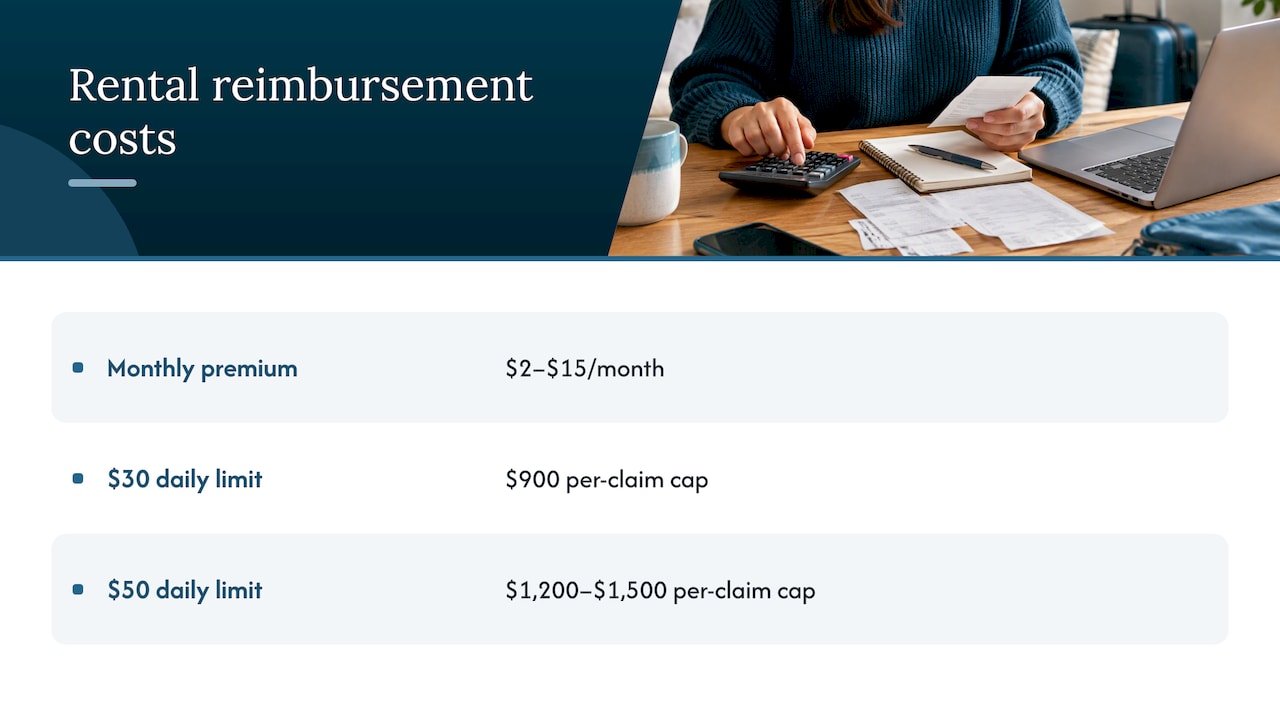
This is one of the cheapest add-ons on a policy. Adding it typically runs from about $2 to $15 a month, depending on the provider and the limits you pick. Higher limits cost more: a $30 daily limit often pairs with a $900 per-claim cap, while $50 a day often pairs with $1,200 to $1,500.
Those are national ranges. We do not publish a flat price for this add-on because it depends on the carrier, your vehicle and the limits you pick. Your agent can quote the exact figure from several carriers.
How to choose your limits
Start with the question: what would a replacement cost, and how long could you go without a car?
- Check local rental rates. Consider rental rates in your area. A basic sedan costs less than an SUV, and prices spike around holidays, big events and tourist season.
- Think about your commute. If your car gets you to work, make sure you have enough coverage for commuting.
- Count your drivers. A family with two cars and one driver at home each day is in a different spot than a single-car household.
- Think about repair times. Body work can run for weeks if parts are back-ordered. A 30-day cap gives more breathing room than a 10-day cap.
- Match the daily rate to the car you need. If you drive a minivan for three kids, a $20 daily limit may not stretch.
A quick worked example: say a mid-size rental runs $55 a day where you live, and your repair will take 14 days. That is $770. A $30 daily limit would leave you paying $25 a day, or $350, out of pocket. A $50 limit would leave $5 a day, or $70. Spending a few more dollars a month on the higher limit would have paid off.
Is it worth it?
For most drivers with only one car, yes. If you have a spare vehicle, a short commute, or a very old car you might drop collision on, it may not be. Our 10% rule article for Georgia drivers explains when dropping collision or comprehensive makes sense. Remember that doing so usually removes your eligibility for rental reimbursement too.
Our perspective
We have been helping Savannah-area drivers for over 45 years, and rental reimbursement is one of the add-ons people most often wish they had bought earlier. Nobody thinks about it at renewal. They think about it when the tow truck pulls away and they realize they have no way to get to work.
Here is how we approach it with clients:
- We start with your week. Who drives where, and what happens if the car disappears for two weeks?
- We set the daily limit to match real rental rates, not the default the carrier proposes.
- We read the fine print on the add-on with you, including whether it covers rideshare or taxis and whether it applies to theft.
- We stay with you through the claim. If the rental benefit runs out before the repair is done, or a settlement offer arrives, we help you understand where you stand.
An agent who represents more than one carrier can compare how each one handles the rental benefit, which matters more than a few cents of premium. Savannah drivers also share roads with summer tourists and storm-season flooding, so a car being out of service is more common than you might hope.
— Nathan
Get the right rental coverage in Savannah
If you are not sure what your policy includes, we will review your declarations page with you and quote rental reimbursement limits that match how you drive. See our auto insurance in Savannah page, or go through our auto insurance coverage guide for a complete policy breakdown. We also write homeowners, renters, RV, boat, motorcycle and golf cart policies, so you can look at everything in one conversation on our services page.
Common mistakes to avoid
- Waiting until after the accident. You generally cannot add the coverage after a loss has happened.
- Assuming your credit card covers it. Card benefits usually deal with rental counter damage waivers, not substitute transportation after a claim on your own car.
- Forgetting about the cap. A 30-day limit does not help if parts take 45 days.
- Using the car for work. Delivery or rideshare use can void personal coverage altogether.
- Not saving receipts. Keep the rental agreement and the invoice in case you are reimbursed after paying.
FAQ
What does rental reimbursement mean on insurance?
It means your auto policy will reimburse you, up to a daily and total limit, for a rental car while your vehicle is repaired after a covered claim. It is an optional add-on. It typically requires comprehensive and collision coverage on the same policy.
Is rental reimbursement coverage worth it?
For most drivers who rely on one car, it is. It generally costs a few dollars a month, and a rental can easily cost more than that in a single day. If you have a spare vehicle or are considering dropping collision on an older car, the value is lower.
Does insurance pay for a rental car after an accident if it was my fault?
Yes, if you have rental reimbursement on your policy and the loss is covered, fault does not stop the benefit. If you do not have the add-on, you pay out of pocket for fault accidents. If the other driver is at fault, their insurer will likely pay for a reasonable rental period.
Does it cover a rental when my car breaks down?
Usually not. The benefit is tied to a covered loss like a collision, theft or vandalism. Mechanical failure and routine maintenance generally fall outside it, so check whether your policy has a separate roadside or breakdown option.
Can I use it for a rental on vacation?
No. It does not pay for a rental you choose to take for travel. For that, look at your policy’s coverage when you rent, your credit card benefits, and the options at the rental counter.
Sources
- What Is Rental Reimbursement Coverage? (NerdWallet)
- Know Your Coverage: Rental Cars After an Accident (Texas OPIC)
- NAIC news release on personal vs. commercial auto use
- NAIC auto insurance consumer page
- NAIC: Does your vehicle have the right protection?
- New York DFS: Collision damage waivers and rental coverage
- California Department of Insurance: Consumer alert on rental cars
- ValuePenguin: Rental reimbursement coverage
- U.S. rental car after an accident: who pays